 HeatPumpPath
Can Existing Radiators and Hydronic Baseboards Work With a Heat Pump?
Water-based radiators, hydronic baseboards, and underfloor loops must deliver each room’s heat at the planned water temperature. See what to compare before deciding what can stay.
In this guideJump to a section
Existing water-based radiators, hydronic baseboards, or underfloor circuits may be retained in a heat-pump design, but their appearance alone cannot answer whether they will keep each room warm. The key comparison is each room’s heat demand against the output of its emitters at the water temperature the proposed system is designed to use.
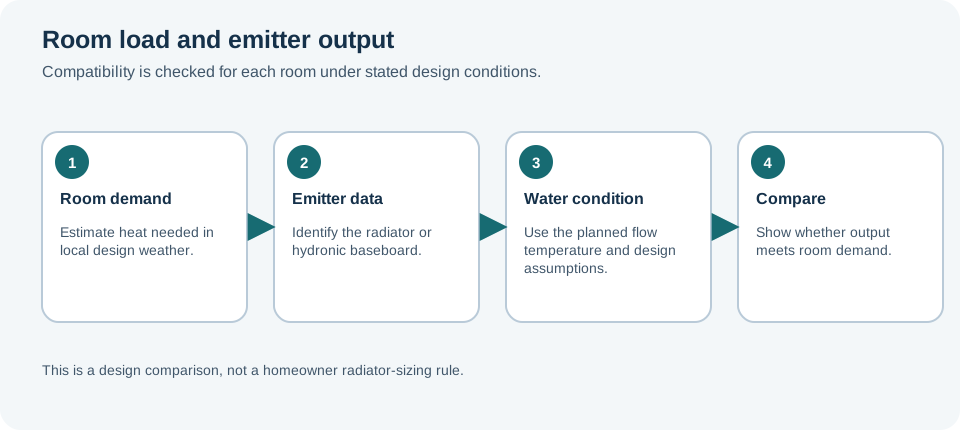
Ask for a room-by-room comparison
A hydronic heat pump heats water and circulates it through the home’s emitters. As the water temperature changes, an emitter’s heat output changes too. A radiator that worked with a hotter boiler circuit may deliver less heat at a lower temperature. That does not mean every radiator must be replaced; it means the design should show how the selected equipment and retained emitters meet the home’s needs together.
Request a written schedule for each room showing its design heat loss, the radiator or other emitter proposed to remain, its expected output under the stated design conditions, and the planned heat-pump flow temperature. Ask what assumptions were made about room temperature, flow, emitter condition, pipework, and controls. A total annual energy estimate does not show whether a particular bedroom or other room will receive enough heat on a cold design day.
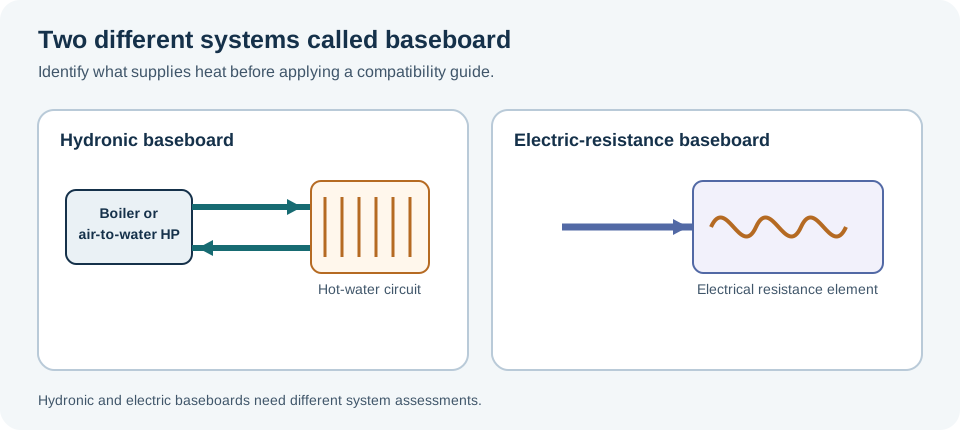
Hydronic baseboard is part of a water circuit. Electric-resistance baseboard heats directly from electricity and is a different system; see the guide to replacing electric baseboards with ductless heat pumps. For fin-tube hydronic baseboard, use ratings for the exact product and conditions rather than an electric-baseboard rule or a generic output. For example, Slant/Fin’s Fine/Line chart applies to named product models; it does not provide output data for every hydronic baseboard.
Understand the design temperature and control plan
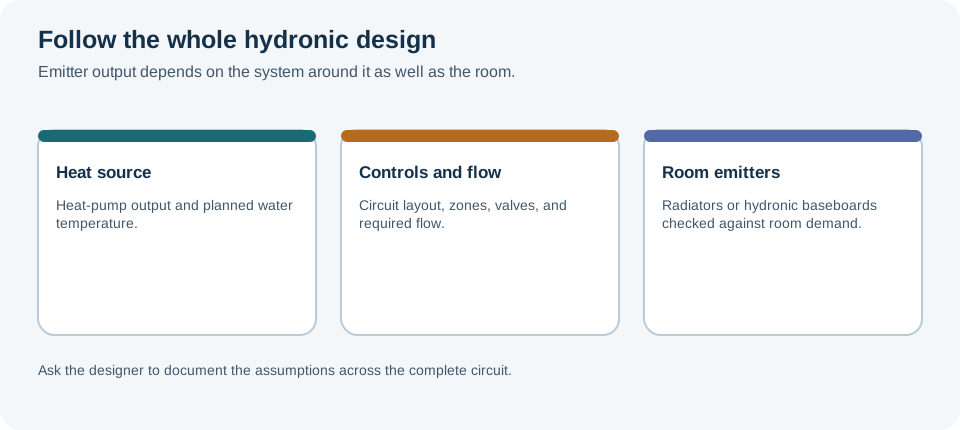
The proposal should explain the heat-pump water temperature assumed when checking emitters and how the system will adjust or maintain that temperature in use. Weather compensation is one control approach: the control changes water temperature in response to outdoor conditions. Installer guidance describes the concept, but example curves do not provide a universal setting for a particular home. Ask who sets up the controls, what information is used, and how their operation will be checked after installation.
Zoning and thermostatic radiator valves can also affect the available flow and water volume in a hydronic system. The UK trade-association controls guide distinguishes open circuits from zoned arrangements and cautions against treating a buffer tank as universally required. The exact design depends on the heat pump, controls, emitters, and pipe layout. Do not change valves or settings yourself to test compatibility.
Consider options where an emitter is short
If a room’s emitters do not meet its calculated demand at the proposed conditions, the designer can assess options such as reducing heat loss, increasing emitter area, changing the heat-delivery arrangement, or selecting a different system design. These choices affect cost, disruption, controls, and operating conditions. The next step is not automatically to replace every radiator or raise the system temperature without checking what that does to the proposed design.
Two layouts deserve a more specific assessment. If the circuit uses small-diameter microbore pipes, the designer needs to check flow and pressure as well as emitter output; see heat pumps with microbore pipes. A one-pipe radiator loop has shared-circuit behavior that can create additional low-temperature control questions; see one-pipe radiator loops and heat pumps.
Use the same room-by-room schedule to compare proposals. Ask which emitters stay, what changes are included, which flow temperature is assumed, and what commissioning evidence will show that the completed system serves the rooms. The answer for a specific home requires a qualified local designer to check heat loss, emitter data, pipework, controls, and the selected equipment’s requirements.
Sources and further reading
- Hydronic Heat Pump — Pre-sale information and performance calculation, Issue 5.0 (primary source)
- Weather compensation and other controls (authoritative-secondary source)
- Controls Guide for Air-Water Heat Pump Systems (authoritative-secondary source)
- Ratings Chart — Residential Baseboard: Fine/Line 15 (primary source)
- Research and analyses on heat supply in existing buildings with heat pumps (authoritative-secondary source)
- Low-temperature heat distribution systems: system evaluation for refurbishments and new construction (authoritative-secondary source)