 HeatPumpPath
Can a Heat Pump Work With Microbore Pipes?
Small-bore hydronic pipework is not an automatic yes or no for a heat pump. Flow, pressure loss, layout, emitters, and room loads need to be assessed together.
In this guideJump to a section
Microbore describes small-diameter pipework in a water-based heating system. Its presence does not by itself prove that a heat pump will work or that the pipes must be replaced. The design question is whether each circuit can carry the flow needed to deliver the planned heat to its rooms without exceeding the pump and equipment requirements.
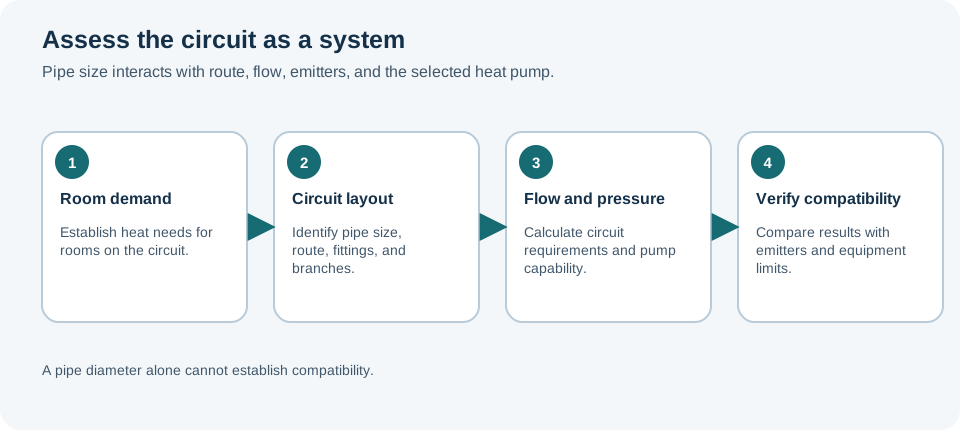
Why pipe diameter is only one part of the answer
A narrower pipe can create more resistance to water flow than a larger pipe, especially over a longer route or through several fittings. The result depends on the pipe’s actual internal diameter and material, circuit length, bends, branches, valves, pump, emitter demand, and the temperature difference across the system. A short microbore run and a long network serving many rooms are not equivalent.
The proposed heat pump and the radiators also matter. The designer needs to connect room heat loss and emitter output at the planned water temperature to the flow each circuit requires. The assessment should account for all relevant circuits and control positions, not just one visible pipe near a radiator. No universal pipe diameter or maximum length establishes whether an existing system is acceptable.
Energy Saving Trust’s installer guidance includes a worked microbore example, but its example assumptions do not create a rule for every home. Ask the designer to identify which of your circuit details match the example and which differ. A separate MCS hydronic pre-sale calculation guide sets out system information used in UK design; it does not provide a cross-border pipe-size threshold.
Ask for the hydraulic assessment
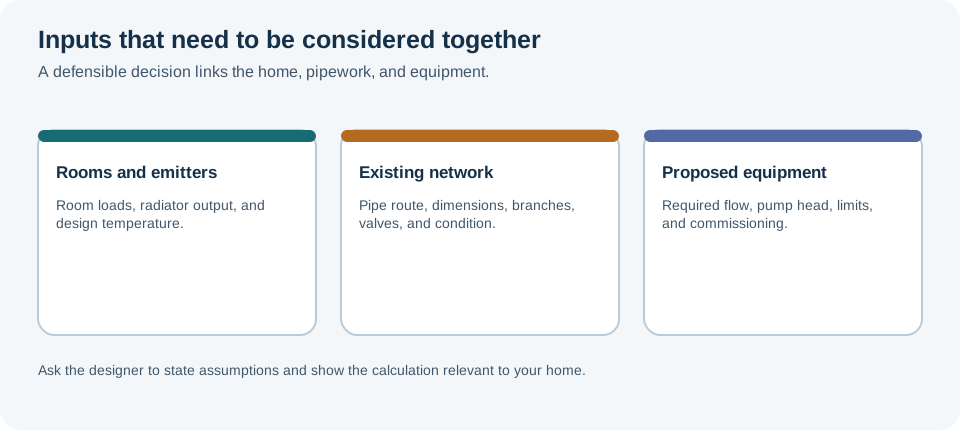
Ask a qualified heating designer to document the room loads, emitter output, pipe routes and sizes where known, circuit flow requirements, pressure losses, pump capability, valves, and proposed heat-pump operating conditions. The proposal should explain whether the existing pipework will stay, what evidence supports that choice, and whether any circuit or emitter changes are included.
If a proposal recommends replacement, ask which specific calculation or equipment limit the current pipework fails to meet. If it recommends keeping the pipes, ask how flow and room delivery will be checked during design and commissioning. These questions help distinguish a property-specific conclusion from a general claim that all microbore systems are suitable or unsuitable.
Do not drain, flush, cut, or modify a heating circuit to test it. The assessment and any changes involve pressurized hot water and should be handled by qualified professionals. In the USA and Canada, UK installer guidance is useful technical context but is not local code or a universal design standard.
Microbore pipe size is different from a one-pipe radiator-loop topology. A system can have small pipes, a shared one-pipe loop, both, or neither. If the radiators share a one-pipe loop, see one-pipe radiator loops and heat pumps. For the room-by-room emitter comparison, see radiators and hydronic baseboards.
Sources and further reading
- How to make microbore pipes work (authoritative-secondary source)
- Hydronic Heat Pump — Pre-sale information and performance calculation, Issue 5.0 (primary source)
- Heat pump myths — Heat pump installer toolkit (authoritative-secondary source)