 HeatPumpPath
Can a One-Pipe Radiator Loop Work With a Heat Pump?
Hydronic one-pipe radiator loops can create extra flow, temperature, and control questions in a low-temperature heat-pump design. The topology calls for assessment, not an automatic rejection.
In this guideJump to a section
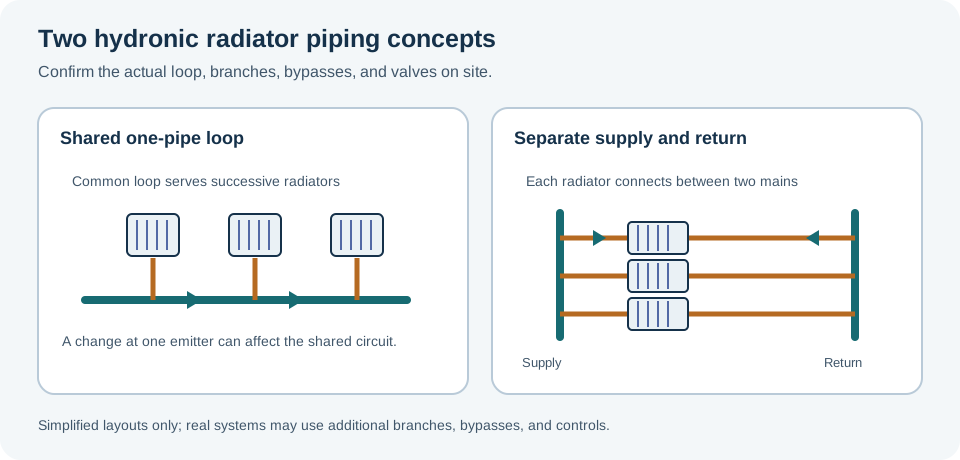
A hydronic one-pipe radiator system has radiators connected along a shared water circuit. That is different from one-pipe steam heating. The shared loop can make water flow, temperature, and control behavior more important when considering a heat pump. Its presence is a reason to assess the actual system, not proof that it cannot be used.
Why the loop deserves a closer look
In a shared one-pipe loop, a change at one radiator or valve can affect conditions elsewhere on the circuit. At part load, the supply and return temperatures can become close together in some one-pipe arrangements. Lowering the water temperature for heat-pump operation can then make it harder to provide enough heat through the existing radiators, depending on their size, loop design, and room demand.
A 2023 German applied-research report describes one-pipe systems as difficult to control for heat-pump use and discusses branch-wise control as one possible design consideration. A 2012 City of Zurich study describes interaction among radiators on a shared loop and recommends considering conversion to a two-pipe arrangement in its low-temperature retrofit context. These studies establish design concerns for the topology they discuss; they do not show that every one-pipe home is unsuitable, that every loop must be converted, or that their recommendations are current rules outside their settings.
What a designer should check
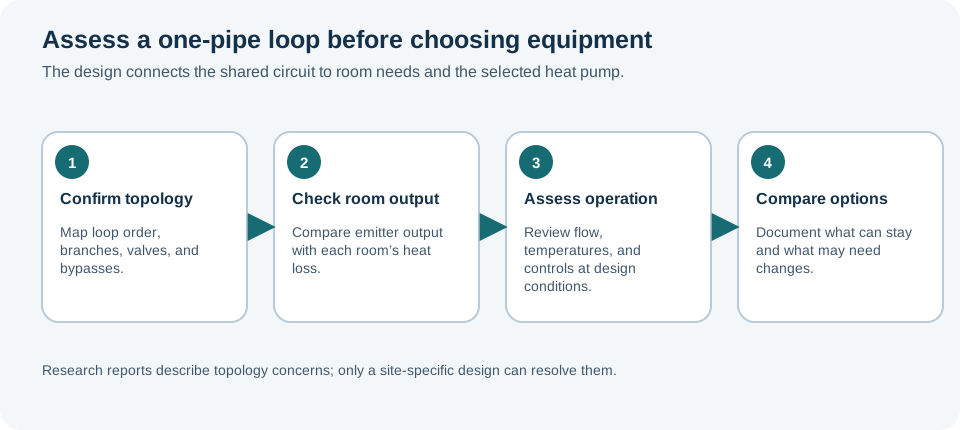
Ask a qualified designer to confirm the system type and map the loop, radiators, branches, bypasses, and valves. The design should compare room heat loss with each emitter’s output at the proposed heat-pump water temperature. It should also assess the circuit’s flow, supply and return temperatures under relevant conditions, balancing and control behavior, and the selected heat pump’s requirements.
Ask for a written explanation of what happens at part load and when individual rooms call for less heat. If the existing arrangement cannot meet the proposed design, the professional may consider emitter changes, a different control arrangement, branch-wise control, or a two-pipe conversion where feasible. Those are options to assess against the actual layout, cost, disruption, equipment, and local requirements; none is a universal remedy.
Do not adjust valves or open the system to test how one radiator affects another. Changes to a pressurized hydronic circuit should be planned and carried out by qualified professionals. If the pipes are also small-diameter microbore, the designer needs to assess that separate flow and pressure question too; see heat pumps with microbore pipes.
For the broader room-by-room question, see whether existing radiators and hydronic baseboards can work with a heat pump. When comparing proposals, ask each designer to identify the topology, the assumptions used for room loads and water temperature, any proposed changes, and the commissioning evidence that will show the completed system serves the rooms.
Sources and further reading
- Research and analyses on heat supply in existing buildings with heat pumps (authoritative-secondary source)
- Low-temperature heat distribution systems: system evaluation for refurbishments and new construction (authoritative-secondary source)