 HeatPumpPath
Do I Need a Hot-Water Cylinder With a Heat Pump?
Find out how a heat-pump system can provide tap water, when storage is involved, and which household and installation details shape the design.
In this guideJump to a section
A heat pump that warms rooms does not automatically heat water for taps and showers. The answer depends on the type of heat pump and how its hot-water equipment is arranged. Some systems store heated water in a cylinder or tank; others need a separate water heater, and some retain an existing appliance for one of those jobs.
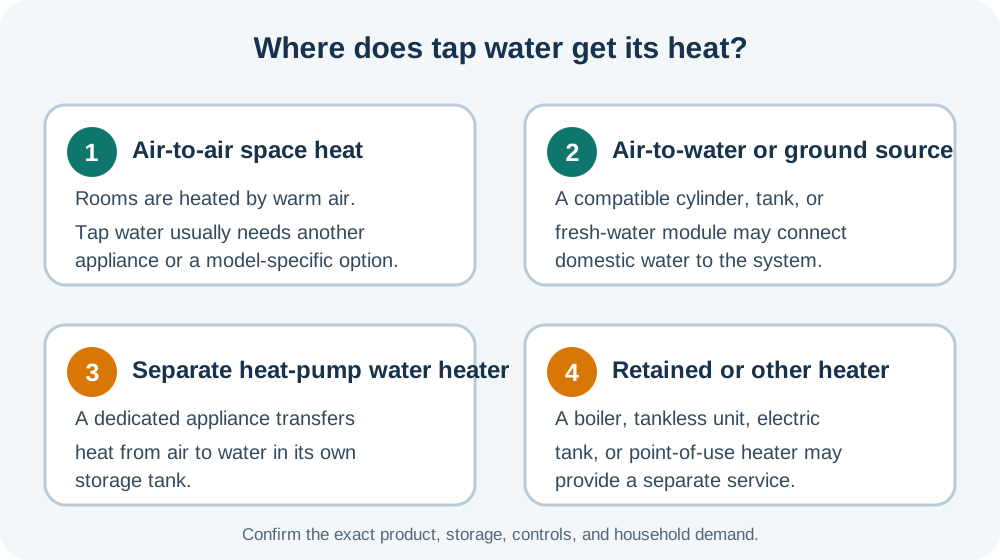
Four ways a heat-pump home can get hot water
- Air-to-air heating: Most room-air heat pumps heat and cool indoor air rather than water. The home still needs a water-heating system, such as an existing boiler, an electric or gas water heater, or a separate heat-pump water heater. Some ducted or exhaust-air products can also heat stored water, so check the exact model rather than assuming every air-to-air system has the same boundary.
- Air-to-water or ground-source heating: These systems can be designed to heat domestic water as well as rooms. A common arrangement uses a compatible cylinder with a heat exchanger, controls, and safety components. One manufacturer’s fresh-water module heats potable water on demand from a separate heating-water buffer, so it avoids storing potable hot water without eliminating thermal storage. Other designs and components vary by product.
- A separate heat-pump water heater: This appliance takes heat from surrounding air and transfers it to water in its own tank. Many models can use electric resistance heat when demand or operating conditions call for it. Airflow, room temperature, sound, condensate drainage, and access for service all affect where it can go.
- A retained or other water heater: A combi boiler, tankless heater, conventional storage tank, immersion heater, or point-of-use appliance may remain in service or provide a separate hot-water path. A hybrid design can also divide space heating and tap-water service between different appliances.
The word cylinder can mean different things in these arrangements. It may be the domestic hot-water store connected to a central heat pump, a tank built into a separate heat-pump water heater, or one component of a larger system. Ask what equipment heats the water, what holds it, and how the controls connect the two.
Start with water use, not a tank rule
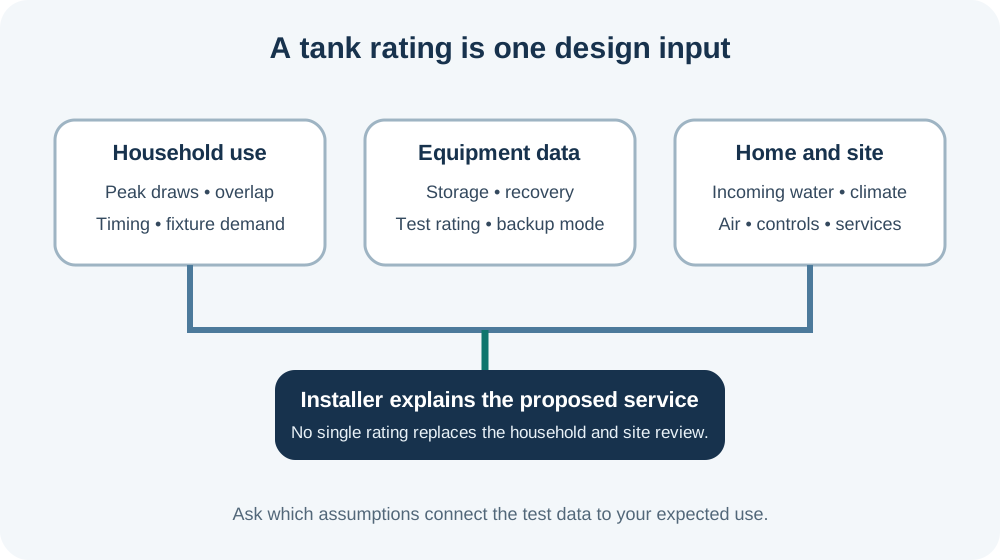
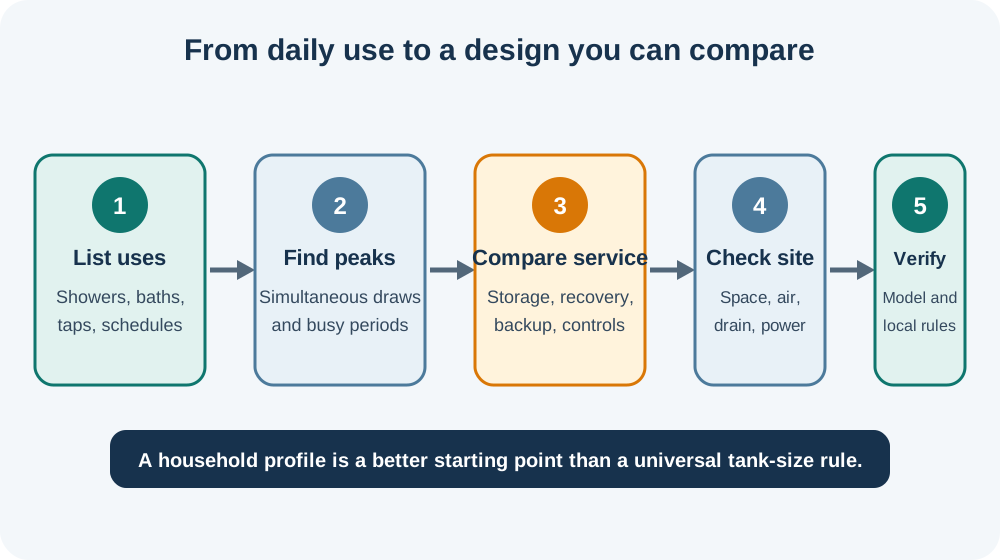
Write down when and where hot water is used: showers, baths, kitchen taps, laundry, and simultaneous use matter more than household size alone. Include the times when demand peaks, how quickly the system needs to recover, and whether people expect to draw water while another appliance is running. Incoming-water temperature, the required delivery temperature, and the equipment’s operating mode also affect the result.
A published tank volume or first-hour rating is a useful item to discuss, not a household design by itself. For U.S. products, first-hour ratings and efficiency ratings come from standardized tests. They do not reproduce every home’s water temperature, draw schedule, room conditions, or control settings. Ask the designer to explain which rating and operating assumptions fit your expected use.
Other equipment can reduce the heat needed from the water heater without replacing it. In Canada, NRCan describes drain-water heat recovery: warm shower wastewater passes heat through a device wall to incoming cold water, while the two water streams stay separate. The opportunity depends on warm drainage and cold-water use happening together. It is a plumbing option, not a heat-pump performance claim or a guaranteed saving.
What should the design proposal show?
Ask the installer to identify the hot-water system path, compatible tank or module, expected recovery after a peak draw, and what happens when resistance or backup heat operates. Request the model-specific installation instructions and the assumptions used for household demand. A system that prioritizes domestic hot water may briefly change space-heating operation; the duration and effect depend on its controls and the home.
The site plan should cover the tank’s route into the property, floor support, service clearances, air source or ducting, sound, condensate, pipework, electrical supply, controls, and any retained equipment. Stored-water hygiene and scald protection are separate design questions. Exact product features and local plumbing, electrical, and safety requirements should be checked by qualified professionals.
Use the small-home fit guide for room, airflow, and access constraints, and the hot-water safety guide for the relationship between stored-water hygiene and outlet temperature. If a combi is being replaced, the UK transition guide explains the service change.
Questions to take to an installer
- Which appliance heats tap water, and is storage part of this design?
- What peak-use profile and recovery time does the proposal assume?
- Which exact tank, cylinder, heat exchanger, sensors, and controls are compatible?
- What is the backup mode, and what electrical supply does it need?
- Where do air, condensate, hot-water pipes, and service access go?
- Which hygiene, scald, plumbing, and local requirements apply to this household?
These answers let you compare complete hot-water services rather than tank labels alone.
Sources and further reading
- Air-to-air heat pumps (authoritative-secondary source)
- Exhaust air heat pumps (authoritative-secondary source)
- How it Works — Heat Pump Water Heaters (primary source)
- Freshwater modules for hygienic DHW heating (primary source)
- Drain water heat recovery (primary source)
- 10 CFR Part 430, Subpart B — Test Procedures (Appendix E: Water Heaters) (primary source)