 HeatPumpPath
Heat-Pump Water Heater for a Small Home: Is It a Fit?
Assess a heat-pump water heater in a small home by checking demand, air, space, noise, condensate, recovery, and electrical requirements.
In this guideJump to a section
A heat-pump water heater (HPWH) can be efficient, but a small home does not automatically have the right place for one. The appliance moves heat from its air source into stored water. That means the room, airflow, noise, drainage, electrical supply, tank capacity, and access for service all matter alongside the household’s hot-water use.
Start with the household’s hot-water pattern
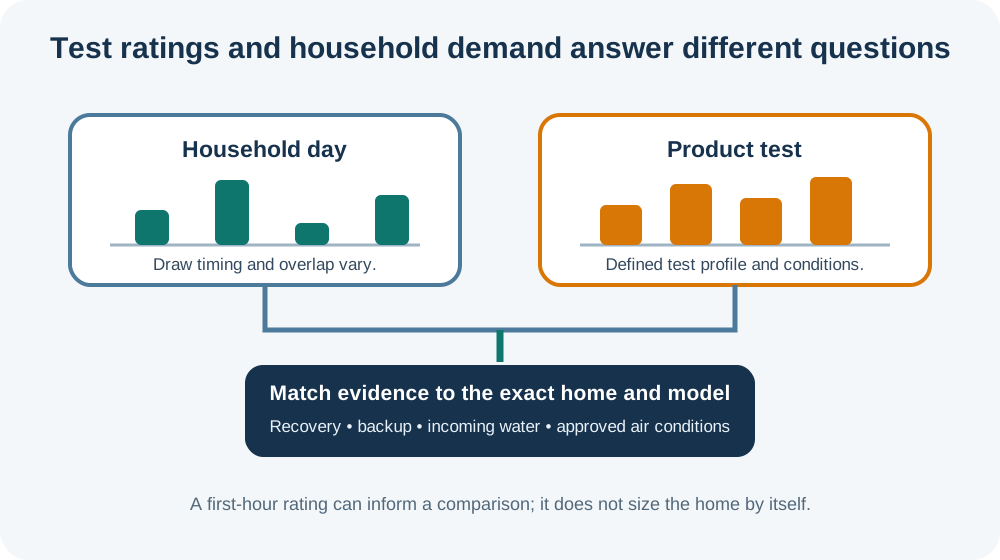
List the showers, baths, kitchen uses, and other draws that happen on a busy day. Note whether several fixtures run at once and when hot water is usually needed. A small household may have concentrated peaks; a larger tank is not automatically the right answer, and a small tank is not automatically a good fit for an infrequent-use home.
Ask the installer to match expected peak demand and recovery time to the exact model. A U.S. first-hour rating is measured under a defined test procedure. It can help compare products, but its test draw pattern is not a label for your household and does not predict the appliance’s performance in every room or climate. Compare the test information with actual use, incoming-water temperature, backup mode, and the manufacturer’s sizing guidance.
Check the room, air path, and service route
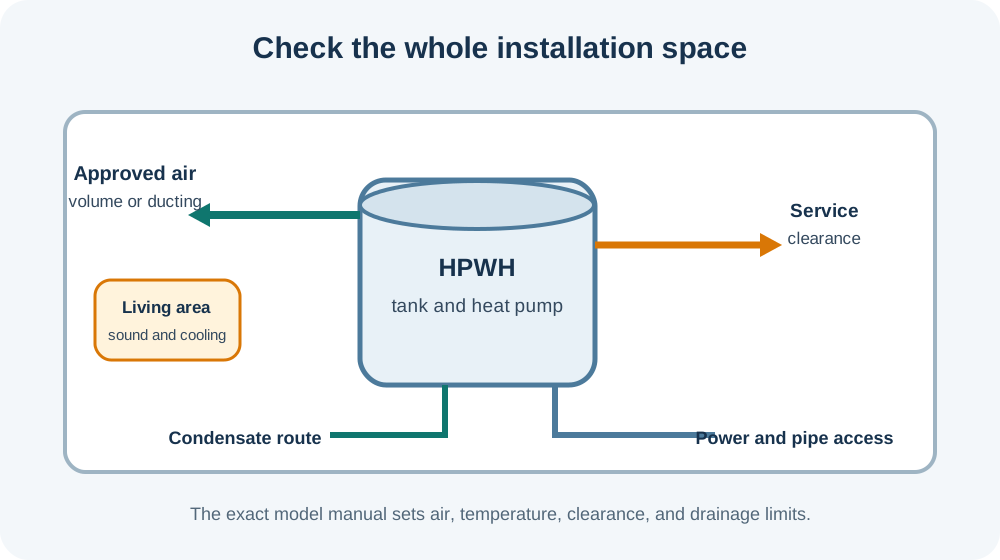
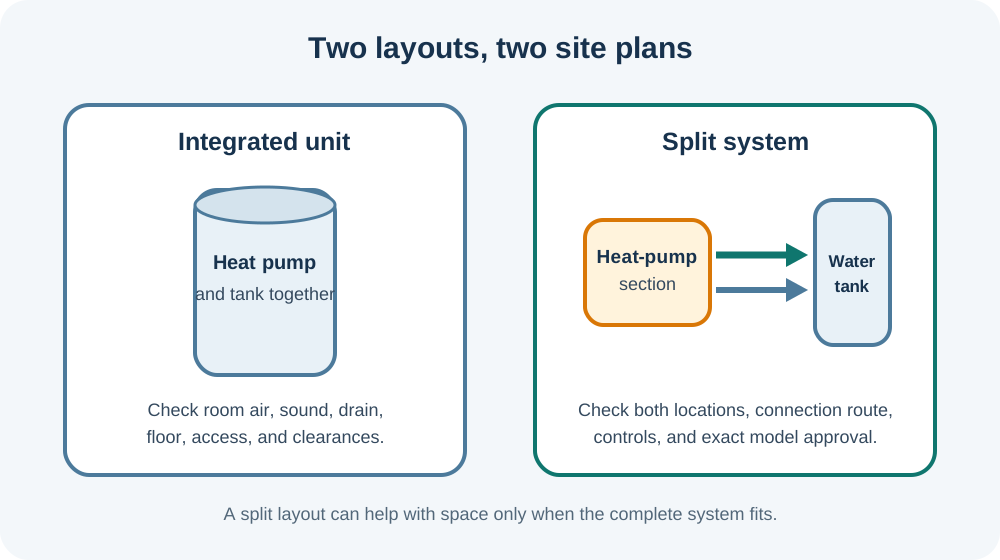
An integrated HPWH contains the heat pump and tank in one appliance. It needs enough manufacturer-approved air volume, or an approved duct arrangement, and space for installation, maintenance, and future removal. The fan and compressor make sound while the unit operates. The unit also cools the air it draws from, which can matter in a small utility room or a room connected to occupied space.
Do not use a generic room-volume figure as a pass/fail test. ENERGY STAR examples vary by product and installation arrangement; the exact installation manual controls. A split-system HPWH places the heat-pump section and water tank in different locations. That can help when one location is constrained, but it introduces connecting equipment, clearances, controls, and product availability that must be checked for the exact system.
In colder climates, an indoor-air HPWH can remove heat from space that the home needs to warm during winter. The size of that interaction depends on the air source, room, climate, and heating system; it is not a fixed efficiency penalty for every house. Outdoor or ducted arrangements also have model-specific temperature, frost, and pipe-protection limits. Verify the permitted conditions for the exact product rather than transferring one model’s cold-weather claims to another.
Follow the water, air, and electrical connections
The tank needs a safe route for condensate and any required relief discharge. Check the path from the delivery point to the location, the floor support, pipe access, electrical circuit, service clearances, and whether doors or other equipment will obstruct maintenance. The installer should document what is included in the quote and what additional plumbing or electrical work may be needed.
Canadian homes may also consider drain-water heat recovery. A device can transfer heat from shower wastewater to incoming cold water through a separate wall, without mixing the two water streams. It is most useful when warm shower drainage and cold-water use coincide. This plumbing option does not establish a particular HPWH’s compatibility, savings, or capacity; ask a qualified installer whether the layout and product make sense.
Compare practical alternatives
If the installation location fails a product requirement, compare a conventional electric storage tank, a different approved HPWH configuration, a central system already serving the home, or another locally suitable water-heating path. A gas or tankless appliance may also be available, depending on the property and local requirements. The right comparison is a complete service proposal, not an efficiency label in isolation.
Ask each installer to document expected hot-water demand, recovery, tank or cylinder model, permitted air conditions, ducting, sound, condensate route, electrical needs, backup mode, and maintenance access. Request the operating instructions and a written explanation of any assumptions. Do not alter the circuit, plumbing, safety devices, refrigerant system, or controls yourself.
The decision is strongest when the model’s installation manual matches the room, the household’s peak draws are addressed, and the quote includes all required connections. If one of those pieces is missing, ask for it before choosing equipment.
Sources and further reading
- Heat Pump Water Heater Design Considerations (primary source)
- How it Works — Heat Pump Water Heaters (primary source)
- 10 CFR Part 430, Subpart B — Test Procedures (Appendix E: Water Heaters) (primary source)
- Guide to residential water heaters (authoritative-secondary source)
- Drain water heat recovery (primary source)