 HeatPumpPath
Hot-Water Delivery, Wait Times, and Heat Pumps
A heat pump heats water, while pipe layout determines how it reaches a tap. Learn which delivery and recirculation questions to ask a plumber.
In this guideJump to a section
A heat pump determines how domestic hot water is heated; the plumbing layout determines how it travels from the tank or heater to a fixture. If a tap takes a while to run hot, the cause may be pipe length, pipe diameter, insulation, water left in the line, or the location of the heater. Changing the heat pump alone may not change the wait.
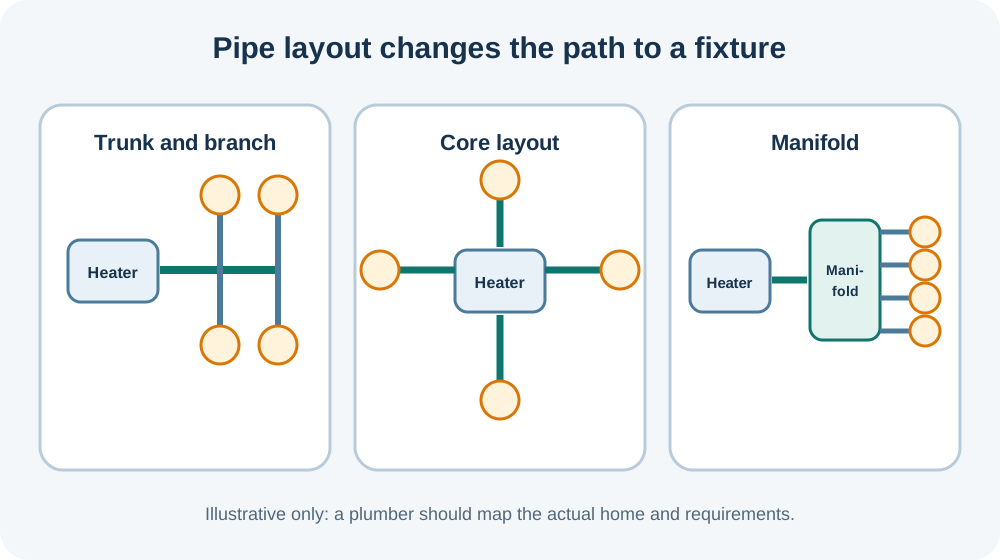
The path from heater to tap
In a trunk-and-branch layout, a larger main pipe serves branches and smaller connections to fixtures. A core layout places the water heater near a central group of uses and sends smaller pipes toward them. A manifold layout sends separate small pipes from a central manifold to individual fixtures. Each layout has trade-offs in pipe length, stored water, installation access, and the way the home is built.
Long or oversized pipe runs can leave more cooled water between the heater and a tap. Insulation, pipe routing, fixture placement, and usage patterns affect how quickly water reaches the outlet. If a home has a distant bathroom, several floors, or dispersed fixtures, ask the plumber to map the actual route instead of assuming that a larger water heater will solve the delay.
When recirculation is considered
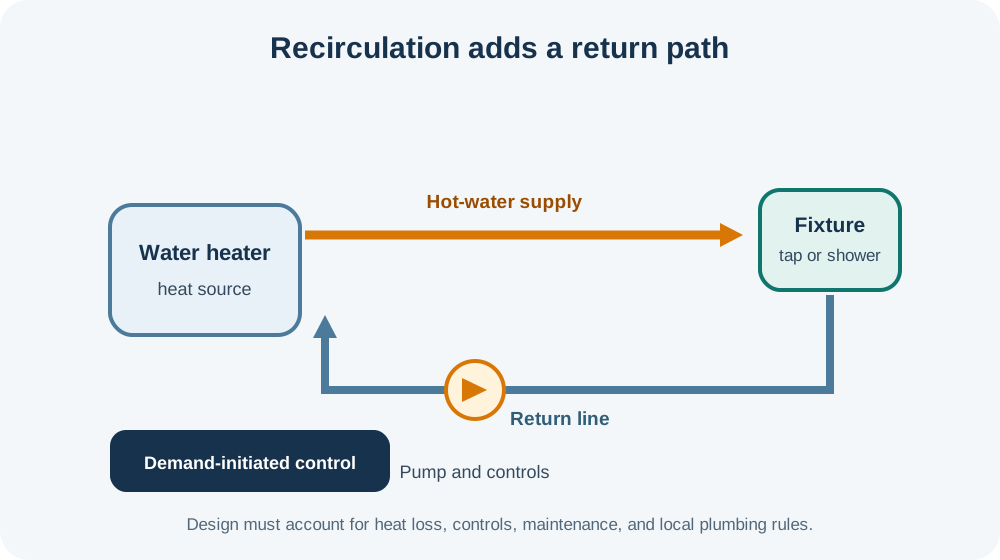
A recirculation system moves hot water around a loop so it is nearer to fixtures. Some systems operate continuously or on a timer; demand-initiated systems use a control such as a button or sensor to start circulation when needed. WaterSense guidance describes demand-initiated recirculation as one option for layouts where longer runs would otherwise be needed. It can add equipment and installation cost, and it must be designed so that operation does not unnecessarily increase heat loss.
The U.S. EPA WaterSense program uses a target of no more than 0.5 gallons stored between the hot-water source and a fixture for labeled-home guidance. This is a program benchmark, not a universal plumbing code, an existing-home retrofit rule, or a guarantee of a particular wait time. Its technical sheet also describes a verification method for that program. A homeowner should not treat that method as a requirement to test or change a hot-water system without the responsible professional.
What to ask about a heat-pump installation
Ask the designer to show where hot water is stored, which pipe route serves each main fixture, and what the proposal expects for delivery and recirculation. If a new cylinder is placed farther from a bathroom than the old boiler, the distribution path may change even if the appliance has ample capacity. Ask whether any new return loop, pump, timer, sensor, or control is proposed and how it affects energy use and maintenance.
For a small home, space for a loop or pump can be limited, while point-of-use or compact layout choices have their own electrical and service requirements. For a larger home, multiple branches, long runs, and multiple bathrooms may make a distribution review more important. Neither building size nor heat-pump type identifies the best layout by itself.
A useful plumbing review
Ask a qualified plumber or installer to identify the heater-to-fixture route, pipe sizes and insulation where relevant, expected use at the farthest fixture, and whether a recirculation option is practical. If the work is new construction or part of a U.S. WaterSense labeled-home project, have the team check the applicable certification method and its measurement requirements. For existing homes in the United States, United Kingdom, and Canada, confirm the local plumbing rules and safe testing approach before relying on any target.
Do not change water-heater temperature controls, valves, electrical connections, or pipework to shorten a wait. If the wait is a new problem, a leak or a control fault may also be involved; ask a qualified professional to investigate it. See the cylinder decision guide for heater and storage paths, and the safety guide for storage hygiene and scald protection.
Sources and further reading
- WaterSense Labeled Homes — Hot Water (primary source)
- WaterSense Labeled Homes Technical Sheet: Hot Water Delivery (primary source)