 HeatPumpPath
Heat-Pump Hot-Water Safety: Hygiene and Scald Protection
Stored-water hygiene and tap-water scald protection need to be designed together. Learn which questions to raise with a qualified professional.
In this guideJump to a section
Hot-water safety has two connected goals: managing the conditions that can allow Legionella and other germs to grow in water systems, and reducing the risk of burns from hot water at taps and showers. A heat-pump cylinder, backup heater, controls, pipework, and outlet protection must be considered as one system.
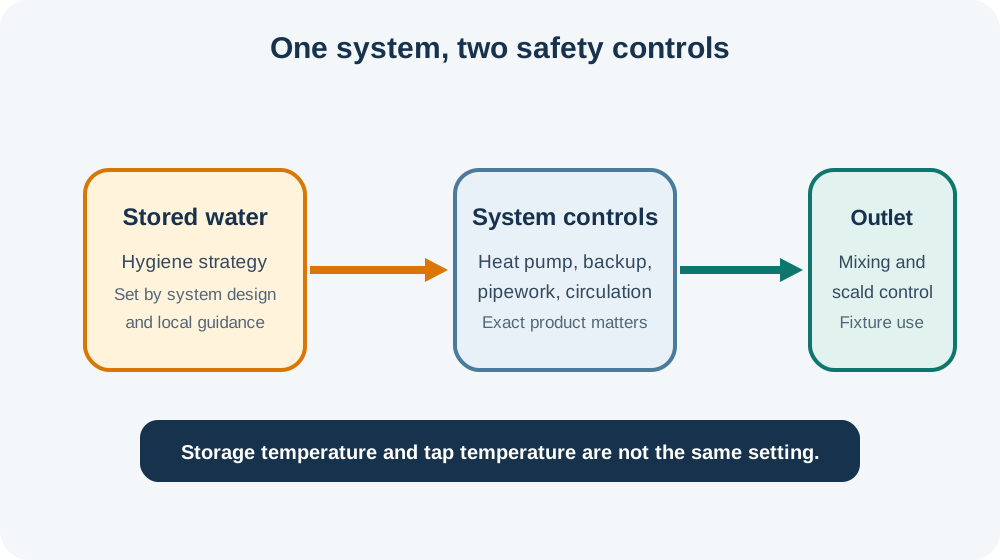
Storage and delivery are different temperatures
The temperature stored in a cylinder is not necessarily the temperature delivered at a tap. Some public-health guidance discusses hotter stored water as one way to reduce germ growth, while also warning that hotter water increases scald risk. A thermostatic mixing valve can blend hot and cold water near the outlet, but the choice, placement, and maintenance of that valve belong in the system design.
Values differ by jurisdiction and building context. The U.S. Centers for Disease Control and Prevention says 130–140°F (54–60°C) can kill germs such as Legionella in water, while noting that these settings increase burn risk. Its home guidance says that when storage is set above 120°F (49°C), thermostatic valves should be used to mix water at the tap, and advises households to discuss health risks with a provider.
Health Canada’s consumer guidance recommends a 60°C water-heater setting and anti-scald mixing that limits hot water at fixtures. UK Health and Safety Executive guidance gives 60°C storage and 50°C at outlets within one minute for the systems it discusses; its page also explains that control depends on the size and type of water system. These are jurisdiction-specific guidance examples, not one universal heat-pump setting or a substitute for current local requirements.
Why heat-pump controls need a system plan
A heat pump may heat water differently from a conventional boiler, and an immersion or electric element may be used for backup or a scheduled heating cycle. The product manual and installed controls determine how those functions operate. Do not assume that every model has the same hygiene cycle, that a backup element will run in every condition, or that a displayed tank temperature describes the temperature at each outlet.
An installer should explain the design’s storage strategy, how the system reaches and maintains the intended temperatures, what the controls do after a large draw, and how any mixing valves and safety devices are checked. System volume, circulation, dead legs, low-use outlets, tank design, and local water conditions can change the risk assessment. A setting copied from another product or household may not provide the same protection.
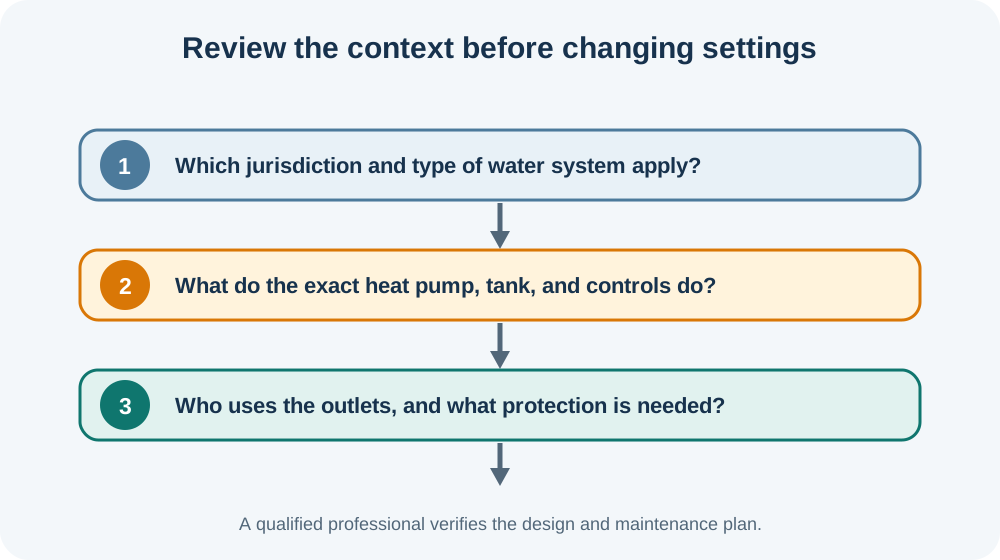
Include people and outlet use in the assessment
Children, older adults, people with reduced mobility or sensation, and people with some health conditions may face greater consequences from scalds or waterborne germs. The right outlet protection and water-management approach should reflect who uses the home and how fixtures are used. A valve also needs the correct hot and cold supplies and ongoing checks; it should not be treated as a one-time guarantee.
If a cylinder or tap temperature seems wrong, use the manufacturer’s instructions and contact a qualified installer or plumber. Do not raise the stored temperature, disable a control, change an immersion-heater setting, or open equipment to investigate. Flushing, maintenance, and repairs should follow the exact product instructions or be handled by a professional.
Questions for the installer
- Which current public-health and plumbing guidance applies in this location?
- What temperature strategy is designed for the stored water, and how is it controlled?
- Where and how is outlet mixing or other scald protection provided?
- What does the heat pump’s backup or hygiene function do, and how is it verified?
- Which outlets, circulation paths, and low-use branches were considered?
- Who should inspect the system and how often under local guidance and product instructions?
For system types and storage choices, see the cylinder decision guide. For the separate question of why a tap waits for hot water, see hot-water delivery and pipe layout.
Sources and further reading
- Preventing Waterborne Germs at Home (primary source)
- Water temperature and burns/scalds (primary source)
- Hot and cold water systems (primary source)