 HeatPumpPath
Sequence a Heat Pump, Water Heater, EV, and Other Electric Upgrades
Build an upgrade sequence around comfort, equipment condition, electrical capacity, future loads, and local tariffs instead of assuming one order fits every home.
In this guideJump to a section
There is no universal order for electrifying a home. A failing heating system, a service that needs assessment, a water heater nearing replacement, an upcoming electric vehicle (EV), and a planned solar or battery system create different constraints. A useful sequence makes those constraints visible before separate contractors design separate pieces of the same electrical plan.
Start with the household’s priorities
Write down what needs attention now and what may change over the next several years. A home with unreliable winter heat has a different first priority from one planning an EV charger years before replacing its boiler. Include comfort, hot-water needs, mobility, outage concerns, and the condition of existing equipment. Do not delay an urgent repair or replacement simply to make a future plan look tidy; ask the relevant professionals how the immediate work can fit a longer-term path.

These paths are examples rather than a universal order; urgent needs and local design constraints shape the sequence.
Build a shared load and timing list
List the equipment already installed and each likely addition: space heating and cooling, backup heat, water heating, cooking, laundry, EV charging, solar, storage, and other large appliances. For each, capture the expected equipment, electrical data from its documentation, installation timing, and when it normally operates. An EV that can charge after midnight is not the same as one that must be ready for an early departure. A heat pump’s demand changes with weather, and a water heater may need to recover when several people have used hot water.
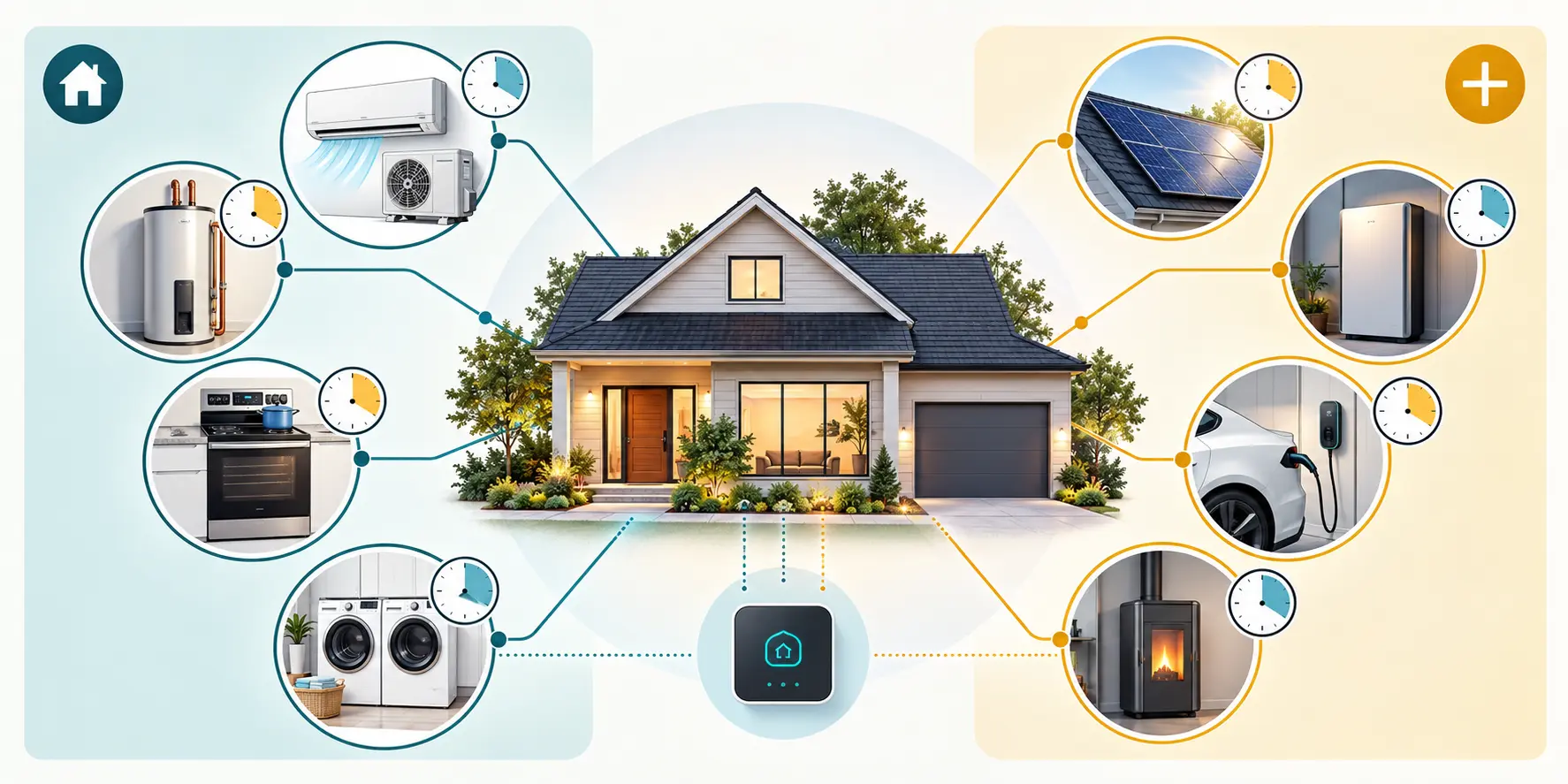
Examples only: include the equipment and schedules that apply to the home; the connected planning lines do not imply universal control or compatibility.
The inventory is a planning aid, not a service calculation. Have an electrician or electrical engineer assess the service, panel, and circuits using the method required locally. The panel-capacity guide explains what to gather before that conversation.
Compare complete sequences, not appliance-by-appliance quotes
Several paths may be reasonable. Replacing failed equipment first may protect comfort while preserving an existing furnace or boiler for supplementary heat. A planned renovation may combine envelope work, a heat pump, hot water, and panel changes. A home with several future loads may use professionally designed load management or stage a service upgrade. Ask what each path makes possible later, what it leaves unresolved, and what assumptions its price depends on.
| Situation | Sequence worth comparing | Main question |
|---|---|---|
| The heating system is failing | Assess the electrical service and heating design while arranging a safe replacement path; include any retained or new supplementary heat. | How can the home stay comfortable while the long-term design is confirmed? |
| An envelope renovation is already planned | Compare the expected heating load after the work with a heat-pump design; coordinate the work without assuming that the renovation removes today’s heating need. | Which design assumptions change after the planned insulation or air-sealing work? |
| An EV or water heater is likely soon | Include it in the same assessment as the heat pump and compare managed charging, staged work, and any required service or panel changes. | What has to operate at once, and which loads can be scheduled or controlled safely? |

These situations illustrate paths to compare, not a required order for every home.
For a Canadian home, Natural Resources Canada’s heat-pump guidance distinguishes add-on from all-electric system paths and notes that service age and whole-home load affect the electrical decision. Use it as regional context, not as an individual service calculation.
Canadian homeowners can also ask their heat-pump designer whether Natural Resources Canada’s LEEP Air-Source Heat Pump Sizing and Selection App fits the project. It is a tool for HVAC designers and contractors to evaluate scenario-specific heat-pump options with builders and homeowners, and it lets project collaborators comment on proposed systems. It supports equipment selection; it does not assess electrical service capacity or replace local design and code review.
An integrated heat-pump water heater may have operating modes or resistance backup that affect the timing and electrical plan. The ENERGY STAR heat-pump water heater guide describes relevant U.S. product and design considerations; it is written primarily for new construction, so confirm the selected model and installation context.
When loads are managed, ask what equipment is controlled, who can send a control request, and what happens when the system loses communications. A schedule or demand-response program can shift some use only if the product, utility or service provider, and customer terms support it. ENERGY STAR’s connected-functionality overview describes utility control as permission-based for applicable certified products and includes a way for consumers to override requests; exact capabilities depend on the product and program. Load management does not create electrical capacity by itself or guarantee a lower bill. See smart heat-pump controls, tariffs, and homeowner choices for that separate decision.
Treat tariffs as inputs, not promises
Time-of-use and other flexible tariffs change the price signal at particular times. Whether shifting a water heater, battery, or EV helps depends on the current offer, fixed and standing charges, equipment behavior, household schedule, and any export terms. A cheap period is not enough to prove an annual saving. Compare the whole bill using a realistic load profile and the prices actually available from the household’s supplier or utility. UK guidance from Energy Saving Trust is specific to its market; it should not be applied as a tariff recommendation in the USA or Canada.
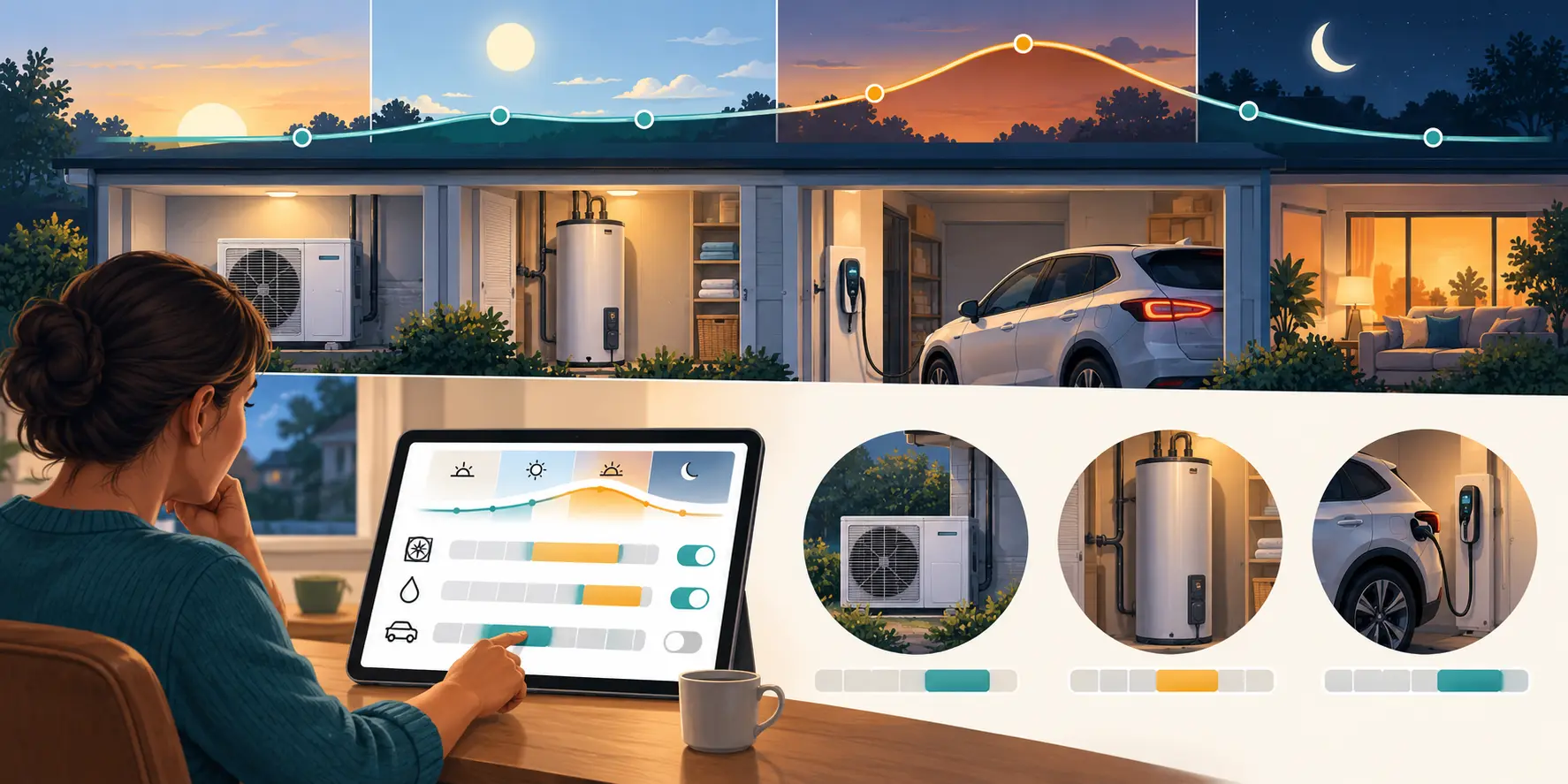
Price timing does not guarantee a lower bill; control options, program terms, compatibility, and homeowner override depend on the actual system.
Make the plan usable for the next contractor
Keep a short record with the proposed dates and equipment, the electrical assessment, the heat-pump and backup assumptions, the hot-water plan, and the future EV or appliance loads. Ask each quote to say what is installed now, what is reserved or controlled, and what later work would trigger another assessment. If the home is in a condo or strata, coordinate at the building level before treating one unit’s panel as the whole electrical picture; see planning heat pumps and EV charging in a Canadian condo or strata.
The sequence is ready when the household knows its immediate priority, the planned loads have been considered together, the professional assumptions are documented, and the next step is clear. For exact costs, incentives, or payback, use current local information and a separate comparison that states its assumptions; do not carry a tariff, load profile, or program from another home into yours.
Sources and further reading
- ENERGY STAR + Connected Functionality (primary source)
- Heat Pump Water Heater Guide (primary source)
- Tariffs for renewable technology (authoritative-secondary source)
- Heating and cooling with a heat pump (primary source)
- LEEP Air-Source Heat Pump Sizing and Selection App (primary source)