 HeatPumpPath
Smart Heat-Pump Controls, Tariffs, and Your Choices
Before joining a flexible tariff or demand-response service, find out what can be controlled, who can request a change, and how comfort, data, and overrides are handled.
In this guideJump to a section
A smart tariff changes the price of electricity at certain times. A connected thermostat or home-energy system changes how equipment operates. A demand-response service may ask a device or controller to adjust use during a particular event. These are related, but they are not the same product or agreement. Before signing up, find out what the offer changes inside your home and what control remains with you.
Separate the price, the controller, and the program
- A tariff sets the prices and charges on your bill. It may have different rates by time, an export rate, or other conditions. Check the current supplier or utility offer, not a general example from another region.
- A controller is the thermostat, appliance control, or home-energy system that schedules or adjusts equipment. Compatibility depends on the exact heat pump, its controls, and the connected service.
- A flexibility or demand-response program defines what can be requested, when requests happen, what the customer receives, and how a customer can take part or leave. Terms vary by provider and jurisdiction.
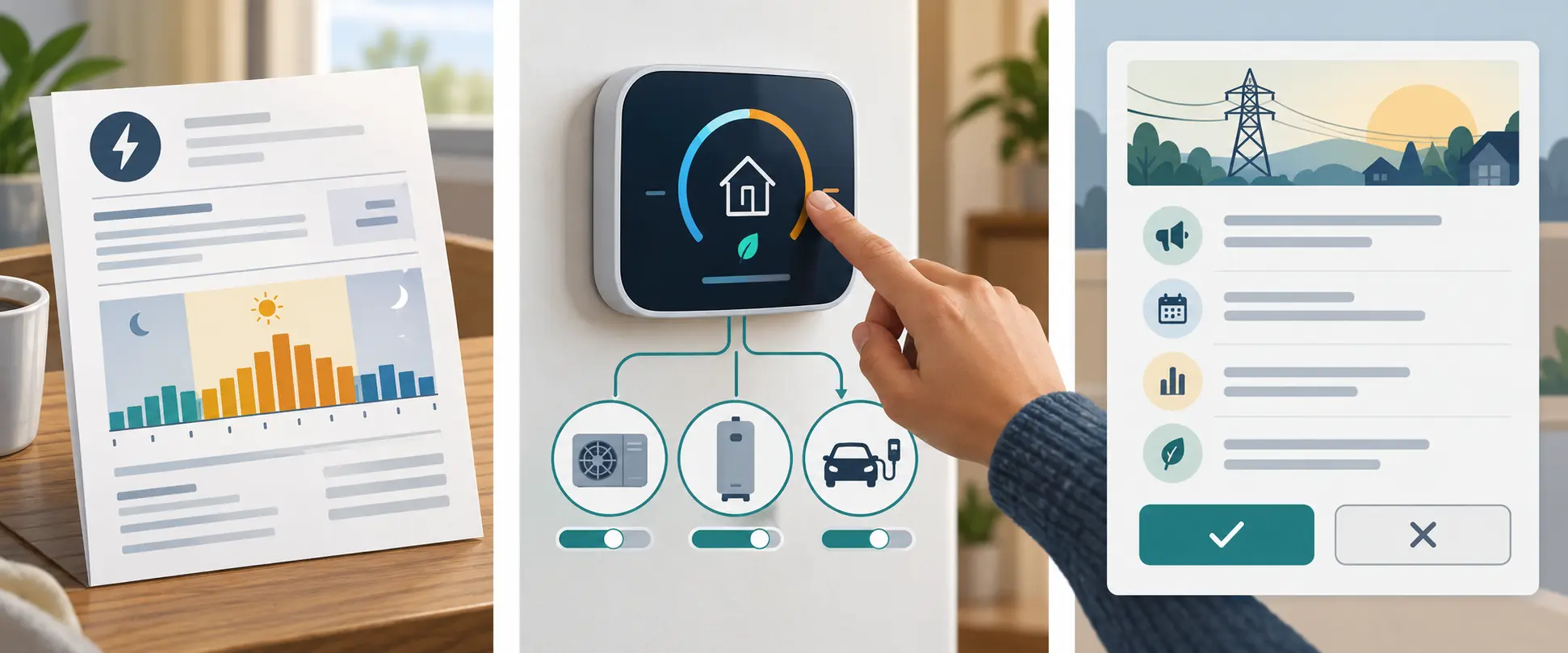
An offer may combine these elements, but prices, control capabilities, and participation terms vary by provider, product, and jurisdiction.
In the United States, a utility or aggregator may coordinate customer energy resources as a virtual power plant (VPP). The U.S. Department of Energy describes VPPs as a grid-level way to address peak demand and reliability pressures. That potential does not show that your heat pump or battery is eligible, that participation will lower your bill, or that equipment will operate during an outage. Ask the local program which devices it can control, what permissions and compensation apply, how you can opt out, and whether backup equipment is separately designed for outages.
A price signal does not automatically control a heat pump. A connected controller does not guarantee that a utility program is available. An offer may coordinate an EV charger or water heater without controlling the space-heating equipment. Ask which exact devices are included.
Protect comfort and understand the override
Ask what a control event can change: a setpoint, run time, water-heater recovery, EV charging, battery dispatch, or another setting. Confirm the expected event duration and the limits that protect comfort and hot water. Find the manual override, how long it lasts, whether it affects payment, and how to pause or leave the service. If a household has a resident who is sensitive to temperature changes, make the acceptable comfort range part of the decision before enrollment.
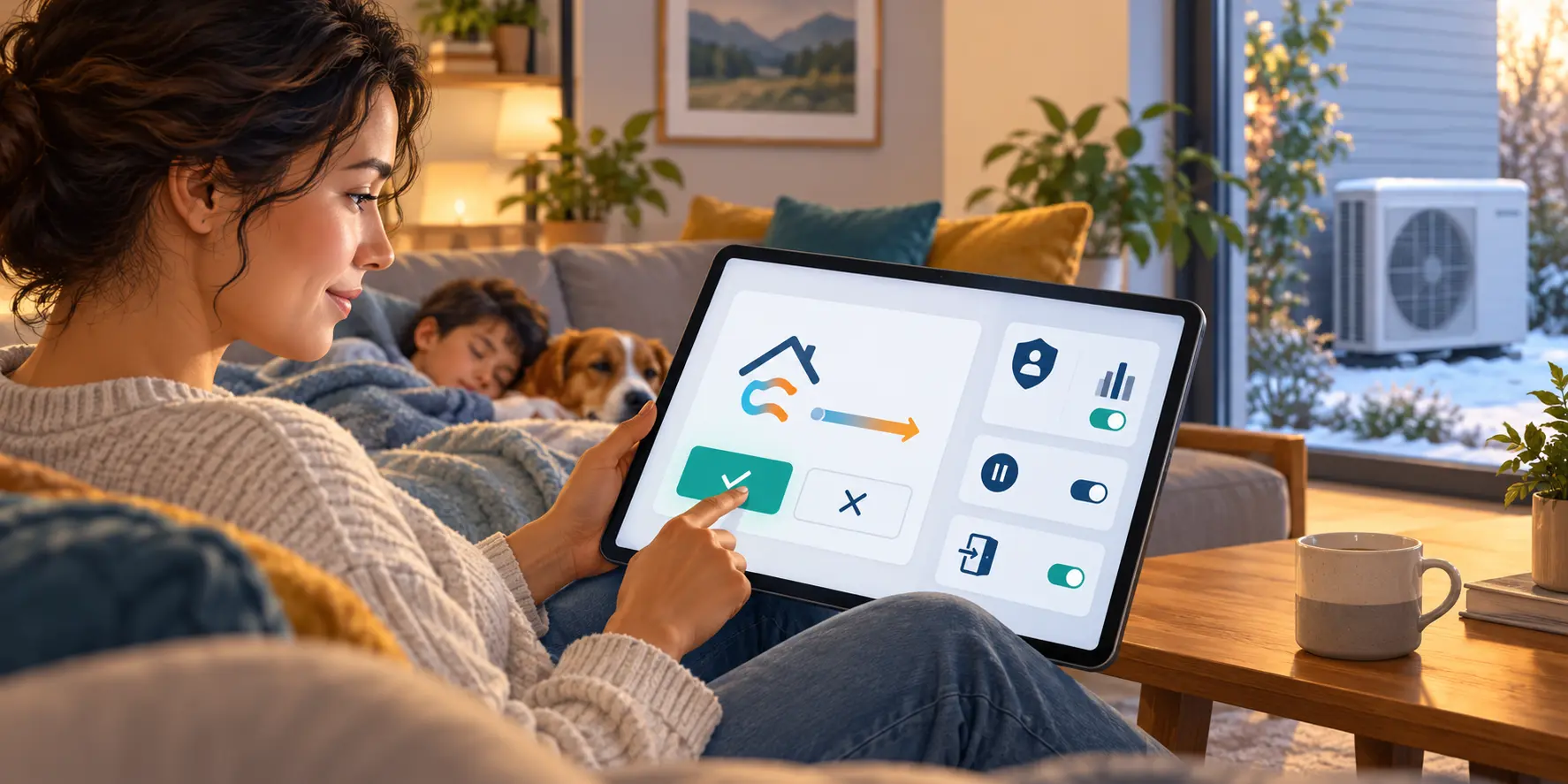
The exact control limits and override options depend on the product and service; check them before enrollment.
In the United States, ENERGY STAR’s smart-home energy-management criteria describe capabilities such as homeowner permission before a device responds to grid requests and a consumer override. Those criteria describe a product category, not a guarantee that a particular heat pump, utility program, or installation has those functions enabled. Check the exact product’s certification and service terms.
In Great Britain, Ofgem’s load-control consumer-protection guidance, published on 7 August 2026 for licensees, covers fair treatment, transparency, complaints, and support for vulnerable consumers. The July 2026 government flexibility roadmap describes consumer-led flexibility as voluntary and bounded by comfort and convenience. These are useful current references, but they do not prove that every tariff or controller provides the same protections. Read the provider’s current contract and check the latest regulatory information.
In Canada, program access and tariff options depend on the province, territory, utility, supplier, and equipment. Do not carry a U.S. product criterion or a Great Britain policy statement across the border as if it were a local customer term.
Check what happens when something fails
Ask whether the thermostat continues to work as a basic thermostat if the internet or service-provider connection is lost. Find out which devices return to their normal settings, whether schedules remain, and how a heat pump behaves during an outage. A control program is not electrical backup: it cannot supply power when the grid is down or establish that a battery can run the heat pump.
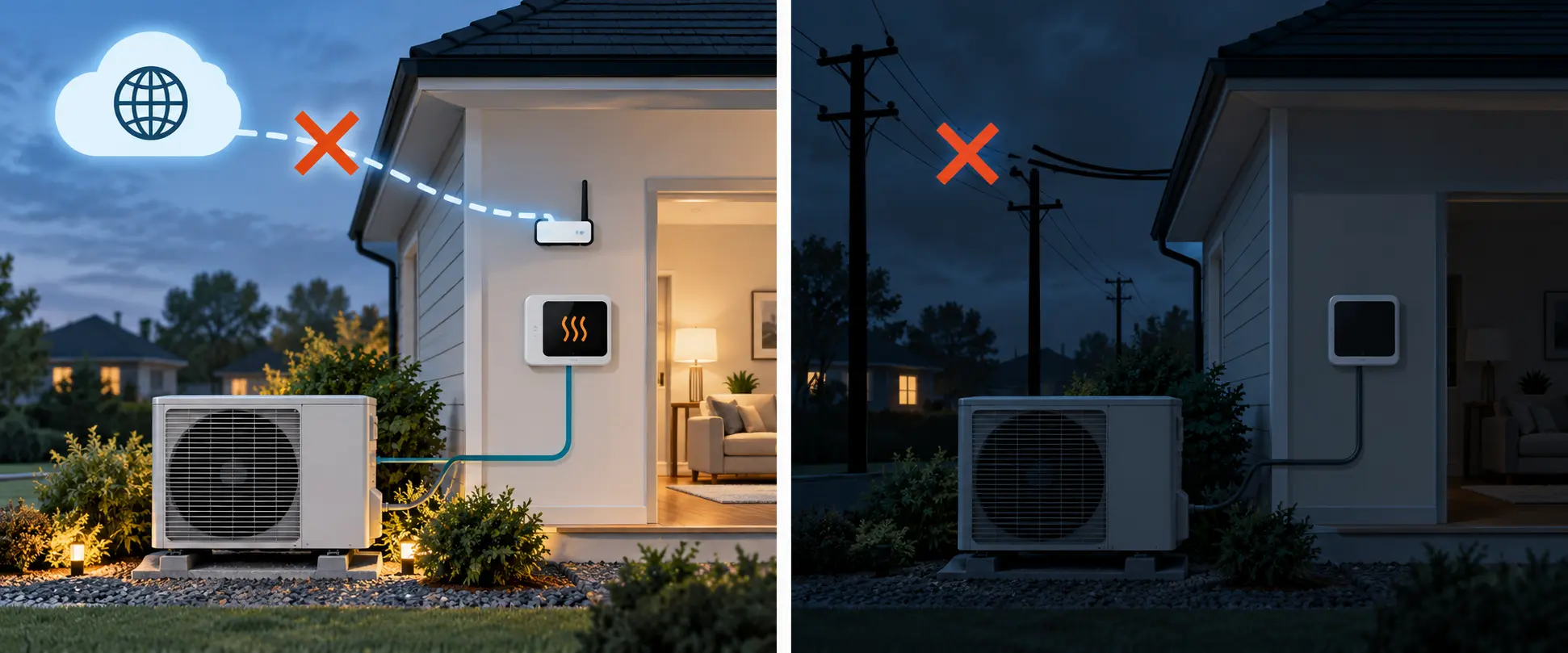
Loss of communications and loss of grid power are different conditions; a control service cannot provide outage electricity.
ENERGY STAR’s smart-thermostat criteria include continued basic thermostat operation when a service-provider connection is absent. That is a certification criterion, not proof that every connected thermostat or heat-pump configuration behaves the same way; check the exact model and wiring.
If the service collects household or meter data, check what information it uses, who can access it, whether sharing is optional, how long it is kept, and how to withdraw access. A system that controls several devices needs a clear way for household members to see the schedule and change it.
Use this checklist before enrolling
- Which appliances, circuits, or settings are actually connected?
- Who can request a change: the resident, the tariff provider, a utility, or another service provider?
- What temperature, hot-water, and vehicle-charging limits apply?
- How do manual override, opt-out, cancellation, and supplier switching work?
- What happens after a communications failure or power outage?
- What data are collected, and who can access them?
- What are the complete tariff charges and program conditions, and how will you check the effect on your own bill?
If the answers are unclear, ask the heat-pump installer, controller provider, and utility to describe the same operating scenario in writing. The upgrade-sequencing guide explains how to include controls in a wider electrification plan without assuming that automation will resolve every capacity or cost question.
Sources and further reading
- Smart Home Energy Management Systems Key Product Criteria (primary source)
- Smart Thermostats Key Product Criteria (primary source)
- Smart Secure Electricity Systems (SSES) Load Control Licence: consumer protection guidance (primary source)
- Clean flexibility roadmap: July 2026 update (primary source)
- U.S. Department of Energy Releases New Reports Highlighting Benefits of Consumer-Centric Solutions for Households, Businesses, and Utilities (primary source)