 HeatPumpPath
Whole-Home vs. Partial-Load Heat Pumps
Define which rooms and share of a home's heating a heat pump will serve, and how any retained heating system will coordinate with it.
In this guideJump to a section
Before comparing equipment, state how much of the home’s heating the heat pump is meant to provide. A whole-home design aims to serve the planned spaces across the design conditions, using the assumptions stated by the designer. A partial-load design intentionally assigns some rooms or part of the heating demand to another system. Those are coverage goals, not guarantees that every room will feel the same in every condition.
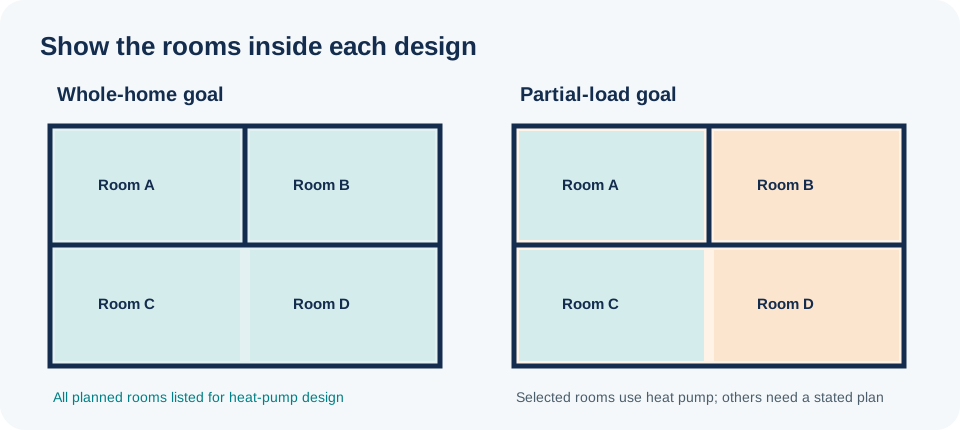
Name the rooms and the operating conditions behind the coverage claim.
What the two goals mean
| Design goal | What to ask the designer to define | What the label cannot establish |
|---|---|---|
| Whole-home | Which rooms are in scope, the load basis, design weather, distribution, and any auxiliary heat | That the system never needs backup, or that the quoted equipment and distribution are correctly sized |
| Partial-load | Which rooms or share of the load the heat pump serves, when retained equipment runs, and how the systems coordinate | How much energy or cost either system will use, or whether the selected room boundary will be comfortable |
“Whole-home” can include auxiliary heat for a design condition, equipment fault, or specific operating mode. It describes the intended coverage of the system design; it does not mean the compressor alone must meet every moment of demand. “Partial-load” can describe a heat pump serving an addition, selected rooms, or a defined share of the home’s load while existing equipment remains available. The term does not specify the boundary or control sequence. Ask for both in writing.
Define the boundary room by room
A useful proposal lists every room included in the heat-pump design and the delivery method for that room. It shows the loads used, the local outdoor design condition, the selected equipment combination, and any constraints in ducts, room-unit placement, or emitters. It also explains which existing system remains, whether it is expected to operate at the same time or take over under a control rule, and what happens if one system is unavailable.
This matters for mixed layouts. A heat pump may use ducts for most rooms and a separate indoor unit for an addition. Or it may cover only a regularly used part of the home while a boiler or furnace continues serving other rooms. Either arrangement needs room-specific coverage and coordinated controls. See ducted vs. ductless distribution for how the air path affects room coverage.
Partial load is not the same as dual fuel
In some U.S. usage, “dual fuel” refers to a heat pump paired with a fuel-burning furnace or boiler, with controls that decide which source runs. That is one possible way to provide auxiliary or retained heat. A heat pump can also be partial-load with electric resistance backup, a second heat pump, or a retained system serving a defined area. Conversely, a home may have a dual-fuel arrangement intended to cover the whole planned load. “Hybrid” can mean different things across products and markets, so identify the actual equipment and control sequence rather than relying on that word.
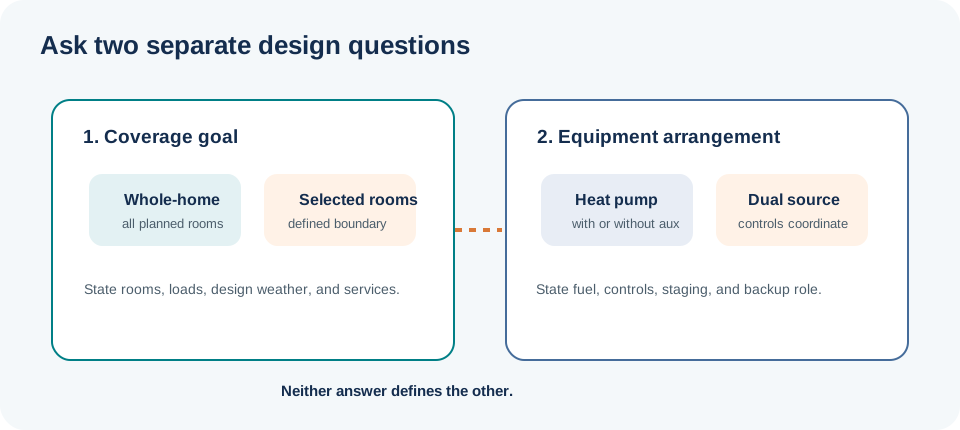
Ask for both the room boundary and the equipment/control arrangement.
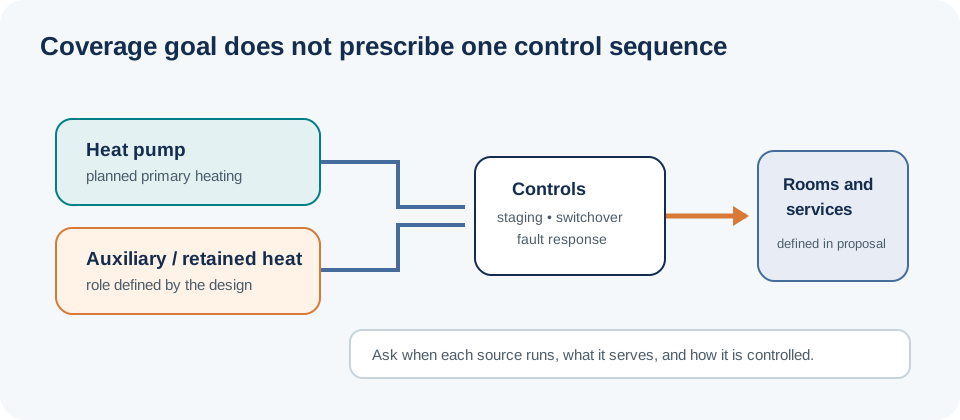
A coverage goal and the control sequence are related but distinct.
Do not remove existing equipment based only on the whole-home label, and do not assume keeping it guarantees a good partial-load design. The equipment may need service, the controls may need replacement, and the electrical or fuel arrangements may affect the proposal. Local definitions and any incentive or permitting rules must be checked for the property and date; this guide does not establish eligibility.
Compare the proposals on the same basis
Ask both designers to state: the rooms and services covered; the room-by-room load method and design weather; the equipment and its capacity at relevant conditions; the distribution changes; the role of retained or auxiliary heat; the control rule for staging or switchover; domestic-hot-water and cooling scope; and what happens during a fault or power interruption. If one proposal includes all rooms and another excludes upstairs bedrooms, their costs and performance are not comparable until the service boundary is clear.
Operating cost also needs a defined boundary. A heat pump’s contribution, retained-system use, energy prices, control settings, weather, and household behavior all affect the result. Ask for the assumptions and modeled annual energy for each system separately; treat any savings estimate as scenario-based, not a promise for the home.
Key points
- “Whole-home” and “partial-load” are coverage goals; ask for the rooms and conditions behind them.
- A whole-home plan may still use auxiliary heat. A partial-load plan needs a clear retained-system role and coordinated controls.
- Dual fuel describes an equipment/control arrangement in some markets, not a synonym for all partial-load designs.
- Compare proposals with the same rooms, services, load assumptions, equipment data, and included work.
Sources and further reading
- CEE Air-Source Heat Pump Decision Matrix and System Design Guide (primary source)
- Air-Source Heat Pumps (primary source)
- ENERGY STAR Heat Pump Guide (primary source)