 HeatPumpPath
Air-to-Air vs. Air-to-Water Heat Pumps
Compare the indoor heat-delivery path, hot-water scope, cooling, and retrofit questions for air-to-air and air-to-water systems.
In this guideJump to a section
“Air-source” describes the outdoor heat source. “Air-to-air” and “air-to-water” describe how heat is delivered inside. That distinction matters in a retrofit: one path warms room air through ducts or indoor units, while the other heats a water circuit that can connect to radiators, underfloor loops, fan coils, or a storage tank. The labels alone do not establish which services a particular model can provide.
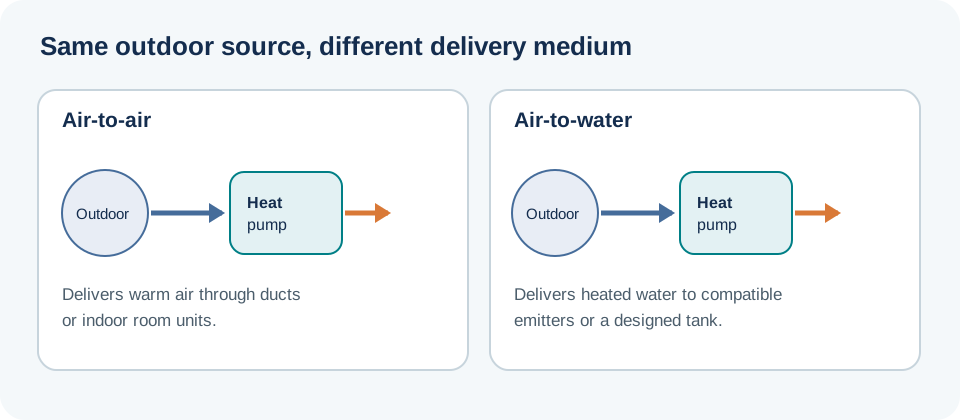
Source and delivery are separate parts of the equipment description.
Follow the heat into the home
An air-to-air heat pump moves heat from outdoor air into indoor air. A ducted air handler can send it through ducts; a ductless system sends it from room-level indoor units. Room coverage depends on the distribution plan and home layout. Some packaged through-wall air-to-air units combine components without a separate outdoor cabinet, but those are a specific product format, not a capability implied by every air-to-air label. Check the current model, wall-opening requirements, sound, access, and local product support.
An air-to-water system transfers heat from outdoor air to water in a hydronic circuit. That water may serve radiators, underfloor heating, fan coils, or a tank if the equipment and controls are designed for that use. Existing emitters need to be checked at the proposed water temperature and design conditions; a radiator that works with a boiler is not automatically able to meet the same room load at a different temperature. The designer should show expected output and the operating assumptions for the actual emitters.
What the type label does—and does not—tell you
| Question | Air-to-air | Air-to-water |
|---|---|---|
| Indoor heat path | Air from a ducted or ductless indoor unit | Water through a compatible hydronic system |
| Common retrofit check | Duct condition, room airflow, indoor-unit position | Emitter output, water temperature, pipe and control compatibility |
| Domestic hot water | Usually a separate water-heating system; verify any claimed exception by model | May include a cylinder or water-heating configuration; verify the model and design |
| Cooling | Often available through compatible indoor units; check the selected system | Chilled-water operation and suitable emitters must be designed and documented |
Neither type is inherently more efficient or less disruptive in every home. Performance depends on the matched equipment, climate, design temperatures, distribution, controls, and how the system is operated. Compare model data at conditions relevant to the property instead of relying on the category name.
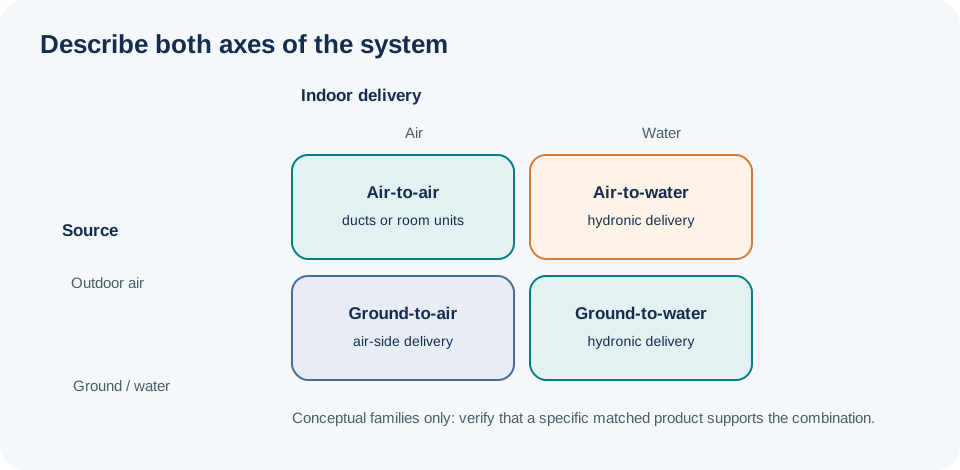
Use the full source-and-delivery description when reviewing a system.
Check the services as separate design decisions
Space heating, cooling, and household hot water can be packaged in different ways. An air-to-air system commonly needs a separate water heater. Some air-to-water systems can heat a hot-water cylinder, while others or particular layouts require separate equipment. A label does not confirm capacity, water-heating priority, recovery, or compatibility with the home’s demand. Ask for a system schematic and the model documentation that show the intended arrangement.
Cooling also needs a design check. Air-to-air indoor units may be configured to cool the rooms they serve. An air-to-water product may support chilled water, but the emitters and controls must be suitable and must manage condensation. Do not assume existing radiators can provide cooling, or that an advertised reversible unit will cool every room effectively.
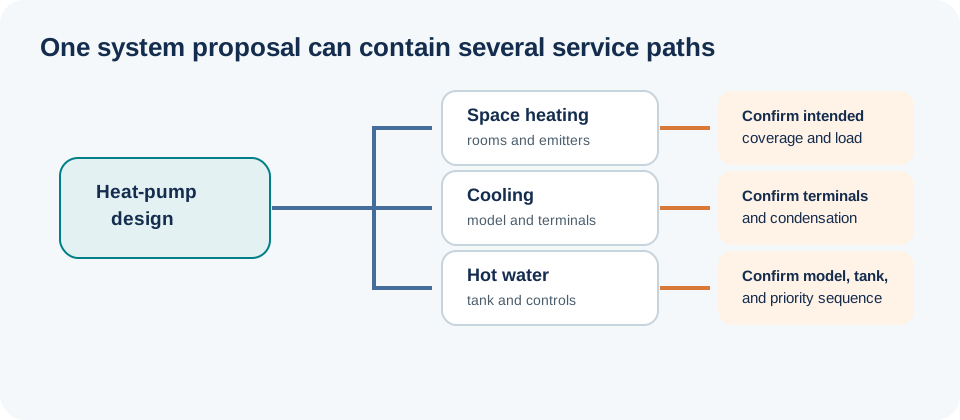
Ask which model and components serve each end use.
Terminology differs by market. In North American consumer material, “air-source heat pump” often covers ducted and ductless air-to-air systems. In UK conversations, it is also commonly used for air-to-water heating systems. When reviewing a quote, ask for the heat source, delivery medium, indoor components, and end uses rather than inferring them from “air-source.”
Questions to settle before comparing quotes
- Which rooms are heated and cooled, and through what ducts, indoor units, or emitters?
- What design load and outdoor conditions support the proposed equipment and indoor components?
- If radiators or underfloor loops are retained, what output do they provide at the proposed water temperature?
- Is domestic hot water included? Which tank, controls, priority sequence, and recovery assumptions apply?
- Is cooling included, and are the indoor terminals designed for it?
- What backup remains, and how do the controls coordinate it with the heat pump?
The ducted vs. ductless comparison covers room-air distribution. The whole-home vs. partial-load guide helps define which rooms and heating share are intended to be served.
Key points
- Air-to-air and air-to-water describe delivery; they do not specify whether the source is air, ground, or another arrangement.
- Check heat delivery, hot water, and cooling independently against the selected model and system design.
- Existing emitters and indoor units need to be matched to the home’s room loads and intended operating conditions.
- Ask for a system diagram and model-specific data before treating a system label as a complete description.
Sources and further reading
- Heat Pump Systems (primary source)
- Air-to-Air Heat Pumps (authoritative-secondary source)
- ENERGY STAR Heat Pump Guide (primary source)