 HeatPumpPath
Air-Source vs. Ground-Source Heat Pumps for a Retrofit Home
Compare the site work and system choices behind air-source and ground-source heat pumps without assuming one is right for every home.
In this guideJump to a section
Air-source and ground-source heat pumps differ in where they exchange heat. That difference can change the outdoor equipment, site investigation, and installation work. It does not by itself tell you how heat will reach each room, whether the system will make household hot water, or how much of the home it can serve. Compare complete designs for the same home and the same services.
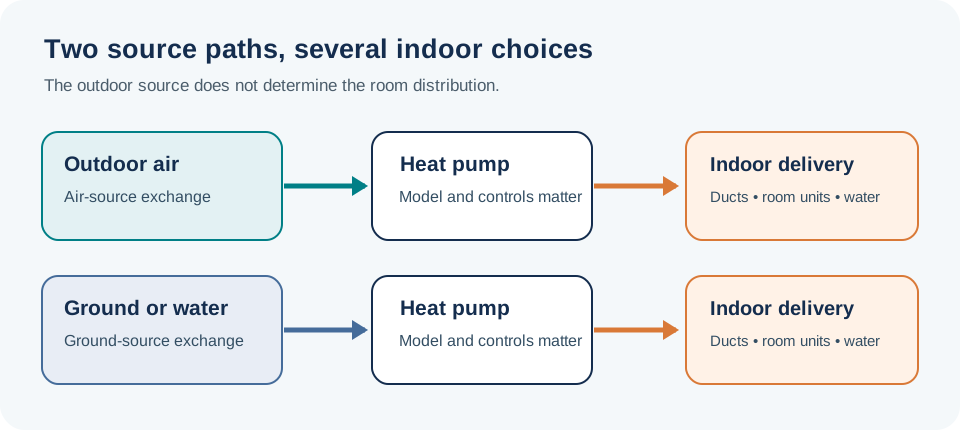
The source side and the indoor delivery side are separate design choices.
What the source changes
An air-source system exchanges heat with outdoor air through an outdoor heat exchanger. Its placement needs service access and clearances, and the designer must account for the local outdoor conditions and the model’s operating data. The unit also needs a path for condensate and defrost water where applicable. Outdoor sound, snow, wind exposure, and nearby rooms can affect a suitable location.
A ground-source system exchanges heat with the ground or, in some designs, groundwater. The building still has a heat pump and indoor distribution, but the project also needs a loop or source arrangement. The land, geology, access for drilling or excavation, water conditions, local permissions, and loop design can all affect feasibility. A ground-source label is not proof that a loop can be installed at a particular property.
The equipment may deliver heat through ducts, room units, radiators, underfloor heating, or another compatible arrangement. Those indoor choices belong to the house-side design. A ground loop does not remove the need to check room loads and distribution; an air-source system is not necessarily ductless.
Compare the project, not just the equipment label
| Question | Air-source path | Ground-source path |
|---|---|---|
| What exchanges heat with the environment? | An outdoor-air heat exchanger | A ground loop or a documented water-source arrangement |
| What site work should be investigated? | Outdoor-unit location, service access, sound, drainage, and airflow | Land or borehole access, ground and water conditions, loop layout, and local approvals |
| What can the label tell you about indoor heat delivery? | Nothing by itself | Nothing by itself |
| What information makes a proposal comparable? | Design load, model and operating-condition data, distribution, controls, and included work | The same home-side information plus loop design, ground assumptions, and included site work |
For a ground-source proposal, ask which source arrangement is being priced. Common examples include buried closed loops laid horizontally or in vertical boreholes, pond loops where a suitable body of water is available, and open-loop systems that use groundwater. These designs have different land, drilling, water-quality, and discharge questions; availability and rules depend on the location. Natural Resources Canada describes these ground-source arrangements, but its descriptions do not establish what a local site can support.
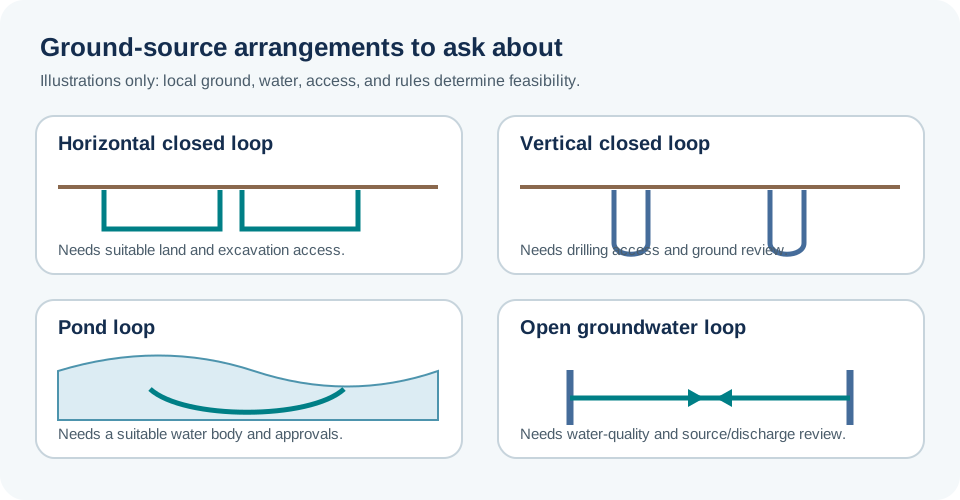
These are schematic arrangements, not a site-feasibility decision.
Keep the home-side questions in both surveys
Ask each designer to state the same design conditions and services. A useful comparison includes a room-by-room heat-loss basis; the outdoor design temperature; the intended rooms and domestic-hot-water scope; the indoor distribution and its operating temperatures; the equipment model and matched indoor components; backup and control assumptions; and the work included in the estimate. For ground-source, add the proposed loop type, sizing assumptions, drilling or excavation access, water or geology checks, and who confirms local requirements. For air-source, add the selected outdoor location, sound and drainage treatment, and performance data at relevant outdoor conditions.
Do not compare a quote that includes loop drilling with one that excludes it, or compare different heat loads and services as though the totals described the same system. Installed cost, running cost, and payback depend on the actual design, site, energy rates, maintenance, and what work is included. Neither source type has a universal cost or performance advantage for every retrofit.
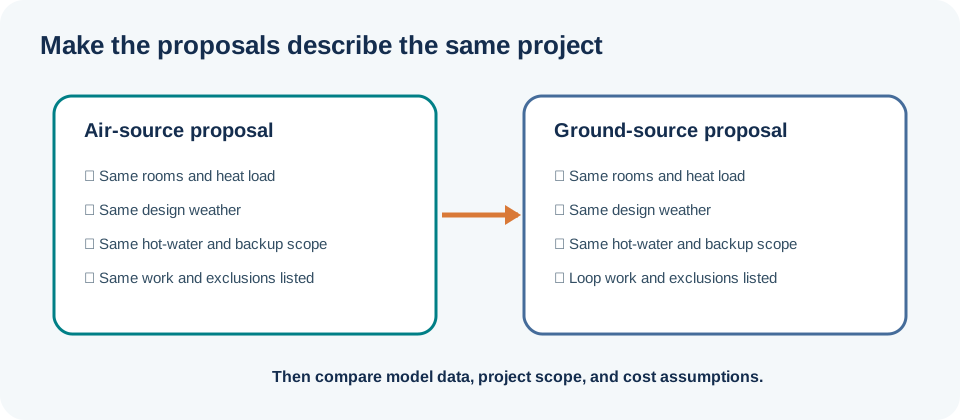
Match the project assumptions before comparing the proposals.
A practical first screen
An air-source investigation may be easier to advance when a suitable outdoor location is available and ground work is constrained. A ground-source investigation may be worth pursuing when the property can support a loop or water-source arrangement and the owner wants a proposal that accounts for that work. These are screening conditions, not recommendations. Local climate, system design, site constraints, and current product data can change the answer.
Before choosing, ask a qualified local designer to inspect the site and the indoor system. The next comparison is often how heat will reach the rooms: see ducted vs. ductless distribution and air-to-air vs. air-to-water delivery. If the project will retain existing heating equipment, define the whole-home or partial-load coverage goal as well.
Key points
- Air-source and ground-source describe the environmental heat source, not the indoor distribution.
- A ground-source proposal needs a site-specific loop or water-source assessment; an air-source proposal needs a suitable, serviceable outdoor location.
- Compare both options using the same load, rooms, services, design conditions, controls, and included work.
- No source label alone establishes suitability, cost, or operating performance for a particular home.
Sources and further reading
- Heat Pump Systems (primary source)
- Types of Ground-Source Heat Pumps (primary source)
- Ground-Source Heat Pumps (primary source)