 HeatPumpPath
Gas-Fired Absorption Heat Pumps: A Different Home Heating Architecture
Understand how a gas-fired absorption heat pump differs from an electric heat pump and a dual-fuel boiler arrangement.
In this guideJump to a section
Most familiar residential heat pumps use an electrically driven compressor. A gas-fired absorption heat pump uses a heat-driven refrigerant cycle instead: fuel supplies heat to the cycle, which also takes heat from an environmental source and delivers useful heat to the building. The architecture can still use electricity for pumps, fans, and controls. A gas-fired absorption unit is not the same arrangement as an electric heat pump paired with a separate gas boiler.
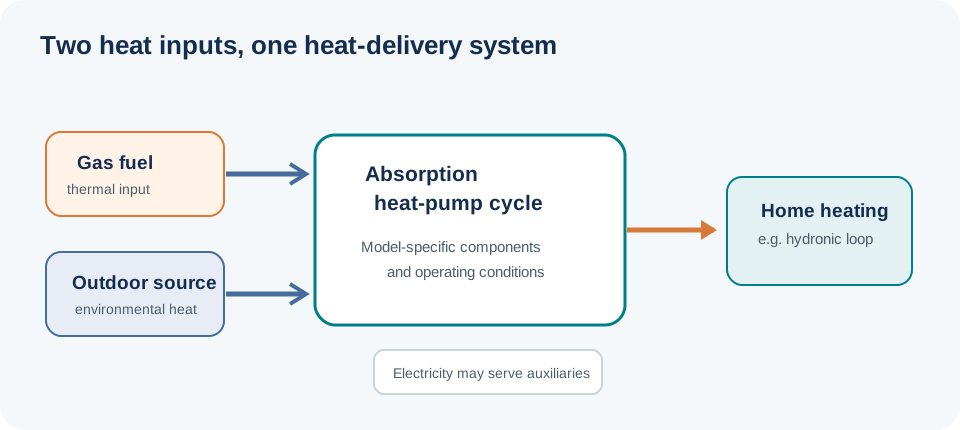
This is a system-level schematic, not a model piping diagram.
The name describes how the cycle is driven
In an absorption cycle, a working refrigerant and absorbent move through a heat-driven process instead of relying on the same compressor arrangement used by a typical electric heat pump. The fuel is one input; environmental heat is another. The delivered heat and the amount of electricity used depend on the model, operating conditions, and system boundary. The U.S. Department of Energy’s residential HVAC research overview describes absorption heat pumps as a distinct technology family; its 2012 discussion is historical context, not evidence of today’s product range.
Some residential gas-fired absorption products are air-to-water designs that connect to a hydronic loop. That makes the indoor-side questions familiar even when the heat-pump cycle is different: what rooms are served, what water temperatures the emitters need, whether hot water is included, and what controls or backup are part of the proposal. Do not infer these details from “gas-fired” or “absorption.”
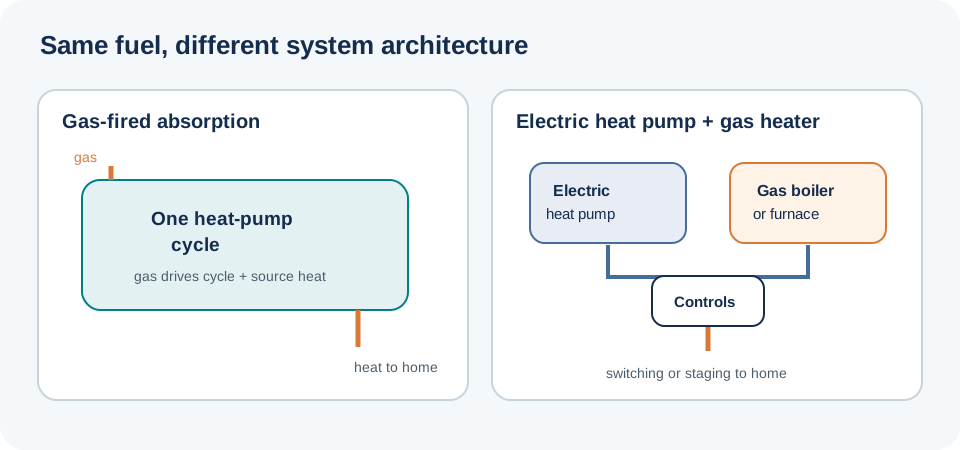
The two systems use fuel in different places and need different comparisons.
Distinguish absorption from dual fuel
| Arrangement | Where the gas is used | What the proposal should show |
|---|---|---|
| Gas-fired absorption heat pump | As heat input that drives the absorption cycle inside the heat-pump system | Environmental heat source, model ratings, gas and electric inputs, water or air delivery, and controls |
| Electric heat pump with a gas boiler or furnace | In a separate heater that supplements or alternates with the electric heat pump | Each unit’s role, room coverage, control or switchover rule, and fuel/electric operating assumptions |
“Dual fuel” or “hybrid” generally describes a system with distinct heat sources coordinated by controls. It is not a synonym for the absorption cycle. A proposal may use both a gas-fired absorption unit and another heating source, but that is a separate configuration that must be described explicitly.
Treat product claims as model-specific
A September 2025 manufacturer submittal describes one U.S.-listed model, the Robur GAHP-AR Plus, with capacity data tied to stated operating conditions and separate gas and electric inputs. That is a useful example of the information to request, but one manufacturer’s data sheet does not establish current market breadth, independent field performance, or suitability for another product or home. Confirm that a model is currently offered and supported in the project location, and use its current installation and performance documentation.
For a fair comparison, request rated capacity and efficiency at conditions relevant to the home; the exact energy-input boundary; output-water temperatures and emitter assumptions; domestic-hot-water and cooling scope; electrical demand; venting and combustion requirements; sound and placement; maintenance; and any backup or control strategy. Compare against another system delivering the same rooms and services under the same design weather. Do not compare a rating at one condition with an annual household result or assume gas input makes the system’s operating cost lower.
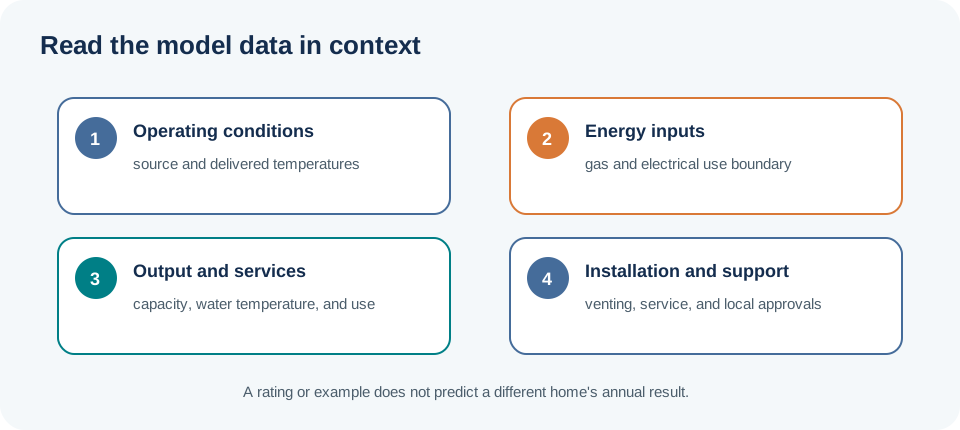
Use the current documentation for the exact model in the proposal.
Questions for a qualified local designer
- Is the proposed equipment an absorption heat pump or a separate electric heat pump plus fuel-burning heater?
- What are the current model number, local supplier, service plan, and documentation for the exact system?
- Which heat source does the unit use, and what are its gas and electrical inputs at the quoted operating conditions?
- Which rooms and services will it cover, and how does it connect to the home’s emitters and controls?
- What are the combustion-air, exhaust, gas-supply, and local approval requirements for this installation?
- What backup remains, and how are fault conditions handled?
The air-to-air vs. air-to-water guide explains the indoor delivery question. The whole-home vs. partial-load guide helps define room coverage and any retained heating system.
Key points
- Gas-fired absorption uses fuel to drive a heat-pump cycle; it is different from a separate gas boiler paired with an electric heat pump.
- Product availability, ratings, energy inputs, and service support must be checked for the exact current model and location.
- Compare systems only when they provide the same rooms and services under the same conditions.
- A gas-fired label does not establish lower cost, emissions, comfort, or suitability for a particular home.
Sources and further reading
- Residential HVAC Research Opportunities (primary source)
- GAHP-AR Plus Submittal, September 2025 (primary source)