 HeatPumpPath
Should I Keep My Existing Boiler or Furnace With a Heat Pump?
An existing boiler or furnace can have different roles beside a heat pump. Compare the intended service, control sequence, operating assumptions, and any local scheme rules before deciding.
In this guideJump to a section
Keeping an existing boiler or furnace can mean several different designs. It may provide supplemental heat in selected conditions, serve as backup if the heat pump is unavailable, or be retained for a separate purpose. A dual-fuel system switches between a heat pump and a combustion appliance; an air-to-water heat pump connected to radiators is a different arrangement. The proposal should state exactly which system serves each room and under what conditions.
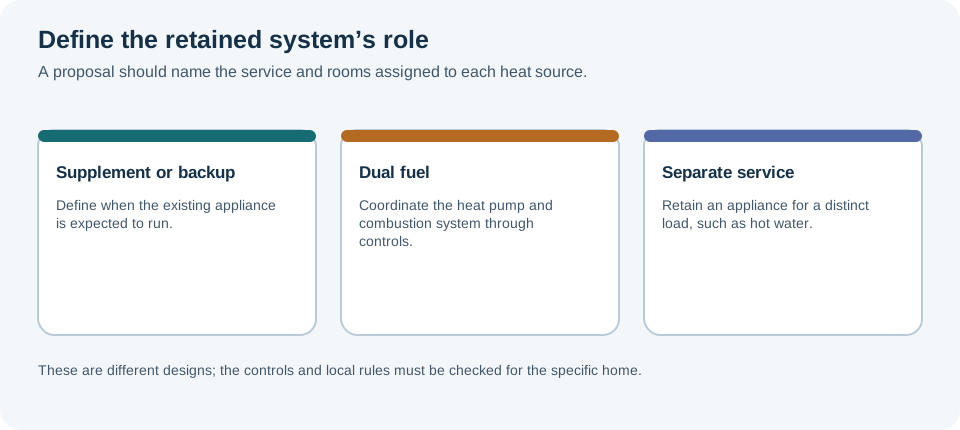
Ask what job the existing system will do
The first question is whether the heat pump is intended to serve the whole home or only part of it. If it is partial, identify the rooms or loads assigned to the old equipment. If both systems may serve the same rooms, ask whether they alternate, whether one supplements the other, and which thermostat or controller makes that decision. A boiler retained for domestic hot water is also a separate service decision from space heating.
The design should connect room heat loss, the heat pump’s available output, local winter conditions, distribution, and the retained system’s condition. A contractor may assess operating costs using current energy prices and equipment performance, but an old boiler label or a simple fuel-price comparison cannot establish which system is cheaper to run. Request the assumptions and any changeover logic in writing, including what happens if a component fails.
Require a written control sequence
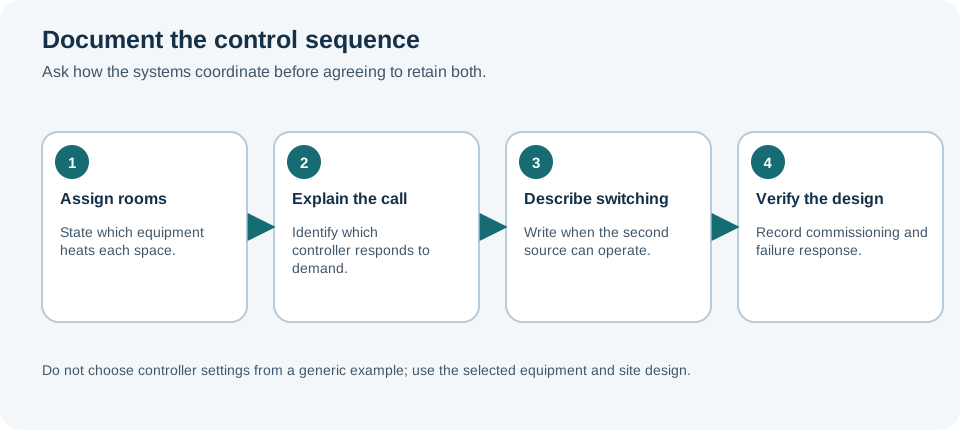
The control plan should explain which equipment receives a call for heat, which rooms it serves, how thermostats interact, when the retained system starts or stops, and how the heat pump resumes operation. Ask what commissioning checks verify that the two systems do not work against each other and that the selected rooms receive heat. Do not set a changeover temperature or rewire thermostats based on a general online example; the correct sequence depends on equipment, controls, local design, and the home.
Keeping old equipment also has practical costs: service, fuel or electricity use, repairs, space, and the possibility that an aging component may fail later. Compare those costs with the scope and disruption of replacing it. Ask the installer to identify equipment included in the design, items left in place, maintenance responsibilities, and the plan if the retained appliance fails.
Check local program conditions separately
Technical suitability and program eligibility are different questions. In England and Wales, the Boiler Upgrade Scheme’s current installer guidance describes scheme-specific requirements for the funded heat pump and supplementary heating. It says a funded heat pump must be sized to meet the property’s full space-heating needs, and fossil-fuel supplementary heating is not allowed under the scheme. These are scheme conditions for England and Wales, not universal design rules for the USA, Canada, Scotland, or all UK projects. Check the live Ofgem installer guidance before relying on eligibility details.
Compare proposals by asking for the heat pump’s intended role, rooms served, output assumptions, backup or supplementary source, controls diagram, operating-cost assumptions, and local program basis. If the configuration adds a ductless mini-split to a central system, see using a mini-split alongside existing central heating. A qualified local professional should assess the home, equipment, electrical and fuel services, controls, and applicable requirements before you decide what to retain.
Sources and further reading
- Boiler Upgrade Scheme (BUS) — Installers (primary source)
- Hybrid heat pumps (authoritative-secondary source)
- Controls for a Heat Pump With Secondary Heating for Contractors (primary source)
- HP RTU Switchover Temperature Guidance (primary source)