 HeatPumpPath
Can I Use My Existing Gas Furnace Ducts for a Heat Pump?
Existing forced-air ducts may be reusable, but the furnace label does not establish that they can deliver a heat pump’s output. Learn what a room-by-room design and duct assessment should cover.
In this guideJump to a section
A heat pump may use the forced-air ducts that served a gas furnace, but the old furnace’s size and the presence of supply registers do not show that the ducts can deliver the new system’s heat to every room. The equipment and the distribution network need separate checks.
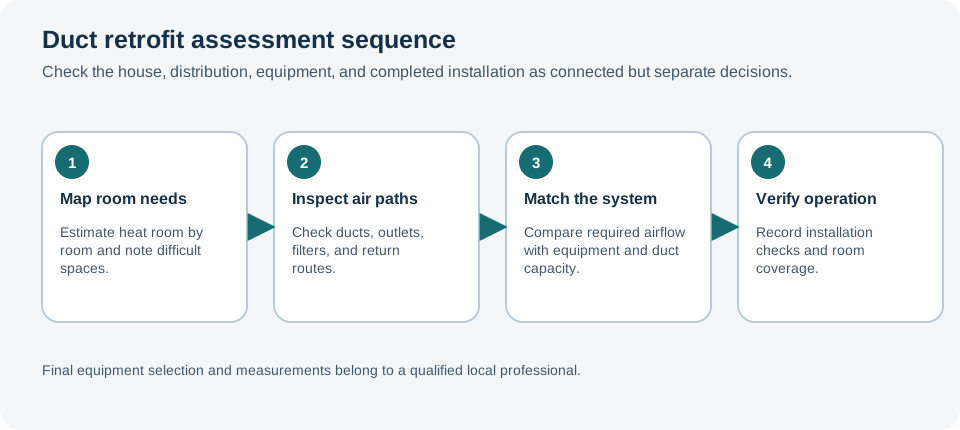
Start with room needs and the duct network
Ask the designer to calculate the home’s heating needs room by room using the method applicable where you live. The calculation should identify rooms that lose more heat, changes to the home since the furnace was installed, and the local winter conditions used in the design. A furnace capacity label is not a substitute for that assessment: a heat pump has different operating characteristics, and an oversized or undersized old furnace does not define the new equipment choice.
The duct review should follow the air path through the home. It can include visible condition, disconnected or crushed sections, insulation, leakage, supply outlets, filters, and the route by which air returns from rooms to the equipment. A closed bedroom door can restrict return airflow if the room has no suitable return path. The contractor should determine whether the existing layout can meet the new design airflow without unacceptable noise or room-to-room imbalance. There is no single homeowner measurement that establishes duct suitability.
A U.S. contractor may describe a room-load calculation using Manual J and may measure duct pressure or airflow during the design and commissioning process. Those names and practices are U.S.-specific examples, not rules for the UK or Canada. In any location, ask the installer to identify the local design method and to state the proposed room loads, equipment output, required airflow, and tests in the written proposal.
Decide what to do with each part of the system
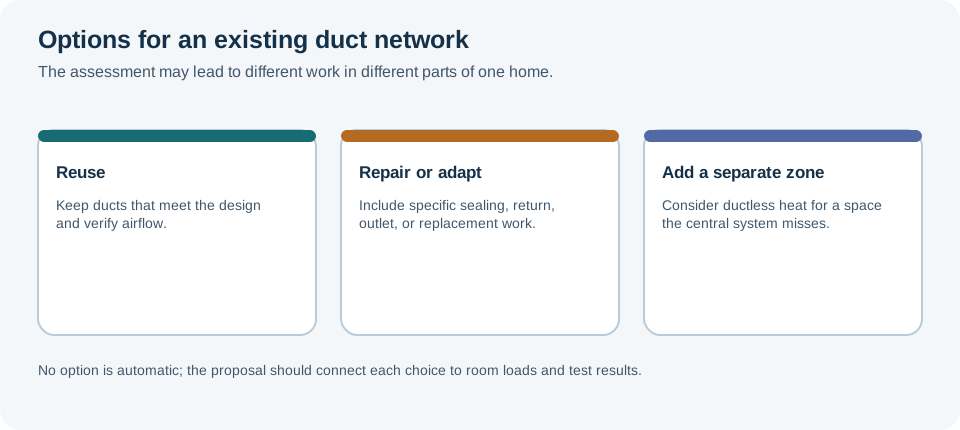
Depending on the assessment, a proposal may reuse sound ducts, repair or seal selected sections, change returns or outlets, or replace parts of the network. If one addition or remote room is poorly served, a separate ductless unit may be considered for that space; it needs its own room-coverage and controls plan. A new ductless unit should not be assumed to fix an airflow problem elsewhere in the house.
If the gas furnace will remain, ask what role it has and how its controls interact with the heat pump. A system that switches between heat sources needs a written sequence, clear thermostat responsibilities, and a commissioning check. Retaining the furnace is a separate design and local-program question; duct reuse alone does not establish whether a particular arrangement is permitted or economical.
Compare proposals on the same scope
Ask each contractor to show which rooms the heat pump is expected to serve, the room-load assumptions, the proposed equipment’s capacity at local design conditions, and the planned duct inspection or measurements. The proposal should list repairs, sealing, return-path work, electrical changes, and exclusions rather than treating the existing system as automatically ready.
Request the commissioning results that demonstrate the installed system meets the design. In the United States, ENERGY STAR’s quality-installation guidance calls for equipment sizing based on the home and airflow checks against manufacturer specifications; it does not set a universal airflow threshold for every house. Ask the installer to explain what values apply to the selected model and where the results will be recorded.
Do not open a furnace, alter ductwork, or attempt pressure or combustion tests yourself. Use the assessment to compare the scope and evidence in professional proposals, then ask for any unresolved room-coverage concern to be addressed before choosing equipment.
Sources and further reading
- Air-Source Heat Pumps (primary source)
- HVAC Quality Installation (primary source)
- CEE Duct Retrofit Decision Guide (primary source)
- Building America Technical Support (primary source)