 HeatPumpPath
Can an Air-to-Air Heat Pump Cool a UK Home?
Learn what reversible air-to-air heat pumps can offer for summer cooling in UK homes and what current modelling cannot predict for your property.
In this guideJump to a section
Some reversible air-to-air heat pumps provide summer cooling as well as space heating. Whether that cooling is useful in your home depends on which rooms the system can reach, how warm those rooms get, and how the equipment is designed and controlled. A heat-pump label by itself does not guarantee comfortable temperatures throughout a house.
What UK modelling can tell you
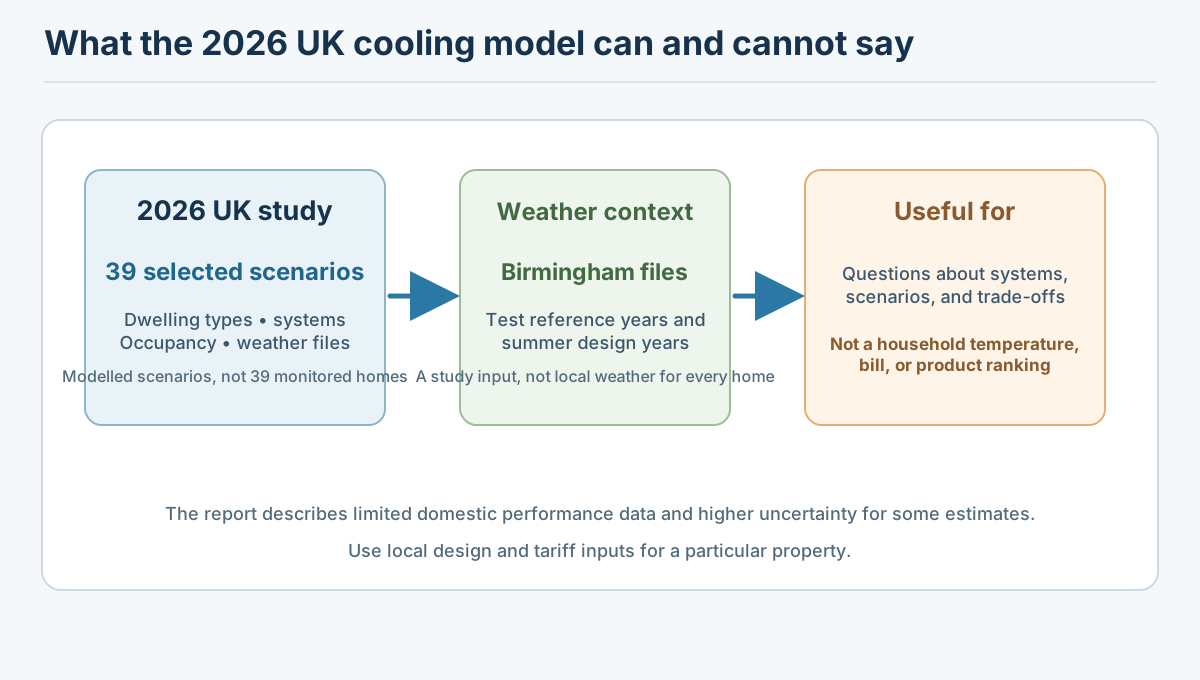
A 2026 Department for Energy Security and Net Zero report modelled reversible air-to-air heat pumps across 39 selected UK dwelling scenarios. The study found that cooling could help manage high temperatures in its modelled homes. It also says there is limited data on domestic air-to-air heat-pump performance and suitability in the UK, and cautions that its efficiency estimates are more uncertain than estimates for other systems.
The scenarios are not 39 monitored households. The report uses dwelling models, occupancy assumptions, and weather files located in Birmingham. It is useful for understanding questions that affect performance, but it cannot forecast the temperature or running cost for a home in another town, building, or household. Do not treat a modelled result as a product rating or a promise of summer comfort.
Check which rooms the system will cool
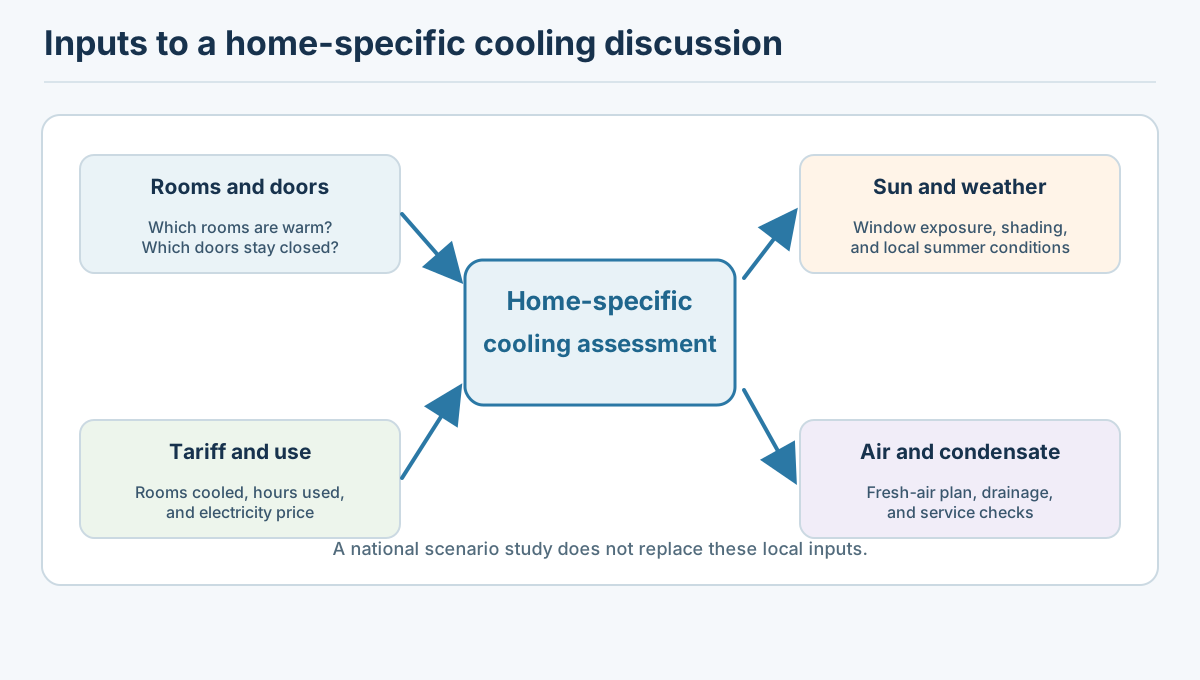
Air-to-air systems use indoor blower units to condition room air. Their reach depends on unit locations and the paths between rooms. A unit in an open living space may not adequately cool a closed bedroom or a room on another floor. Ask the designer to show which rooms are included in the cooling assessment, how door positions and room loads affect the result, and whether any transfer-air path is part of the design. For a room-by-room checklist, see Do ductless heat pumps cool a whole home?.
Write down which rooms become uncomfortable during warm weather and when it happens. Note large sun-exposed windows, the floor level, shading, and whether bedroom doors are usually closed. Those observations help a designer assess the home; they do not replace a cooling-load calculation.
 If you live in England, the home-cooling checklist covers seasonal overheating cues and preparation. Its guidance is specific to England.
Include cooling in the design and cost discussion
Ask whether the proposal is designed to cool the rooms you care about, not just to meet a winter heating target. The installer should explain the cooling assumptions, equipment controls, indoor-unit locations, and how performance is expected to change when cooling demand is modest. Ask how condensate will be managed and which checks will confirm that the installation operates as designed.
Cooling uses electricity. Your cost depends on the system, the rooms cooled, how often it runs, and your electricity tariff. The DESNZ study compared modelled operating costs under a fixed-price tariff; it does not provide a current bill estimate for your household. Ask for the assumptions behind any estimate and compare proposals using the same cooling needs and tariff.
Also check what provides fresh air. An indoor heat-pump unit conditions air already in the room; it does not automatically supply planned outdoor-air ventilation. Ventilation, cooling, and moisture control can interact, but they are separate design questions. See heat pumps, ventilation, and HRV/ERVs in an older home for the distinction.
Questions to take to an installer
- Which rooms are included in the cooling design, and what assumptions were made about doors, occupancy, windows, and shading?
- How does the equipment operate when cooling demand is low, and what controls are included?
- What electricity use and tariff assumptions are behind the cost estimate?
- How are fresh-air ventilation and condensate handled?
Reversible air-to-air heat pumps can provide cooling, but the value for a particular home depends on its layout, local weather, cooling needs, and system design. Use the UK modelling as context for questions—not as a substitute for a home-specific assessment.