 HeatPumpPath
Keeping an English Home Cool During Hot Weather
Use England's public-health overheating guidance to prepare shading, ventilation, and heat-pump cooling questions for your home before a hot spell.
In this guideJump to a section
Heat-pump cooling can be part of a home’s summer plan, but it is not the only factor that affects overheating. Window exposure, shading, ventilation, the floor plan, and how people use the home also matter. The UK Health Security Agency’s checklist applies to England and offers seasonal preparation advice; it is a risk-awareness guide, not a cooling-load calculation or a rating of an individual home.
Look for cues that deserve attention
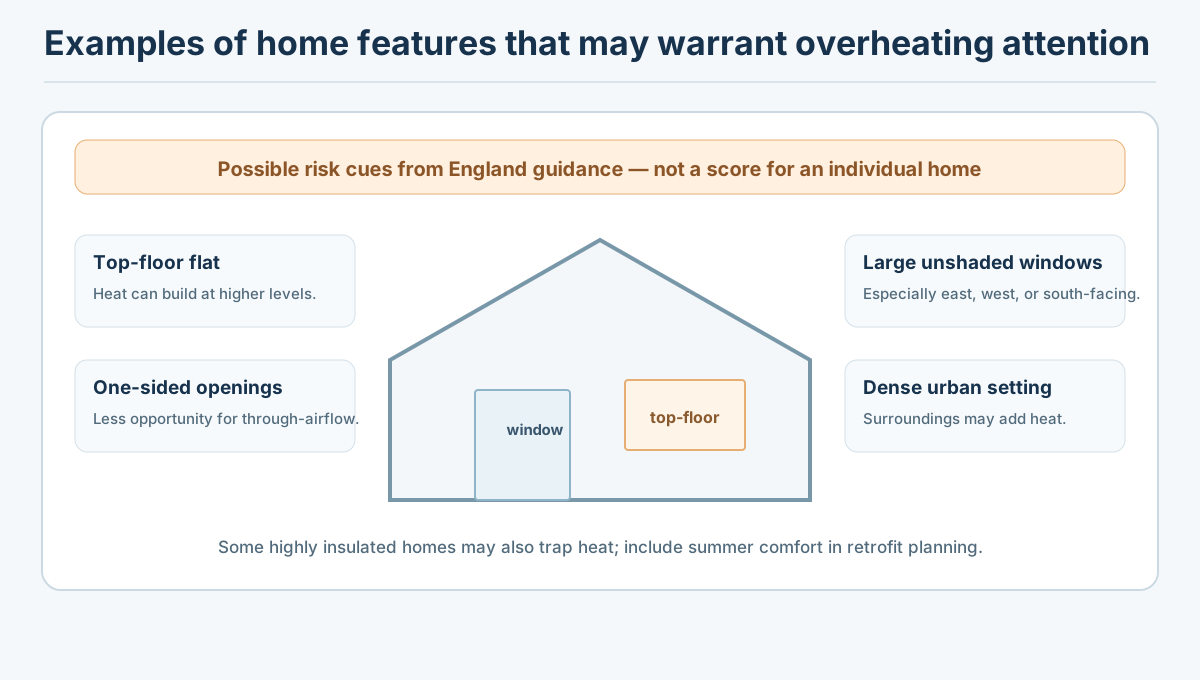
The England checklist identifies examples of homes that can be more likely to overheat during warmer weather: top-floor flats, homes with opening windows on only one side, little external or internal shading, and large unshaded east-, west-, or south-facing windows. Dense urban surroundings, restricted windows, and some highly insulated or energy-efficient homes can also merit attention. These are possible risk cues, not a score or a guarantee that a home will overheat.
If you are planning insulation, new windows, or other refurbishment, include summer comfort in the conversation before the work is specified. Some energy-efficiency changes may alter how heat enters, leaves, or moves through a home. The checklist recommends asking installers how to reduce overheating as part of refurbishment; it does not say to avoid insulation or to assume that a heat pump alone will solve the issue.
Prepare the home before a hot spell
Consider whether curtains, blinds, shutters, or external awnings can shade sun-exposed windows. If a ventilation system has a summer mode, check its instructions and ask a qualified installer whether it is configured for the home. Think about which rooms remain comfortable at night and where people can rest if a room becomes too warm.
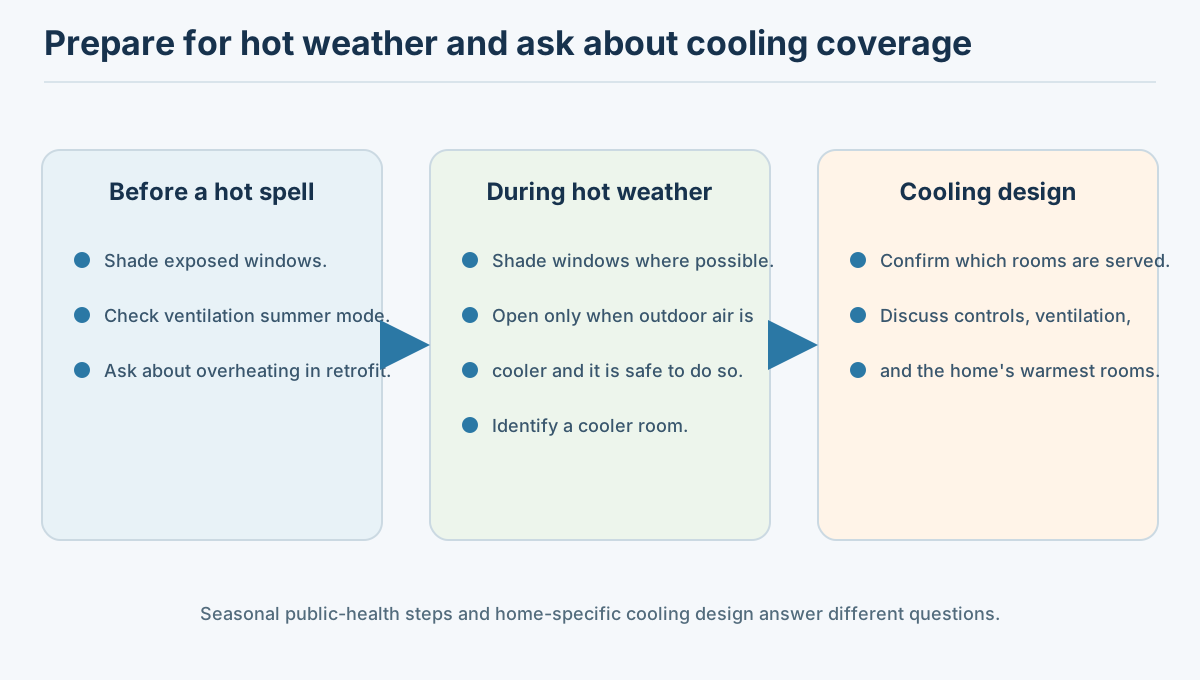
During hot weather, the checklist advises shading windows where possible and opening them when outdoor air feels cooler, such as at night, when it is safe to do so. Window security, noise, pollution, insects, and outdoor conditions can affect whether that is practical. Do not leave a window open where doing so creates a safety risk, and do not assume that ventilation is always cooler than the indoor air.
Ask how the heat pump fits the cooling plan
A heat pump can cool only as designed by the selected system and its controls. Ask the installer which rooms receive active cooling, how air reaches rooms behind closed doors, and how the proposal addresses the home’s warmest rooms and peak sun exposure. A temperature reading in one room does not establish comfort everywhere. Also ask how cooling operation interacts with ventilation and moisture control; these are related but different functions.
If you are comparing proposals, ask for the cooling assumptions and room coverage in writing. Discuss shading and ventilation opportunities alongside equipment selection rather than treating a larger unit as a substitute for a home-specific design. For the technical difference between cooling and moisture removal, see heat-pump cooling and humidity in a hot-humid home. If a ductless system is proposed, check its whole-home room coverage.
Keep the location and health boundary clear
This guide summarizes an England checklist and does not establish local rules for every UK nation. The risk examples and actions are general and seasonal; they do not forecast indoor temperatures or compare the performance of passive measures with air conditioning. For current health advice during hot weather, use the linked government guidance and NHS resources. A qualified local professional should assess cooling capacity, ventilation controls, and building work for the specific home.
Sources and further reading
- Beat the heat: keep cool at home checklist (primary source)