 HeatPumpPath
Heat Pumps, Ventilation, and HRV/ERVs in an Older Home
Learn how heat pumps, fresh-air ventilation, air sealing, and heat- or energy-recovery ventilators do different jobs in an older home.
In this guideJump to a section
A heat pump can heat or cool indoor air without supplying outdoor air. That distinction matters in older homes, especially where there are no ducts, fuel-burning appliances, or planned air-sealing and insulation work. A heat pump, a ventilation system, and moisture control may need to work together, but they are not interchangeable.
What each system does
An air-source heat pump moves heat between indoors and outdoors. Its indoor unit or duct system conditions air already inside the home. Unless a particular installation includes a designed outdoor-air connection, this circulation does not establish a fresh-air ventilation rate.
Ventilation brings outdoor air into occupied spaces and removes indoor air through planned openings or mechanical equipment. Natural ventilation, exhaust-only fans, supply systems, and balanced systems move air in different ways. Their results depend on the home, climate, occupants, air paths, and outdoor air quality. Health Canada describes those factors for Canadian homes; local requirements and suitable designs differ by jurisdiction (Health Canada, Ventilation and the indoor environment).
An HRV (heat-recovery ventilator) exchanges indoor and outdoor air while transferring heat between the outgoing and incoming air streams. An ERV (energy-recovery ventilator) also transfers some moisture. The names explain a function; they do not establish which system is right for a particular house.
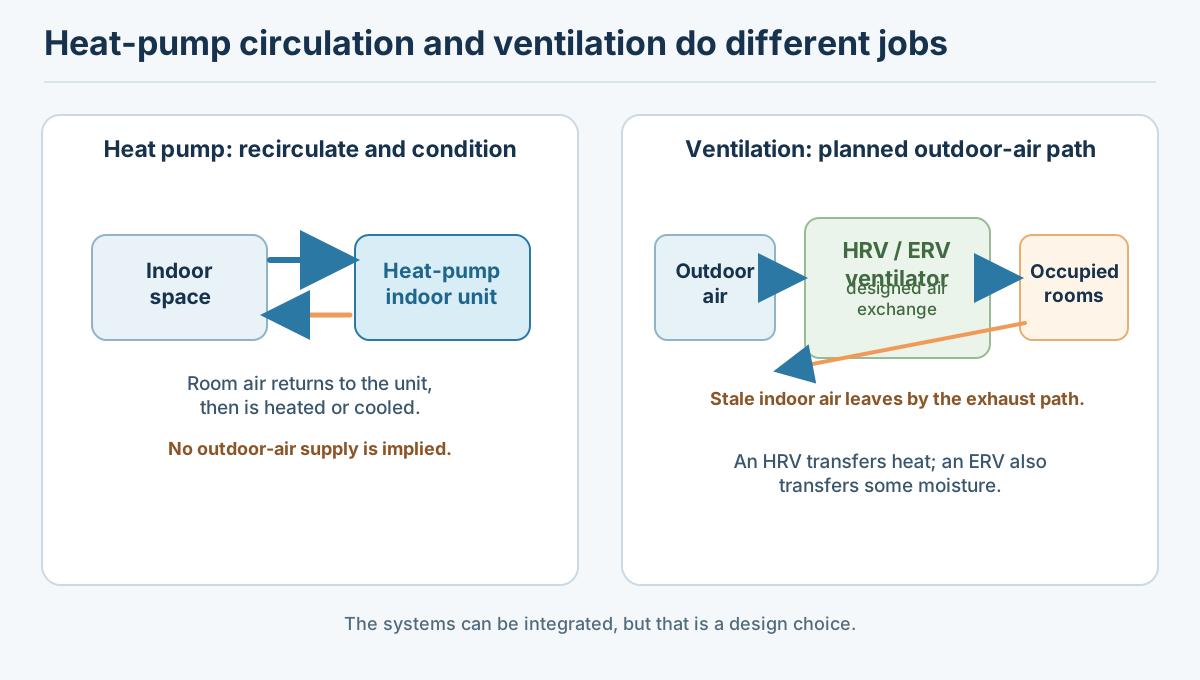 Natural Resources Canada notes that climate, the home, and household needs affect that choice (NRCan, What’s a heat/energy recovery ventilator?).
Why older homes need a whole-home view
An older home may rely on a mixture of window opening, bathroom and kitchen fans, incidental leakage, chimneys, or later additions. Air does not necessarily reach every room equally: closed doors, long corridors, separate floors, and rooms far from a supply or exhaust path can matter. A heat pump in one room does not solve that distribution problem by itself.
Air sealing can reduce uncontrolled leakage, which may affect both comfort and the way outdoor air enters. DOE advises assessing fresh-air needs and combustion-appliance ventilation alongside air sealing, rather than treating the two as unrelated tasks (DOE, Consumer Guide to Air Sealing the Home). For a focused checklist on this decision, see Does an older home need more ventilation after air sealing?.
The same change can affect moisture and cooling. In humid weather, outdoor air may add moisture; in other conditions, air movement and humidity behavior differ.
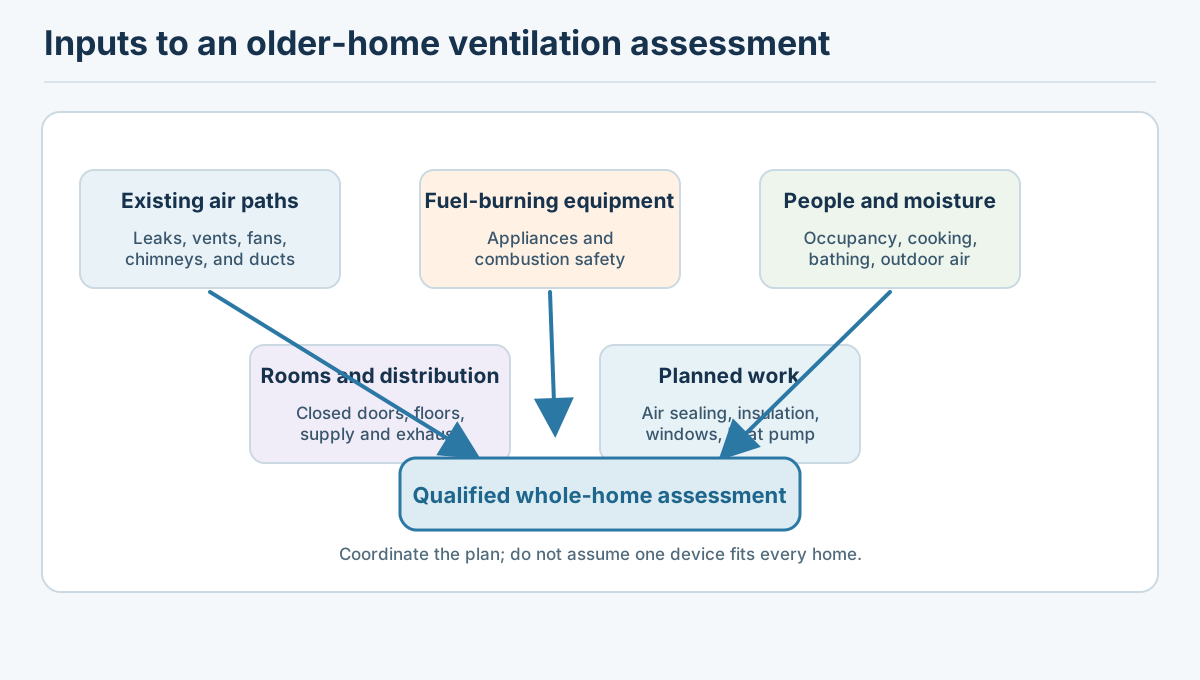 Insulation, windows, occupancy, cooking and bathing, outdoor pollutants, existing exhaust fans, and combustion appliances all belong in the assessment. A ventilation system should not be chosen from the age of the home or heat-pump type alone.
Questions for a local building or HVAC professional
Before combining a heat pump with ventilation or envelope work, ask:
- Does this heat-pump configuration bring in outdoor air? If so, through which equipment and into which rooms?
- What ventilation system and air paths already exist, and how will airflow to closed rooms be assessed?
- Are fuel-burning appliances, fireplaces, or large exhaust fans part of the safety review before air sealing?
- How do climate, moisture sources, outdoor air quality, and planned insulation or window work affect the ventilation approach?
- If an HRV or ERV is proposed, how will it be sized, balanced, commissioned, filtered, and maintained?
- Which local rules apply to this home and scope of work?
Do not treat “heat pump installed” as proof that the home has adequate fresh-air ventilation, and do not assume that adding an HRV or ERV automatically fixes humidity or air quality. Design, combustion safety, and local compliance require qualified assessment. If the planned work includes air sealing, start with the ventilation-after-air-sealing checklist.
Sources and further reading
- Ventilation and the indoor environment (primary source)
- What’s a heat/energy recovery ventilator and why do I need one? (primary source)
- Consumer Guide to Air Sealing the Home (primary source)