 HeatPumpPath
Does an Older Home Need More Ventilation After Air Sealing?
Understand why air sealing changes the ventilation question and what homeowners should have assessed before tightening an older home.
In this guideJump to a section
Air sealing can reduce uncontrolled air leakage, but it does not produce one automatic answer about how much ventilation a home needs or which system to install. The useful question is what outdoor-air and combustion-safety provisions the home needs after the planned work, given its existing systems, occupants, climate, and local requirements.
The U.S. Department of Energy advises homeowners to consider air sealing and ventilation together. Its consumer guide says the first step is to determine fresh-air needs and account for fuel-burning appliances, then use an appropriate home assessment to plan the work (DOE, Consumer Guide to Air Sealing the Home). The U.S. Environmental Protection Agency likewise warns that energy upgrades can affect indoor air quality when an appropriate assessment is not made before work begins (EPA, Protect Indoor Air Quality in Your Home).
Why the answer depends on the home
Older homes may have a mix of leakage, window opening, kitchen or bathroom exhaust, chimneys, and mechanical ventilation. Leakage is not a reliable way to deliver a known amount of fresh air to every occupied room. Air sealing changes those paths, while insulation and window work may change temperatures and surface conditions. Occupants, cooking and bathing, fuel-burning appliances, outdoor pollution, and room layout also affect the assessment.
This does not mean every air-sealed home needs an HRV or ERV, or that opening windows is always sufficient. Health Canada describes airtightness, occupancy, season, climate, air distribution, and outdoor pollutants as factors in Canadian ventilation decisions. Its guidance is Canadian context, not a universal code rule. Requirements and acceptable approaches differ across the United States, Canada, and the United Kingdom, and within each country.
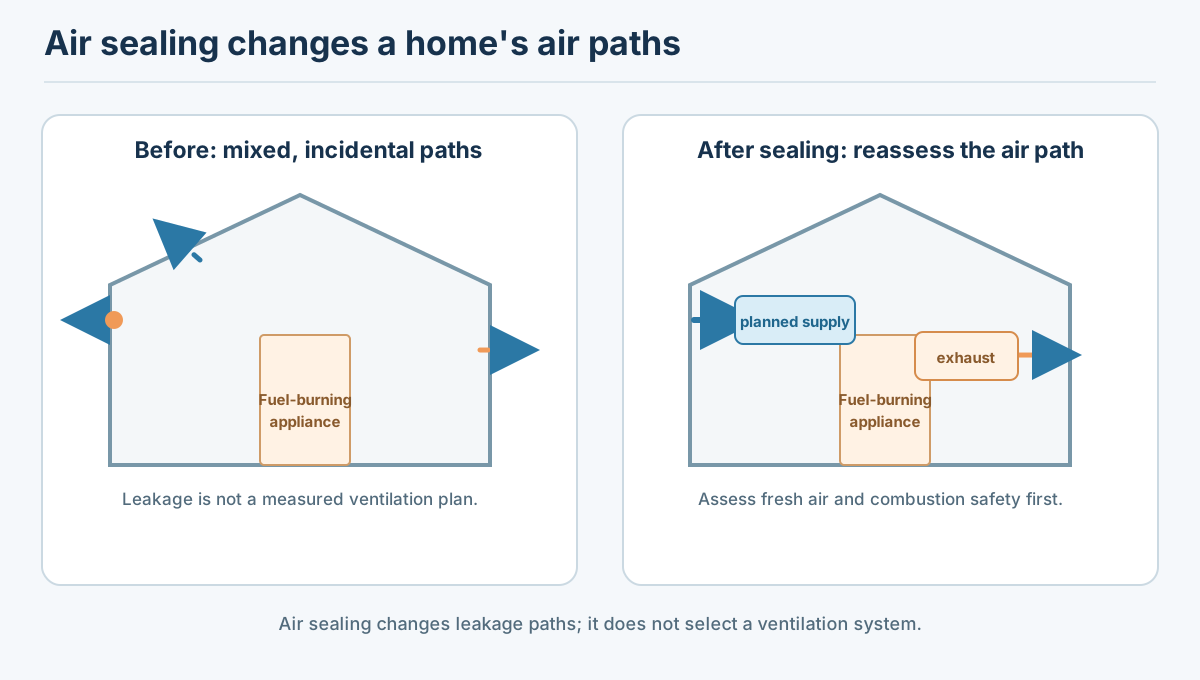
What to assess before the work
Ask a qualified home-energy or HVAC professional to review the home and planned work as a whole. Useful questions include:
- What ventilation equipment, exhaust fans, vents, and outdoor-air connections already exist, and which rooms do they serve?
- Are there furnaces, boilers, water heaters, fireplaces, or other fuel-burning appliances whose safe operation must be considered before leakage paths change?
- What air-sealing, insulation, window, or heat-pump work is planned, and how could those changes affect air movement, moisture, and cooling?
- Would an airtightness or blower-door assessment help characterize the home? What will its results tell the designer, and what additional evaluation is needed?
- How will fresh air reach occupied rooms, including bedrooms with closed doors?
- If mechanical ventilation is proposed, how will airflow be measured, balanced where relevant, commissioned, and maintained?
- Which current local building and safety requirements apply to this property and project?
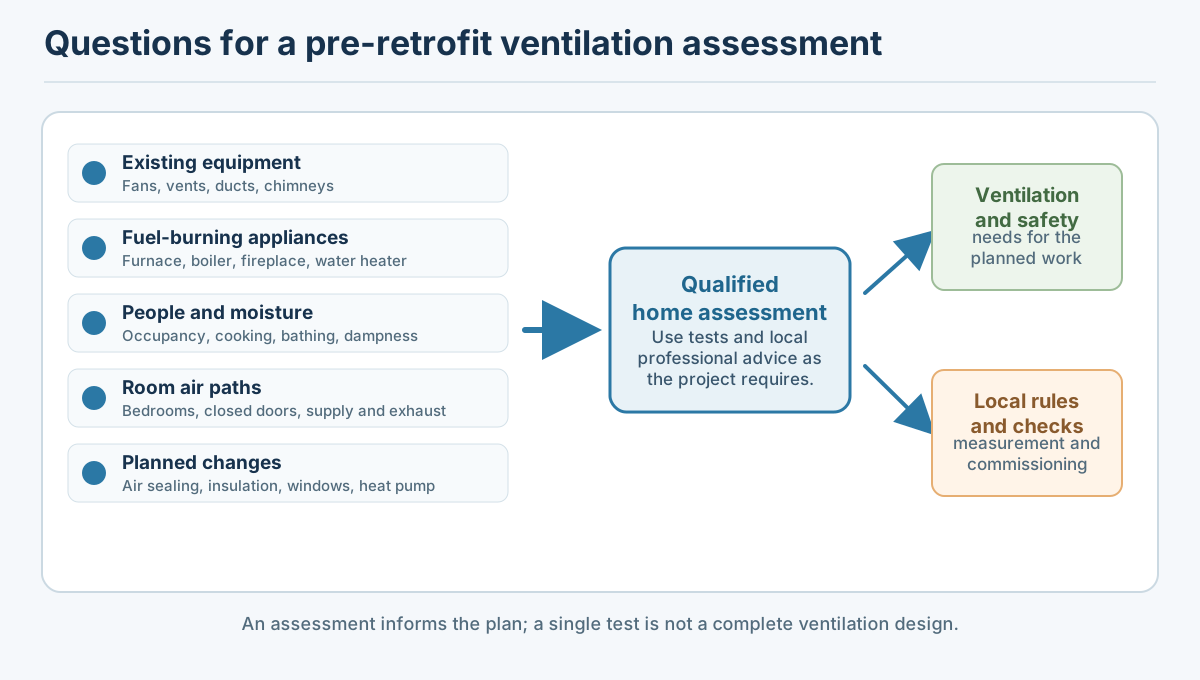
DOE identifies blower-door testing and thermal imaging as tools a qualified assessor may use to find leakage and evaluate a home. A test can inform the plan, but it is not by itself a ventilation design or a combustion-safety approval.
Ventilation options are not interchangeable
Window opening and other natural air paths vary with weather, outdoor air quality, noise, security, and occupant habits. Exhaust-only systems remove air and rely on replacement air entering through other paths. Supply and balanced systems use different arrangements to move outdoor and indoor air. HRVs transfer heat between outgoing and incoming air; ERVs also transfer some moisture. Each approach has design, operating, and maintenance considerations.
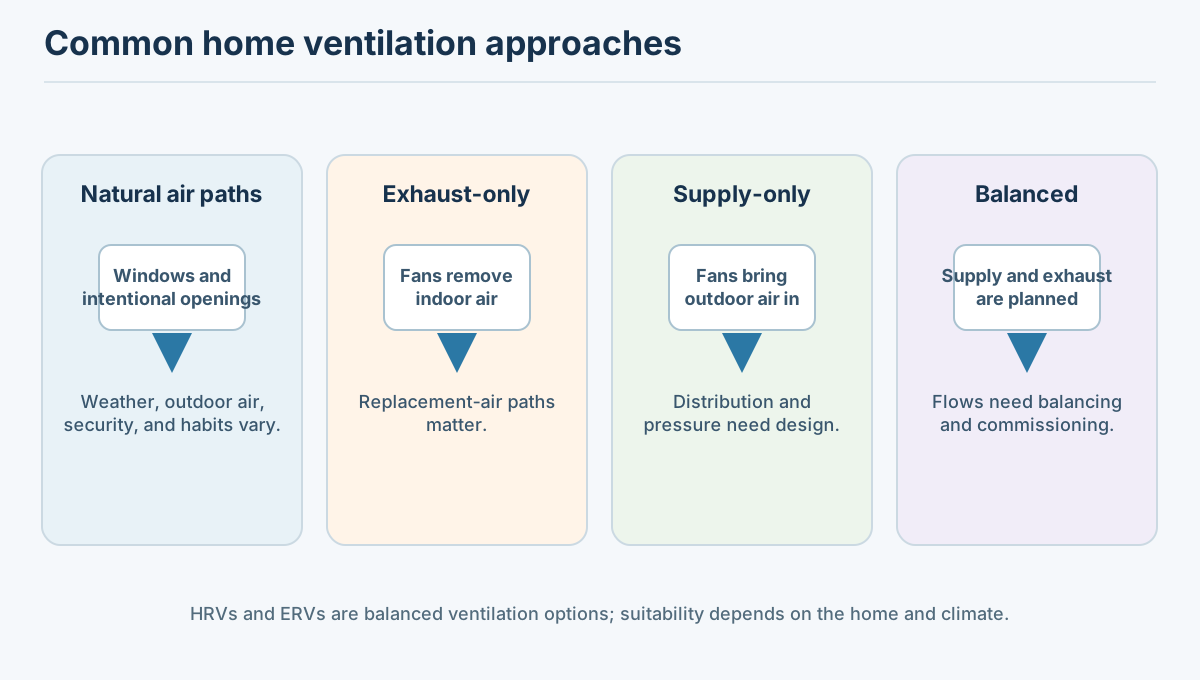
The right system cannot be chosen from the home’s age alone. In particular, do not block vents or alter a flue, chimney, or combustion-air opening as part of a DIY sealing job. Air sealing near fuel-burning equipment needs qualified safety advice. Persistent dampness or moisture entry also needs investigation of its cause, not just the purchase of a ventilation device.
England government guidance for housing providers notes that some energy-efficiency work can reduce ventilation and calls for professional advice about whether ventilation is adequate or needs improvement. That document has a narrower housing-provider scope; it is a reason to check the local route, not a universal homeowner rule (GOV.UK, damp and mould guidance).
For the separate question of whether a heat pump supplies fresh air, see Heat pumps, ventilation, and HRV/ERVs in an older home. The goal is a coordinated plan for the actual home, not a generic ventilation prescription.
Sources and further reading
- Consumer Guide to Air Sealing the Home (primary source)
- Protect Indoor Air Quality in Your Home (primary source)
- Ventilation and the indoor environment (primary source)
- Understanding and addressing the health risks of damp and mould in the home (authoritative-secondary source)