 HeatPumpPath
Can a Heat Pump Work Without Backup Heat?
Separate the question of cold-weather heat capacity from fuel switching, emergency operation, and power-outage planning.
In this guideJump to a section
Sometimes a heat-pump system is designed to meet the home’s heating load without a second thermal heat source. That is a home-and-equipment design decision, not a promise that every heat pump can heat every house in every cold snap. It also does not answer whether the home has heat during an equipment failure or a power outage.
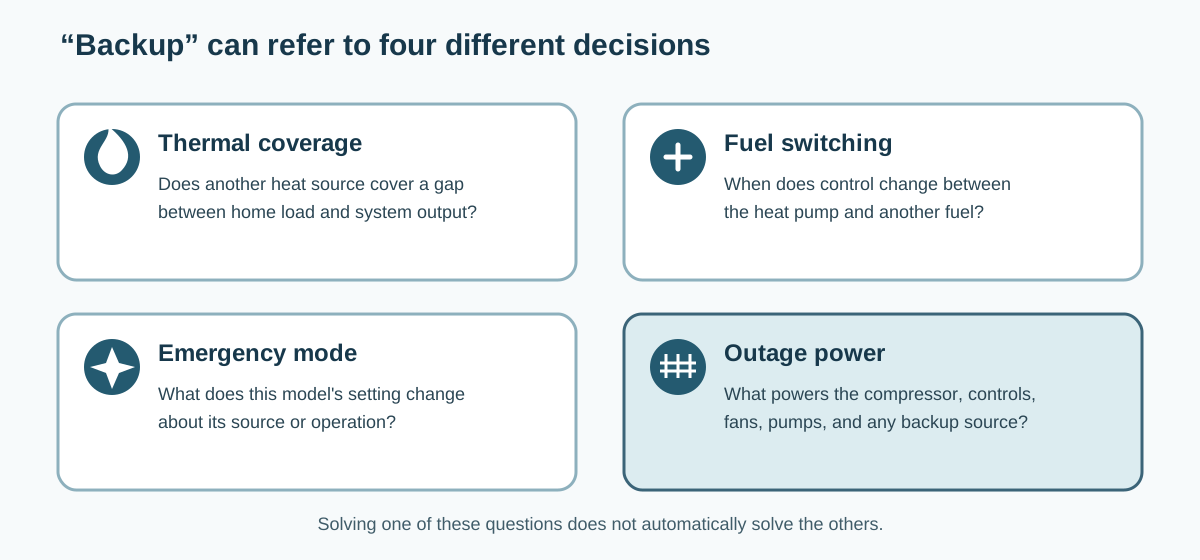
Ask what “backup” means
- Supplemental thermal heat adds heat when the heat pump’s available output is below the home’s load, or when the controls call for extra heat. It may be electric resistance or another source.
- Fuel switching changes which system heats the home. A dual-fuel design may switch between the heat pump and a retained furnace or boiler under stated control conditions. The switch point may reflect the design objective or operating costs; it is not automatically the home’s thermal balance point.
- Emergency heat is a control setting whose meaning varies by equipment. It may use another heat source or change how the system operates. Ask what the setting does on the proposed model rather than assuming it means a separate, fully independent heater.
- Outage power is a separate resilience question. A grid-connected heat pump needs electricity for its compressor and the controls, fan, or pumps that move heat. A thermal backup source can also depend on electricity or fuel availability.
What a no-supplement proposal must show
The designer should compare the home’s calculated room and whole-home heat losses with the available output of the exact proposed system at local design conditions. The calculation should reflect the home’s insulation, air leakage, planned envelope work, and the temperatures occupants expect in each room. The comparison also depends on how heat reaches each room: an outdoor unit’s output is not useful room heat if ducts, radiators, underfloor loops, or controls cannot deliver it as designed.
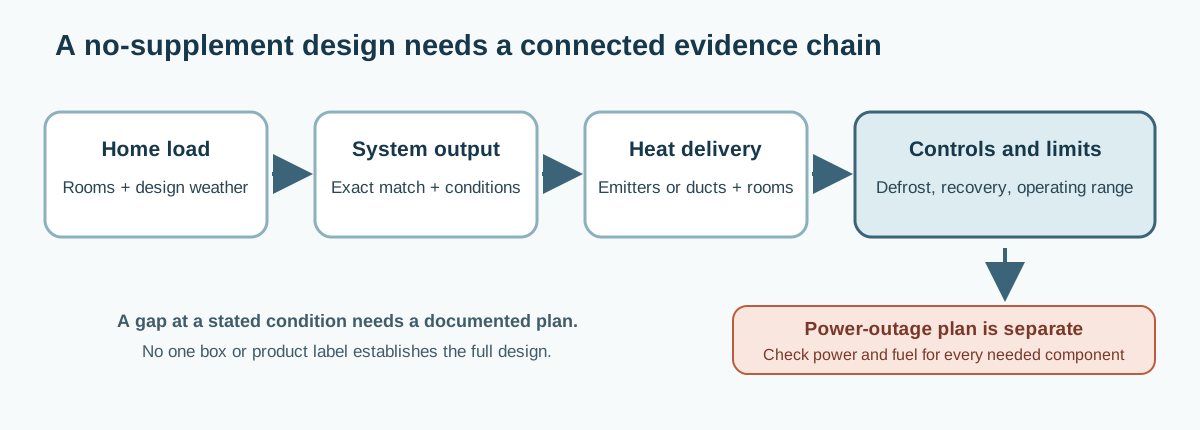
Ask for the home’s load report, design weather, matched-system performance data, distribution assumptions, and the proposed controls. Request the capacity and efficiency data at the design temperature, how defrost and operating limits are treated, and what happens when available heat falls short. If the system can modulate, ask how its minimum output behaves in milder weather too.
A product’s cold-climate label or ability to run below a test temperature does not establish that it can cover this home’s load at its local design condition. Conversely, an expectation that supplemental heat may be used does not by itself mean the heat pump is poorly selected. The goal matters: a system intended to supply most, but not all, of the heat has a different balance point from a design intended to cover the full design load. The right amount of backup also depends on expected recovery after a setback, how long the home must remain comfortable during unusually cold weather, and the controls’ ability to use the sources as intended.
Compare the options without assuming a winner
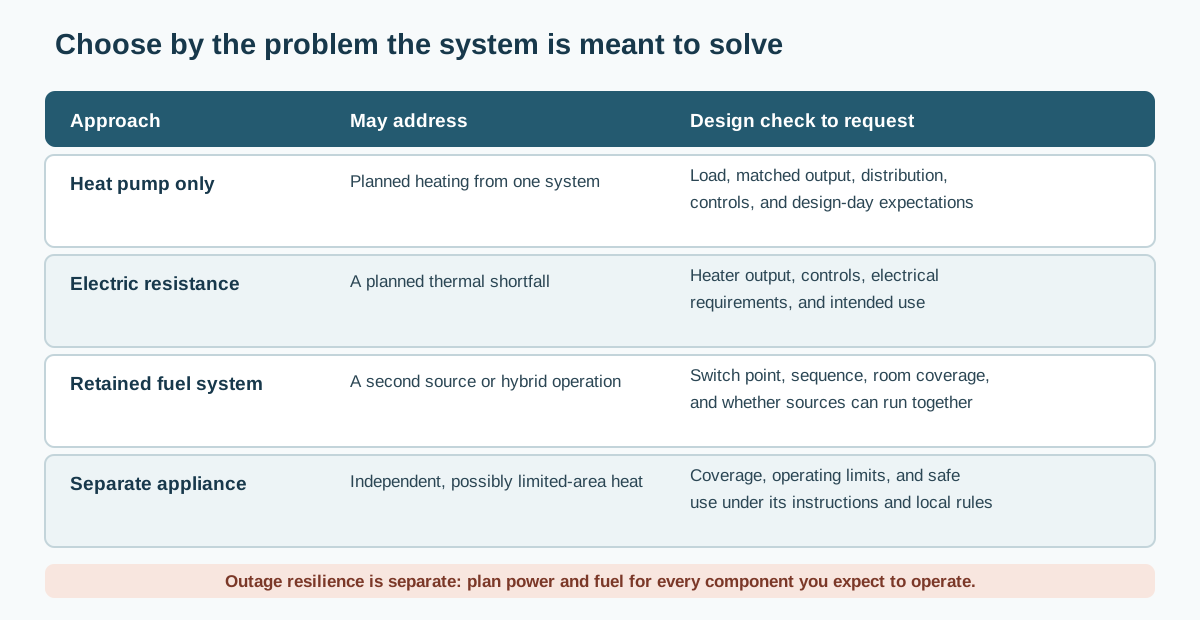
Heat pump only avoids a planned second thermal source, but the proposal should show how the selected system and distribution cover the design load and explain expectations outside those conditions.
Electric resistance backup can be designed to cover a heat-capacity gap, but its output, controls, electrical requirements, and intended use need to be stated. It does not provide heat during an outage unless a separate power arrangement supports the equipment.
Retained gas, oil, propane, or other fuel equipment in a hybrid system can provide another heat source. Ask when it switches on, whether both sources can operate together, which rooms each system serves, and how the control decision is made. A switchover for cost is not the same as one triggered by a capacity shortfall.
A separate appliance, such as a room heater or solid-fuel appliance, may serve only part of a home and may not be linked to the heat pump’s controls. Confirm its intended coverage and follow its manufacturer instructions and local safety requirements; do not count it as automatic backup unless the design explicitly provides that function.
No option answers every question. Discuss the trade-offs with a qualified local designer and confirm the electrical and fuel assumptions with the relevant professionals.
Use this proposal checklist
- Does “no backup” mean no electric resistance, no retained gas, oil, or propane equipment, or no second heat source of any kind?
- What are the home’s room and whole-building loads at the selected outdoor design condition, including planned envelope work?
- What can the exact system deliver at that condition, with the proposed indoor units, distribution, and controls?
- At what conditions does another heat source operate, can the sources run together, and what recovery behavior is expected?
- If the heat pump also supplies hot water, how does the design account for that separate demand?
- What outage duration and season should the household plan for, and which parts of the plan depend on electricity or fuel?
If the proposal does not answer these questions, it has not yet established a no-supplement design. Review the matched-system capacity data alongside the home load calculation.
Sources and further reading
- Cold Climate Heat Pump Sizing and Selection (primary source)
- Air-Source Heat Pumps (primary source)
- Heating and Cooling with a Heat Pump (primary source)
- MIS 3005-D: The Heat Pump Design Standard (primary source)