 HeatPumpPath
Heat Pump Running but the House Is Still Cold
Record where and when rooms stay cold, check safe user-accessible settings, and prepare a useful installer discussion without guessing at the cause.
In this guideJump to a section
A heat pump can be running while one room or the whole home remains below the temperature you want. The sound of the outdoor unit does not show whether enough heat is reaching every space. Cold rooms can involve controls, air distribution, room layout, heat loss, outdoor conditions, backup operation, or a service issue. Start by describing the pattern; a symptom alone does not identify the cause.
First identify where the problem occurs
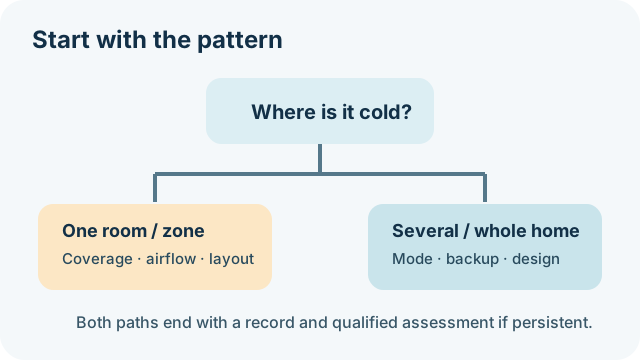
Is one room cold, several rooms cold, or the whole home below the intended temperature? Note when it began, whether it follows a weather change or a defrost event, and whether the system eventually reaches its setpoint. In a ductless home, note which indoor head serves each space and how far the affected room is from it. In a ducted or radiator system, identify the rooms or zones served by the same equipment or control.
Check only controls and items the manual identifies as user-accessible: confirm the intended mode and setpoint, look at the filter indicator or filter condition, and make sure visible vents are not blocked by furniture. Do not open equipment, adjust refrigerant or wiring, or change a boiler, furnace, or backup setting to test a theory. If a message or code appears, copy it exactly rather than trying to clear it.
Use the pattern to frame questions
If one room is affected, ask the installer to review how that room is served: head or grille placement, airflow, doors, zoning, radiator output, or room heat loss may matter. If many rooms are affected, ask whether the system is in the expected mode, whether backup is operating as intended, and whether the original design conditions still describe the home. These are investigation branches, not homeowner diagnoses.
ENERGY STAR’s guidance points homeowners toward proper sizing, system airflow, refrigerant charge, and duct evaluation as quality-installation topics for a contractor. Those are measured professional checks, not tasks to perform from a consumer checklist. Ask for the design load, room coverage plan, and commissioning or handover notes if they are available.
For a home with an enrolled U.S. smart thermostat, available device or utility-program history may be one record to compare when comfort changes. ENERGY STAR certification criteria describe device capabilities, not your household’s certification, enrollment, an actual event, or a cause. Check your own records before drawing a connection.
Keep a short comfort log
For several observations, record the date and time, outdoor conditions, rooms that feel cold, any displayed room temperatures, thermostat mode and setpoint, filter status, visible messages, and whether backup equipment appeared to run. Use the same thermometer locations if you compare readings. Note recent changes to schedules, doors, furniture, or the building, but do not make multiple control changes while trying to identify a pattern.
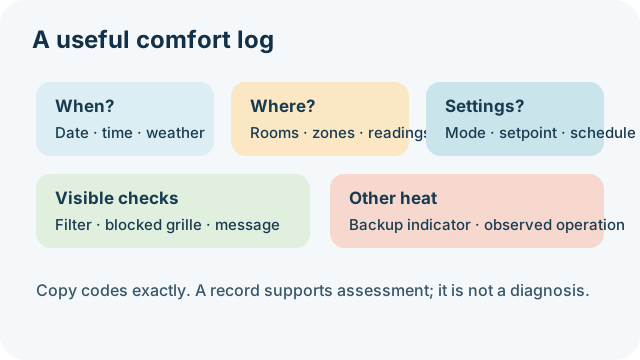
Bring the record to the installer. Ask what measurements would distinguish room coverage from system capacity or a control/service issue, and whether measured airflow, design load, and commissioning results can be reviewed. If the problem is paired with repeated outdoor ice, see the defrost guide; if the concern is cost, see how to compare high bills.
Escalate persistent problems
Request qualified help for persistent failure to maintain comfort, repeated backup operation, suspected electrical or combustion concerns, refrigerant-related symptoms, or a fault message. Seek urgent local assistance for an immediate safety hazard. The available evidence does not establish a universal room-temperature threshold or a single cause for a cold-home complaint.
Sources and scope
ENERGY STAR’s air-source and ductless guides give homeowner context. Its quality-installation checklist directs sizing, airflow, charge, and duct checks to contractors. Its smart-thermostat criteria do not establish that a specific home receives a utility event. Follow the manual and local professional advice for the installed system.
Sources and further reading
- Air-Source Heat Pumps (primary source)
- Ductless Heating & Cooling (primary source)
- HVAC Quality Installation (primary source)
- Smart Thermostats Key Product Criteria (primary source)