 HeatPumpPath
Heat-Pump Defrost and Outdoor Ice in Cold Weather
Learn why frost and defrost water can appear on an air-source heat pump, what to observe safely, and when persistent ice or storm damage needs service.
In this guideJump to a section
Frost on an air-source heat pump’s outdoor coil can be part of winter operation. When conditions call for it, the system runs a defrost cycle to clear frost; the unit may briefly change its operation, and meltwater or vapor may be visible. The timing and control logic depend on the equipment and weather. A brief event by itself does not establish a fault, and there is no universal duration or ice-thickness threshold for every model.
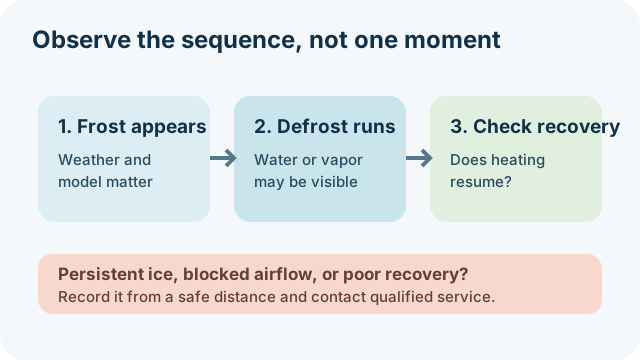
Observe the location and what happens next
From a safe position, note whether frost is on the coil, whether the system appears to complete a cycle and return to heating, and whether meltwater drains without creating a hazard. Record the outdoor temperature or weather, time, any error message, unusual noise, and whether indoor comfort recovers. Do not touch the fan, remove covers, scrape a coil, pour hot water, or change a control to force defrost.
Snow, debris, roof runoff, and refreezing water can affect airflow or drainage. Do not climb, reach through a guard, or move material close to an operating fan. If ice creates a walkway hazard or water is pooling, keep people away and ask a qualified professional to assess the drainage or placement rather than improvising a repair.
Separate ordinary frost from a severe-storm warning
One Carrier owner manual for split-system heat pumps using R-454B describes a separate heavy-snow or ice-storm condition: accumulation on top of the unit or on its fan blade may cause excessive vibration, damage, or reduced performance. For the equipment covered by that exact manual, it says turning the heat pump off and using available auxiliary heat may be appropriate until snow or ice has cleared. This is not a general instruction for other models, and the manual does not give a method for removing snow or ice. Check the unit label and applicable manual before relying on that example; do not reach into the unit.
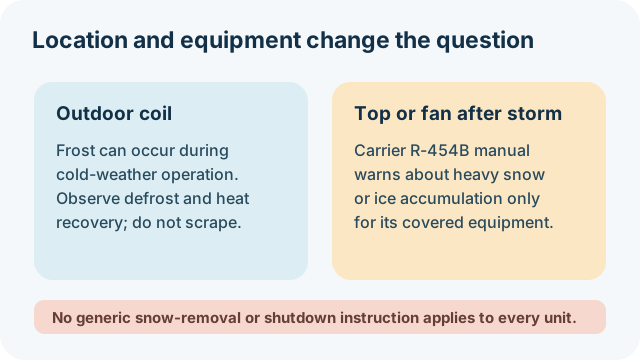
When to request service
Contact the installer or qualified service provider if ice remains across the coil, blocks airflow, repeatedly returns with poor heat recovery, causes unusual vibration, or accompanies a persistent loss of heat or an error. Provide the model, time, weather, photos taken from a safe distance, and what happened after the cycle. Do not diagnose a refrigerant, fan, sensor, electrical, or control fault from appearance alone.
If the problem is mainly a cold room, see how to document comfort symptoms. For routine filter and recordkeeping guidance, use the homeowner maintenance checklist. Snow clearance, drainage design, and equipment placement may require an installer’s site-specific assessment.
Sources and limits
Natural Resources Canada’s homeowner guide and ENERGY STAR’s ductless guidance describe heat-pump operation and outdoor airflow. The Carrier R-454B owner manual is the source for the severe-storm example above. Normal frost, a manual-specific warning, and a service diagnosis are different things; none gives a universal homeowner repair procedure.
Sources and further reading
- Heating and Cooling with a Heat Pump (primary source)
- Ductless Heating and Cooling (primary source)
- Owner’s Manual — Split-System Heat Pump Using R-454B Refrigerant (primary source)