 HeatPumpPath
Using an EnerGuide Evaluation to Plan a Heat-Pump Quote
Use the rating, Homeowner Information Sheet and Renovation Upgrade Report as context for a heat-pump conversation, while keeping an EnerGuide evaluation distinct from a system design.
In this guideJump to a section
An EnerGuide home evaluation gives you useful context about your home’s energy use and possible improvements. It does not, by itself, size a heat pump or decide whether your existing radiators, ducts, electrical service, or backup system are suitable. Use the report to make the first conversation more specific, then ask the designer to verify the information needed for the proposed system.
What to bring to the conversation
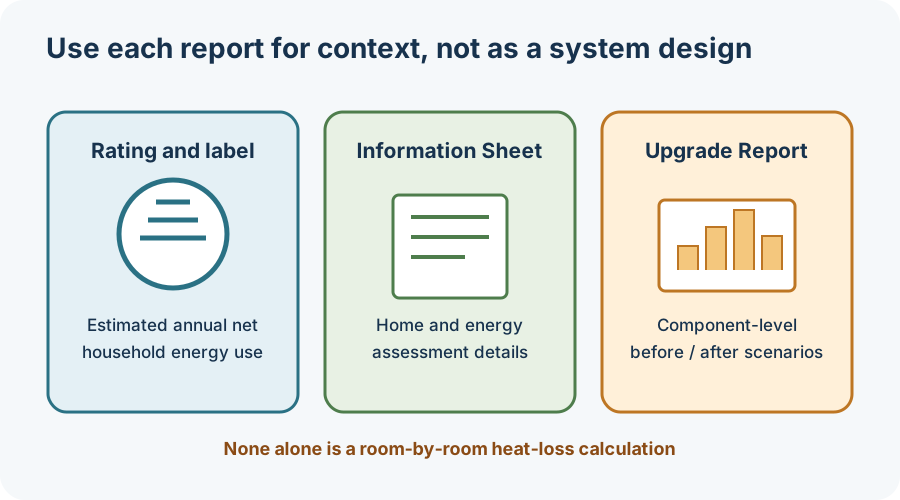
After an evaluation, Natural Resources Canada describes three outputs: an EnerGuide rating and label, a Homeowner Information Sheet, and a Renovation Upgrade Report. The rating is an estimate of annual net household energy use. The materials can show energy by source and end use, and the upgrade report includes before-and-after comparisons by building component.
These outputs can help you explain the home’s present condition and discuss planned changes. They are not the same thing as a room-by-room heating load, a heat-pump capacity selection, or a guarantee of future savings. Tell the assessor or installer whether insulation, windows, air sealing, additions, or heating equipment have changed since the evaluation. A new design should use the home and improvements that actually exist or are firmly planned.
Turn the report into design questions
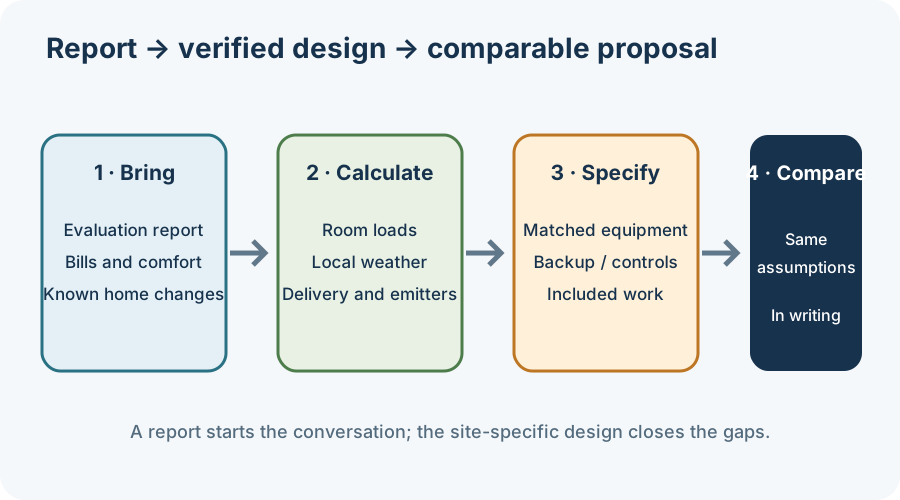
Bring the complete report and ask which findings matter to the heat-pump proposal. What room-by-room heat-loss calculation will be used? Which outdoor design condition applies to the location? How will the system distribute heat to each room? If radiators or ducts remain, what assessment confirms their output, airflow, or condition? What equipment performance data apply at the stated conditions? If envelope work is planned, will the design account for it without sizing from a hypothetical future home that never gets upgraded?
Keep a gas-hybrid discussion in scope
NRCan’s cited gas-hybrid homeowner pamphlet asks owners to discuss sizing, switching controls, maintenance, warranty, and lead time for upgrades with a skilled contractor. Its examples concern a heat pump paired with a gas furnace. Do not treat that guidance as a control design for a gas boiler and radiator circuit. A boiler-based home needs a separate hydronic assessment of the radiators, water temperature, controls, and any retained heating role.
Ask the contractor to state when the heat pump is expected to operate, when the other source is expected to operate, which rooms each source serves, and what assumptions are used for the local weather and energy prices. If the proposal includes electrical or plumbing work, request the relevant scope, local approvals, and qualified trades in writing. An evaluation report does not establish current incentive eligibility or local code compliance.
The useful result is a quote that explains how the home’s measured condition connects to the proposed equipment and distribution. For an overview of representative Canadian comparisons, see how to read heat-pump home archetypes. For online screens, see what checkers and calculators can establish.
Sources and further reading
- After your EnerGuide home evaluation (primary source)
- HeatPump_Pamphlet_GasHybrid_ENG_2025_V2 (primary source)
- Heating and Cooling with a Heat Pump (primary source)