 HeatPumpPath
High-Pressure Heat-Pump Sales: Warning Signs and Next Steps
Use a pause-and-verify checklist when a heat-pump offer comes with urgency, unusual payment demands, or claims you cannot check independently.
In this guideJump to a section
A rushed pitch can make it hard to check a heat-pump proposal, financing, and the person asking you to sign. Treat urgency as a reason to slow down and verify. It is a warning signal, not proof on its own that a seller has committed fraud.
Pause when you cannot check the offer
Take extra care if someone says a price or incentive expires today, claims to be “working nearby” with leftover equipment, asks for a large upfront payment, insists on cash, asks you to arrange permits, or pushes a loan through a lender they chose. A claim that every home qualifies for a rebate or will reach a particular bill saving also needs written evidence and independent checking. The U.S. Federal Trade Commission lists similar pressure, payment, permit, and financing tactics as warning signs in home-improvement sales.
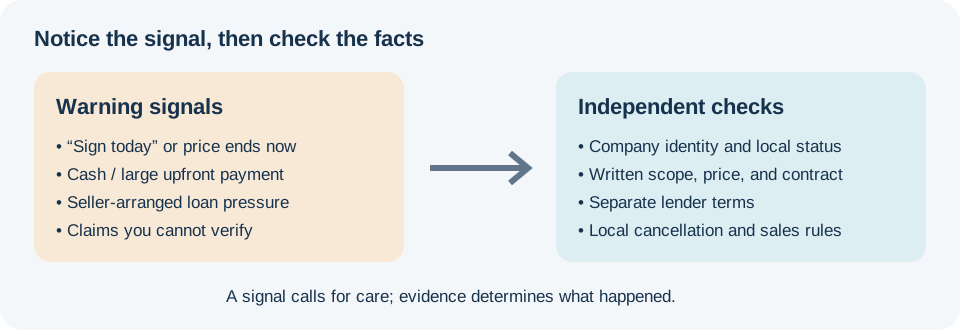
You do not need to accuse anyone to pause. Say that you need the complete proposal and financing terms in writing, and that you will contact the company using details you find independently. Ask for the seller’s name, employer, business address, license or registration where required, and the name of the company responsible for the work. Do not rely only on a phone number, QR code, or link provided during a pressured visit.
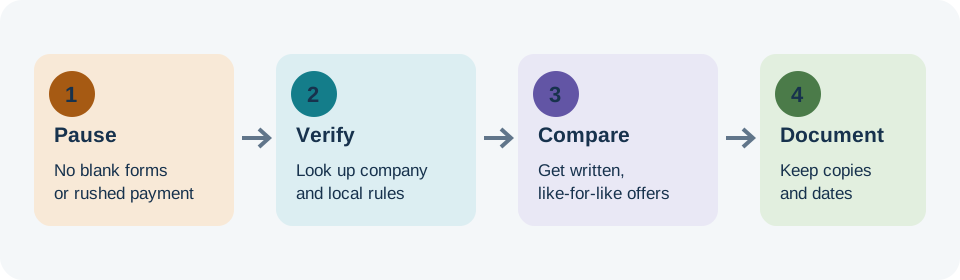
Use a short pause-and-verify routine
- Stop the decision. Do not sign blank forms or let a salesperson hurry you through a loan, title, or payment document. Ask for a copy of everything already signed.
- Verify the seller. Look up the company independently and check its current local authorization, insurance, and complaint route. Match the legal name to the proposal and payment recipient.
- Compare the offer. Request at least two other written proposals based on the same home and scope. Put equipment, work, exclusions, price, finance, and incentive responsibility side by side using the quote guide.
- Check local rights. Contact the consumer-protection office for the property location about contract, cancellation, deposit, and door-to-door rules. Keep the contract, advertisements, messages, and payment records.
Rules depend on where and how a contract is made. In the US, the FTC Cooling-Off Rule gives three days to cancel certain covered sales at a home or other specified locations, but important exceptions apply; do not assume every heat-pump contract qualifies. Canada has provincial and territorial rules. As of August 1, 2026, British Columbia bars certain door-to-door heat-pump sales, with limited exceptions; that provincial rule is not a Canada-wide rule. In the UK, check the current consumer guidance for the contract and sales setting. If a deadline may apply, contact the relevant authority promptly rather than relying on a general article.
If you already signed or paid
Keep dated copies of the agreement, cancellation form, advertisement, messages, lender paperwork, receipts, and a note of what was said. Contact the seller and any lender using independently verified details, and ask the local consumer authority how to preserve any cancellation or complaint rights. If money may have been taken fraudulently, contact your payment provider and local reporting channel promptly. Do not wait for a salesperson’s promise to resolve a deadline.
A pressure tactic does not establish that the equipment or design is unsuitable, just as a calm sales visit does not establish quality. Evaluate the technical proposal separately and verify who is accountable for the work with the credential checklist.
Sources and further reading
- How To Avoid a Home Improvement Scam (primary source)
- Buyer’s Remorse: The FTC’s Cooling-Off Rule May Help (primary source)
- Door-to-door sales (primary source)
- Knock, knock. Who’s there? New rules for door-to-door sales in BC (primary source)