 HeatPumpPath
How to Compare Heat-Pump Installer Quotes
Put heat-pump proposals on the same footing by comparing design assumptions, included work, exclusions, costs, and the records promised at handover.
In this guideJump to a section
Two totals are comparable only when the proposals describe roughly the same job for the same home and outcome. A lower price may reflect a different design assumption, an omitted enabling job, or work left for you to arrange. Use the proposals to find those differences before choosing; a quote is not a guarantee of comfort, bills, or finished-system performance.
Start with the same home and outcome
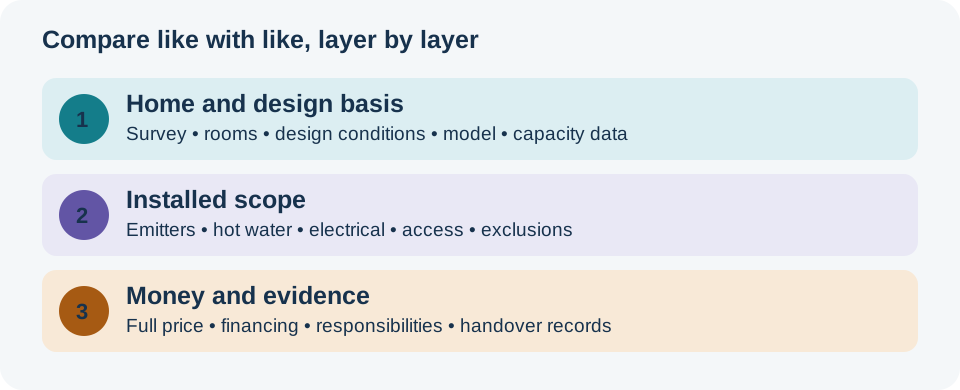
Make one comparison sheet and copy each proposal’s wording into it. Record the date, property details used, rooms or zones included, current heating and hot-water arrangements, and the comfort outcome discussed. Note what the installer actually inspected. A brief visit, remote estimate, and detailed room-by-room assessment do not establish the same design basis.
Ask how the heating requirement was estimated and which outdoor design conditions were used. Record the proposed equipment model and configuration, not just the brand or a nominal capacity. Ask for the capacity and efficiency figures at the conditions relevant to the design, and the product data or calculation used. The ENERGY STAR quality-installation guidance describes sizing, airflow, refrigerant charge, and duct checks as parts of a quality installation; a model name alone cannot show that the proposed system fits your home.
Compare the work, not just the unit
List the distribution and related work beside the equipment: radiators or other emitters, duct changes, pipework, hot-water cylinder, controls, backup heat, electrical supply, outdoor-unit position, condensate route, noise considerations, and making good. Mark each item included, excluded, assumed, provisional, or retained by you. Ask who will arrange any excluded work and how its completion affects the installation date or warranty.
For an assumption, ask what finding would change it and how the price or design would be revised. For a provisional sum, request the amount, what it covers, and who approves any increase. Check whether permits, inspections, registrations, disposal, access equipment, and repairs to disturbed surfaces are included where they apply locally.
| Compare | Record for each proposal |
|---|---|
| Design | Survey performed, heat-loss method, design conditions, model/configuration, stated performance conditions |
| Scope | Distribution changes, hot water, controls, backup, electrical work, placement, drainage, finishes |
| Gaps | Exclusions, assumptions, provisional sums, owner tasks, required approvals |
| Delivery | Schedule, subcontractors, responsible company, commissioning records, owner instruction |
| Money | Itemized price, taxes, deposit and stages, financing terms, incentives, service and warranty terms |
Put the money and promises in writing
Separate the installed price from optional work, maintenance plans, finance charges, and incentives. Check whether an incentive is a confirmed amount, an estimate, or a payment you must apply for yourself. Compare the full financed cost and named lender terms with a separate finance offer; do not compare a monthly payment to another quote’s project total.
Ask for the model and scope to appear in the written agreement, together with the process for changes, a realistic schedule, payment stages, the party responsible for permits, and what happens if site conditions differ. Confirm who carries out the work if subcontractors are involved and who handles defects, service calls, and complaints. A directory listing or credential can help you check responsibility, but it does not show that the design or this installation is right for your home; see how to check credentials and protection.
Close the gaps before signing
Send the same questions to each installer and ask for written answers or a revised proposal. Keep the answer beside the original quote so you can see what changed. If an item remains uncertain, keep it visible in the comparison rather than treating it as included. A practical next step is to ask the preferred installer to confirm the final equipment, all owner-arranged work, the total price, and the records you will receive at handover. The commissioning and handover checklist explains which records to request.
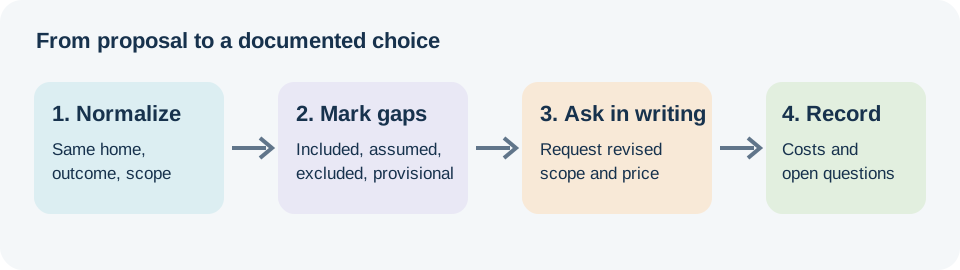
The lowest or highest proposal is not automatically the best fit. Choose only after you understand the design basis, the work each price buys, the responsibilities that remain, and the unanswered questions. If proposals still differ materially, ask each installer to explain the difference rather than averaging the figures.
Sources and further reading
- HVAC Quality Installation (primary source)
- Find a heat pump installer (primary source)
- Buying green heating and insulation products: a consumer guide (primary source)