 HeatPumpPath
Heat-Pump Installer Credentials and Consumer Protection
Check who is responsible for a heat-pump job and what a license, training badge, insurance policy, consumer scheme, or program listing does and does not establish.
In this guideJump to a section
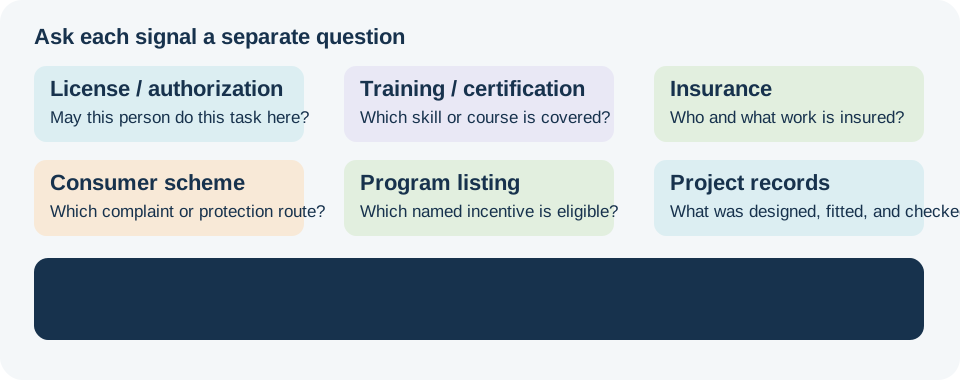
A badge, license, insurance certificate, consumer-code membership, and grant listing answer different questions. Check each against the work you are buying and the place where the property sits. None of them, by itself, proves that a proposed design is suitable or that the finished system will perform as expected.
Identify what each signal covers
Legal authorization is a local permission to perform particular work. The required trade, license, registration, or permit may depend on the equipment and jurisdiction. Technical training or certification describes a course, assessment, or defined skill area. Ask which person holds it, what tasks it covers, and whether it is current. Manufacturer training may relate to particular products or service conditions; it is not a substitute for any required local authorization.
Insurance is a policy with a named insured, coverage, and limits. Ask for current proof and confirm which company is covered for the work. A consumer scheme or code may provide specified complaint, warranty, or financial-protection routes, but only within its rules and eligible contracts. Program eligibility means an installer or project meets a named incentive’s requirements; it does not independently assess every part of the design or guarantee a payment. A directory listing is a lead to verify, not an endorsement of the company.
Verify the responsible person and company locally
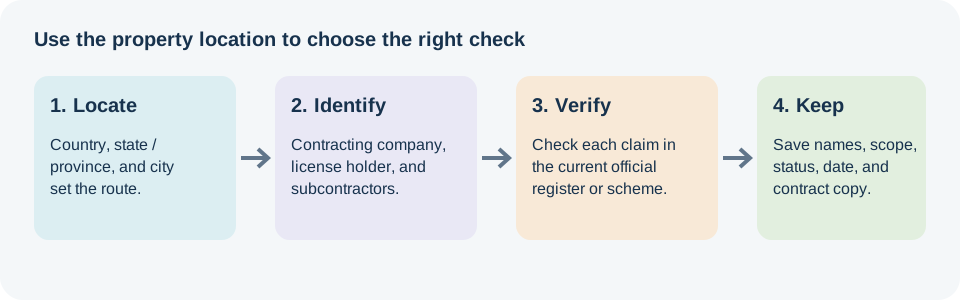
Begin with the address where work will happen. Find the responsible licensing or consumer-protection authority for that jurisdiction, then search its current official register yourself. Check the exact business name, license holder, status, trade, permitted task, and any public limits. A national or manufacturer directory may be useful, but it may not replace a local license check.
In the UK, ask what certification route and certificate apply to your installation, and whether an incentive requires a particular scheme. Scheme rules and consumer-code arrangements can change; membership is not a universal UK requirement for every job. In the US, licensing and permit rules are commonly set locally, so check the state, county, or city authority responsible for the specific work. In Canada, ask the provincial or territorial consumer office and relevant trade authority what applies. The federal consumer guide notes that door-to-door rules and other protections vary among provinces and territories.
If the contractor cites a training credential, ask for the exact program name, the individual who completed it, its status, and the tasks it covers. For a US DOE Energy Skilled mention, the recognition is attached to a program. It is not an individual license or DOE endorsement of a contractor; what the recognition covers explains the distinction.
Tie the check to the contract
Ask which legal entity signs the contract, accepts payment, employs or subcontracts the installers, obtains permits, and responds if the work is incomplete. Request current insurance evidence and read the coverage description rather than relying on a logo. Ask which consumer code or warranty applies to your exact company, contract, equipment, and installation, and where you would take a complaint. Keep the answer and the date you checked it.
Before paying, read the full scope, price, schedule, deposit, payment stages, cancellation terms, and change-order process. Confirm who applies for incentives and what happens if approval or payment is delayed. A financing offer is a separate agreement: identify the lender, total repayable amount, fees, rate, and any lien or security before signing. Compare the proposal itself using the quote checklist.
Credentials help answer who may do particular work or which scheme rules apply. They do not replace a home-specific design, a clear proposal, or records showing what was installed and checked. Request those records at handover and keep a copy of the commissioning checklist with your home documents.
Sources and further reading
- Find a heat pump installer (primary source)
- Energy Skilled for consumers (primary source)
- How To Avoid a Home Improvement Scam (primary source)
- Door-to-door sales (primary source)