 HeatPumpPath
DOE Energy Skilled Heat-Pump Recognition: What It Shows
Understand the U.S. DOE Energy Skilled program areas for heat-pump work and what program recognition does not prove about an individual worker or installation.
In this guideJump to a section
A contractor may say that a heat-pump worker has a DOE-recognized credential or completed a DOE-recognized program. The U.S. Department of Energy’s Energy Skilled recognition describes training and certification programs in defined HVAC job areas. It helps you ask a more precise question about scope; it is not a general approval of the contractor or the work proposed for your home.
Three program areas have different scopes
The DOE HVAC Programs directory covers distinct areas that can relate to heat-pump projects:
| Program area | What the area concerns | A useful follow-up |
|---|---|---|
| Comfort advising | Helping customers assess heating and cooling options | Which assessment or recommendation tasks did the program cover? |
| Heat-pump installation | Installing heat-pump equipment and related systems | Which equipment, tasks, and worker did the credential cover? |
| Residential HVAC commissioning | Checking and documenting installed residential HVAC systems | Which commissioning process and tests were taught or assessed? |
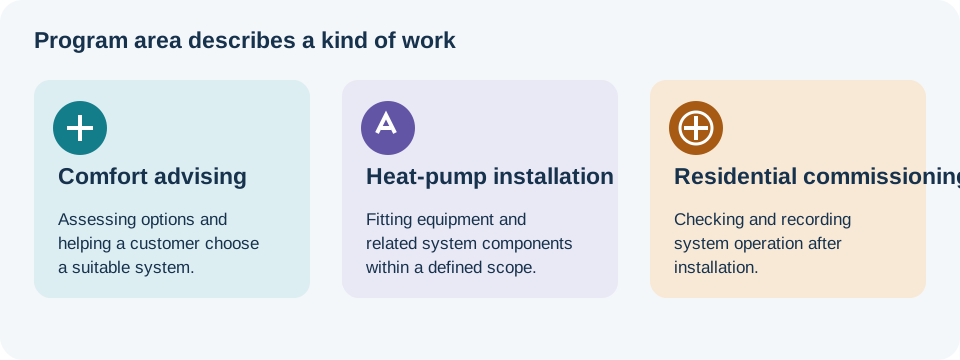
Check the current directory for the exact program name and recognized scope. Then ask the company which worker completed it, when, and how that person’s planned role relates to your installation. A listing for a program does not establish that a named employee completed it, holds an active individual credential, or will do the work at your home.
Keep program recognition separate from licensing and project evidence
Recognition applies to a training or certification program’s scope. It is not itself an individual state or local license, an incentive approval, a DOE endorsement of a contractor, or a guarantee of workmanship, comfort, savings, or safety. Required licensing and permits remain a separate local check.
For a project, ask for a home-specific proposal that identifies the design assumptions, selected equipment, work included, exclusions, and responsible installer. At completion, request the records for the checks and settings that apply to the system and an explanation of how to operate it. Those documents describe this job in a way a course listing cannot. Use the quote comparison before signing and the handover checklist to collect project evidence.
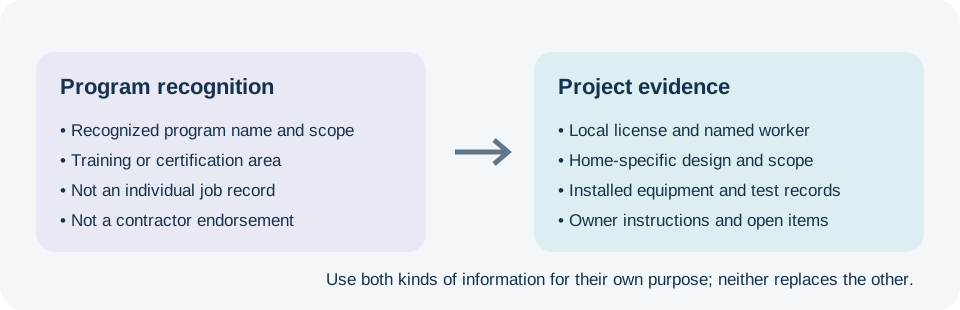
If a contractor relies on DOE recognition as the main reason to hire them, ask for the exact public listing and their local license information, then compare the written proposal with other offers. The separate credential and consumer-protection guide covers other checks. Do not assume a program recognition badge transfers across countries or overrides local rules.
Sources and further reading
- HVAC Programs (primary source)
- Energy Skilled for consumers (primary source)
- What is Energy Skilled recognition? (primary source)