 HeatPumpPath
Can Existing Ducts Work With a Heat Pump?
Prepare for an HVAC assessment of existing ducts by recording comfort problems and understanding the tests that determine whether ducts can be reused, changed, or replaced.
In this guideJump to a section
Existing ducts may be reusable, but appearance alone cannot show whether they can deliver the airflow a proposed heat pump needs. Leaks, damage, poor insulation, unsuitable sizing or an imbalanced layout can affect comfort and performance. The decision to keep, modify or replace ductwork belongs with a qualified HVAC professional who can assess the ducts against the selected equipment and the home’s room-by-room needs.
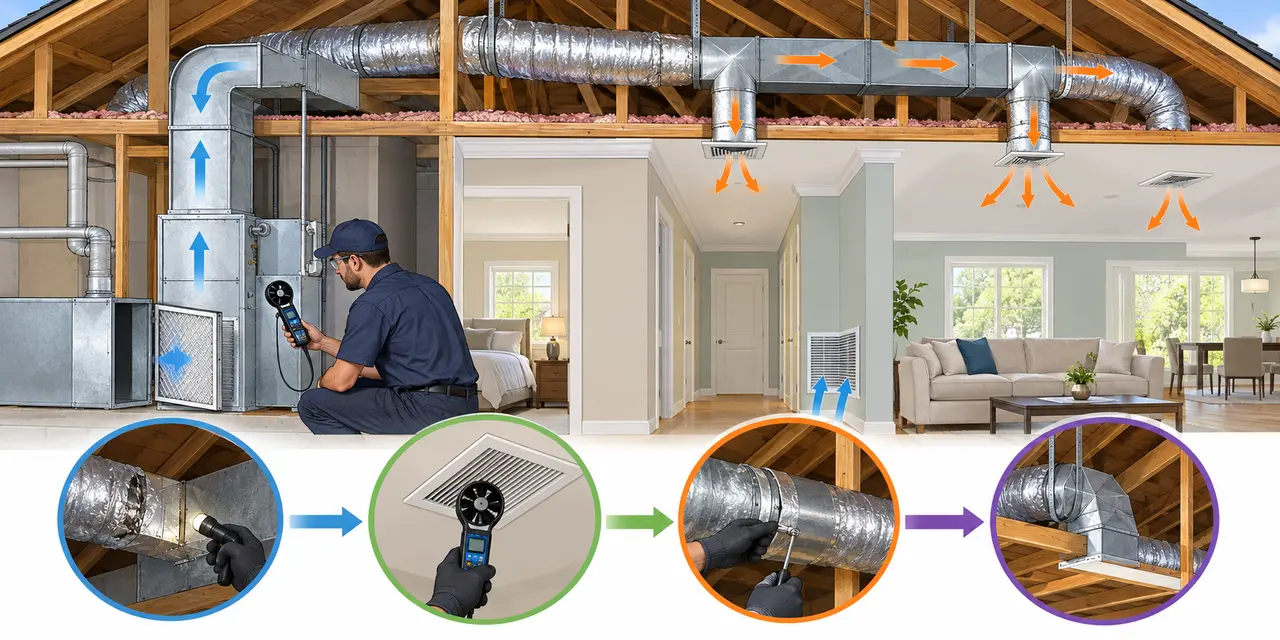
Start with household observations
Before the survey, write down which rooms feel too warm or too cool, whether airflow seems weak at particular registers, and whether the system is unusually noisy. Note how often filters are changed, any recent duct or equipment work, and whether ducts run through an attic, crawlspace, garage or another unheated area. If a room’s use or layout changed, include that too.
These observations are useful clues, not a duct test. A room that feels uncomfortable may have several causes, including the envelope, controls, equipment or distribution. Do not remove panels, drill into ducts, use smoke or pressure tools, or attempt to seal inaccessible runs as a substitute for professional assessment.
What a professional assessment can establish
The installer should identify the duct layout and condition, including accessible branches, returns, insulation, visible disconnections or compression, filter arrangement and access for maintenance. Measurements and tests can then be compared with the proposed heat pump’s manufacturer requirements and the design airflow. A system that served one furnace or air conditioner cannot be assumed to suit a different unit just because the connections look similar.
A contractor-oriented U.S. Department of Energy guide describes acceptable reuse as a combination of visual condition, required airflow, manufacturer pressure limits, reasonable balance, intact ducts and suitable return paths. Those are professional evaluation criteria, not a homeowner pass/fail checklist or a universal numeric standard. Heating and cooling may impose different distribution demands, so ask the designer to say which modes and rooms the proposed duct system will serve.
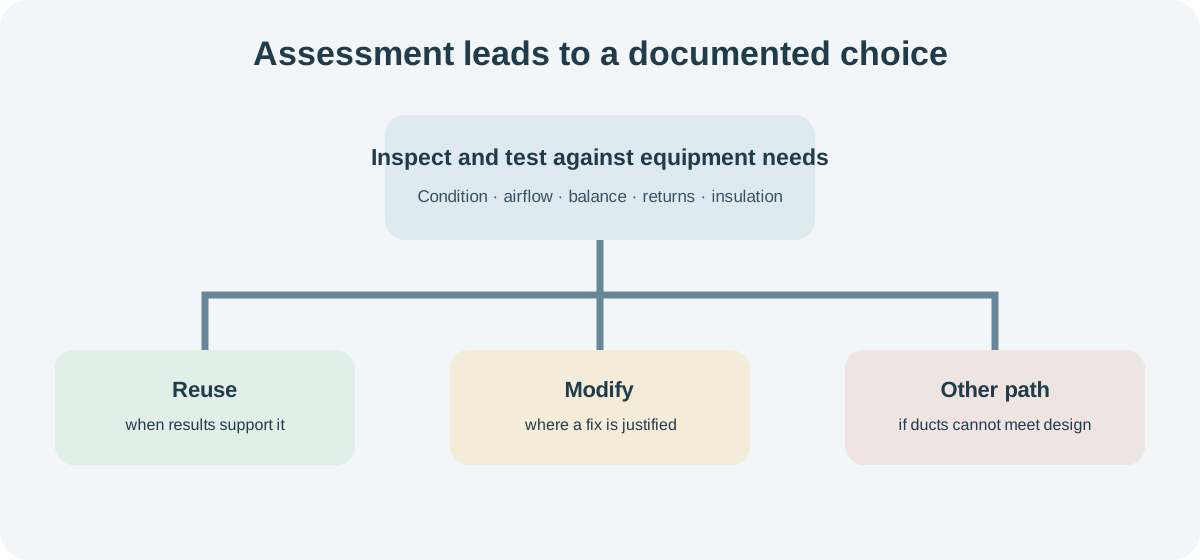
Reuse, modify, or choose another path
If the system passes the equipment-specific assessment, reuse may avoid unnecessary work. If a limited defect is found, targeted repair, insulation or balancing changes may address it. If the ducts are deteriorated, poorly located or unable to meet the design, replacement or another distribution approach may be considered. The right answer depends on measured conditions and project scope; one visible tear does not prove the entire system must be replaced, and clean-looking ducts do not prove they are adequate.
For a house where ductwork is impractical, a ductless system may be an alternative, but its room coverage and configuration belong in the system-design conversation. Discuss distribution options with your designer and see category 003’s system-design guides.
Questions to put in the proposal
- Which rooms will the duct system serve, and what design airflow is required?
- What measurements or tests were used to assess the existing supply and return paths?
- Are any ducts outside conditioned space, damaged, compressed or poorly insulated?
- Does the filter and return arrangement fit the selected equipment’s requirements?
- Which repairs or modifications are included, and which remain optional?
- If ducts are not reused, what alternative distribution design is proposed?
Ask for the findings and scope to be documented so later changes are visible. If insulation work is also planned, coordinate it with the envelope assessment and the heat-loss design.
Sources and further reading
- Duct Retrofit Decision Guide (primary source)
- Decarbonizing Building Thermal Systems: A How-to Guide for Heat Pump Systems and Beyond (primary source)
- Heat pumps (primary source)