 HeatPumpPath
Ontario Ground-Source Heat Pump Permits and Approvals
Identify the ground-loop design and the provincial, water, building, and municipal approval questions to resolve before drilling in Ontario.
In this guideJump to a section
Before drilling or installing an earth loop, ask the designer to describe exactly how the system exchanges heat with the ground or water. “Ground-source” can refer to several arrangements, and one project’s approval route does not automatically apply to another. The installer should identify the loop configuration, depth, well status, water source, discharge plan, and local construction work before you sign.
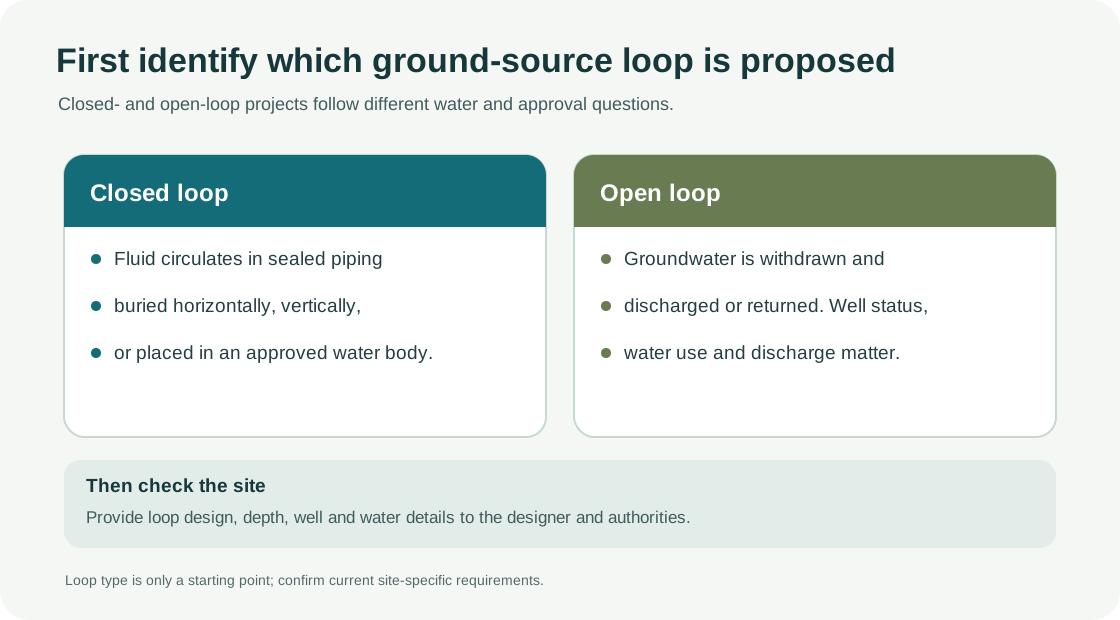
Identify the loop before asking who approves it
A closed-loop system circulates fluid through buried pipe or heat-exchange panels. It may use horizontal trenches, vertical boreholes, or another site-specific arrangement. An open-loop system takes groundwater or surface water through the heat pump and then returns or discharges it. The source, flow, and destination of water matter because separate permissions may apply.
Ontario’s earth-energy guidance describes a regulatory framework for ground and groundwater systems, including specific concerns around drilled holes and well rules. The province’s vertical closed-loop guidance and environmental-approval information should be checked for the proposed design. The exact approval depends on the work and current law; do not infer an exemption from a sales description or from a different property’s permit.
Separate provincial, water, and local checks
Ask the geothermal designer to state whether the proposal needs an Environmental Compliance Approval or work plan, whether any well or water-taking rules apply, and whether discharge or source-water protection conditions matter. For open-loop projects, ask who is responsible for water withdrawal, treatment, return, or discharge approvals. For vertical closed loops, ask how borehole construction, geology, and any hazardous-gas procedure are addressed.
These provincial questions are separate from a municipal building permit, zoning rules, by-laws, conservation requirements, utility locates, and any source-water protection plan. A provincial approval does not grant every local permission. The Government of Ontario’s Environmental Compliance Approval page directs project proponents to consider municipal by-laws, zoning, the official plan, and source-water impacts; it does not decide whether a particular home needs an approval.
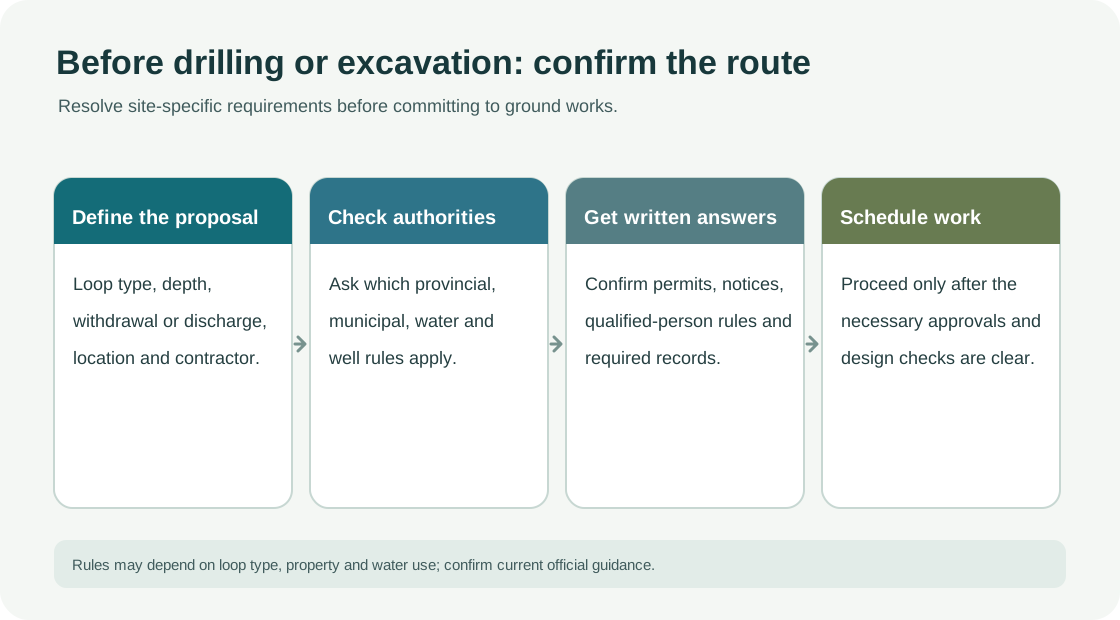
Get the answers in writing before the site work
Ask the contractor to provide a drawing that labels each loop, borehole or well, pipe route, water source, and discharge point. Request a list of required applications and who will file each one, including the qualified professional responsible for any technical work plan. Confirm utility locates, drilling access, restoration, and the permit authority’s response time before scheduling equipment.
If an installer says no approval is needed, ask which current rule and project fact support that conclusion. Where the Ontario source page or a municipal answer is unclear, have the designer confirm the route with the relevant ministry, well authority, conservation body, and municipality. This guide cannot determine approvals for a property or substitute for the current law.
For a broader look at Ontario climate, electricity plans, and incentives, see the Ontario regional guide.
Sources checked 29 October 2026: Ontario earth-energy systems guidance, Environmental Compliance Approval information, and the vertical closed-loop heat-pump guidance. The vertical closed-loop page did not load during this check; verify its current instructions directly before relying on a specific rule.
Sources and further reading
- Earth Energy Systems in Ontario (primary source)
- Environmental Compliance Approval (primary source)
- Installing vertical closed-loop ground-source heat pumps (primary source)