 HeatPumpPath
Heat Pumps and Wildfire Smoke: Filtration During a Smoke Event
Use U.S. EPA guidance to compare ducted-system filters and portable air cleaners during wildfire smoke, while checking compatibility and ventilation controls for your equipment.
In this guideJump to a section
During wildfire smoke, homeowners may need to manage indoor particles while keeping the home comfortable. U.S. Environmental Protection Agency (EPA) guidance describes general heating, ventilation, and air-conditioning (HVAC) options; it is not a heat-pump performance test. The right option depends on whether your system is ducted, whether its fan and filter can support the change, and what local air-quality officials advise.
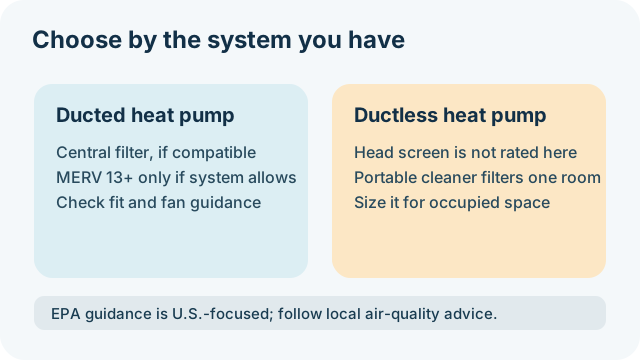
If your heat pump uses central ductwork
EPA recommends a high-efficiency HVAC filter, preferably MERV 13 or higher, when the installed system can accommodate it. The filter must fit snugly. A filter with more resistance than the system can handle may interfere with airflow, so check the equipment instructions or ask the manufacturer or an HVAC technician before changing the rating. Do not assume that a higher number is safe for every air handler.
EPA’s smoke guidance also discusses running a forced-air system fan more often during smoky conditions to move air through a compatible filter. Fan modes differ across heat pumps, and this temporary smoke-filtration objective may differ from routine operating advice. Confirm the mode is supported by your equipment, monitor the filter, and follow current local guidance. Replace or clean the filter according to its instructions, sooner if it becomes dirty.
If your system is ductless
A wall-mounted head has its own filter, but the EPA sources do not establish that this screen is rated to remove fine wildfire particles. Do not treat an ordinary dust filter as a smoke-particle filter. A portable air cleaner can provide room-level filtration; EPA advises placing it where people spend time and choosing a unit sized for that room. Its fact sheet gives a smoke clean-air-delivery-rate benchmark of at least two-thirds of room area in square feet and recommends a CARB-certified model to limit ozone emissions.
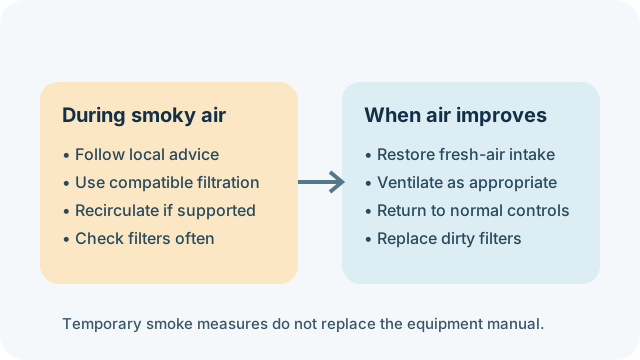
Check ventilation controls and restore them afterward
If the home has a fresh-air intake, EPA says to use recirculation or close the outside-air damper during smoky conditions when that control is available. Not every home has the same intake or controller. Do not disable ventilation permanently or change a control you cannot identify. EPA advises airing the home when outdoor air quality improves by opening windows or the HVAC fresh-air intake and using exhaust ventilation as appropriate.
For all systems, keep windows and doors closed when local officials advise staying indoors and doing so is safe. Follow evacuation alerts and local public-health instructions; filtration does not make an unsafe outdoor fire situation safe. Avoid devices that can produce ozone for smoke removal. EPA notes that electronic air-cleaning technologies may not effectively remove smoke particles and may produce ozone.
Keep the claim within its evidence
The EPA sources are U.S. wildfire and indoor-air guidance. They do not establish a universal fan schedule, filter fit, ductless-head particle rating, energy cost, or health outcome. Canadian and UK readers should use their local air-quality and public-health guidance and verify equipment settings against their manuals. If you are unsure whether a filter or fan setting is compatible, ask a qualified professional before changing it.
For routine system care, see the maintenance checklist. A smoke-related filter choice should not be confused with a permanent change to the heat pump’s normal operation.
Sources and further reading
- Indoor Air Filtration (primary source)
- Wildfires and Indoor Air Quality (IAQ) (primary source)