 HeatPumpPath
Heat Pump for an Old House With Radiators
Learn how room heat loss, radiator output and proposed water temperature shape a heat-pump retrofit in an older home, and what to ask before choosing a system path.
In this guideJump to a section
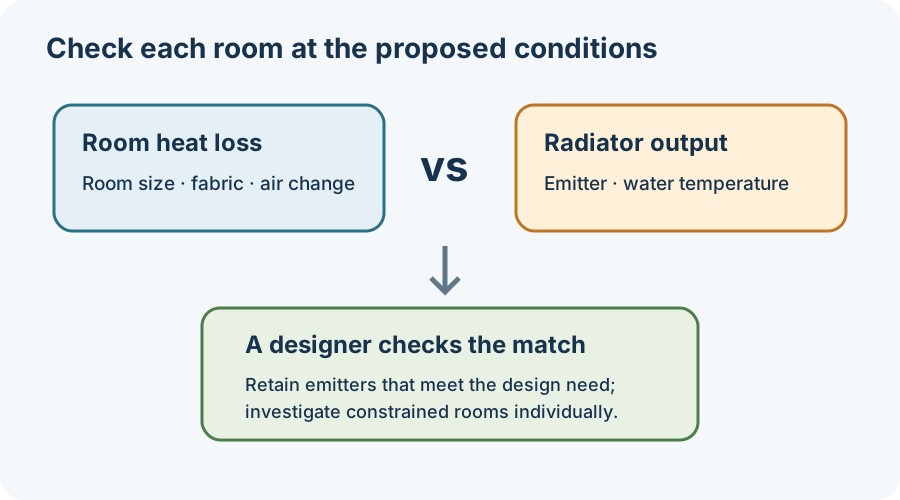
Hot-water radiators do not automatically rule out a heat pump, and their presence does not prove that a direct replacement will work. The key comparison is between the heat each room needs on a cold design day and the output its emitters can provide at the water temperature the proposed system is designed to use. That comparison depends on the building, the radiator circuit, controls, and local weather—not just the radiator’s age or appearance.
First identify the heating system
Check whether the home has a hot-water boiler and radiators, a steam system, or electric radiators. This guide focuses on hot-water radiators. Steam distribution is a different design problem; do not assume the radiator circuit can connect directly to an air-to-water heat pump. Ask a qualified designer to identify the system before comparing proposals.
For a hot-water system, gather the radiator type and approximate dimensions in each room, the boiler and control information you already have, and a note of rooms that struggle in cold weather. Add the home’s insulation, windows, drafts, floor plan, and any planned improvements. Do not remove a radiator or change boiler settings to test it. A qualified assessor can determine whether the available information is enough or whether measurements are needed.
Why lower water temperature matters
Heat pumps generally work more efficiently when they can deliver heat at a lower temperature, but a radiator gives off less heat as its water temperature falls. The room still has to meet its calculated heat loss. A designer therefore checks each room, rather than assuming all radiators will perform equally or that one whole-house temperature is suitable.
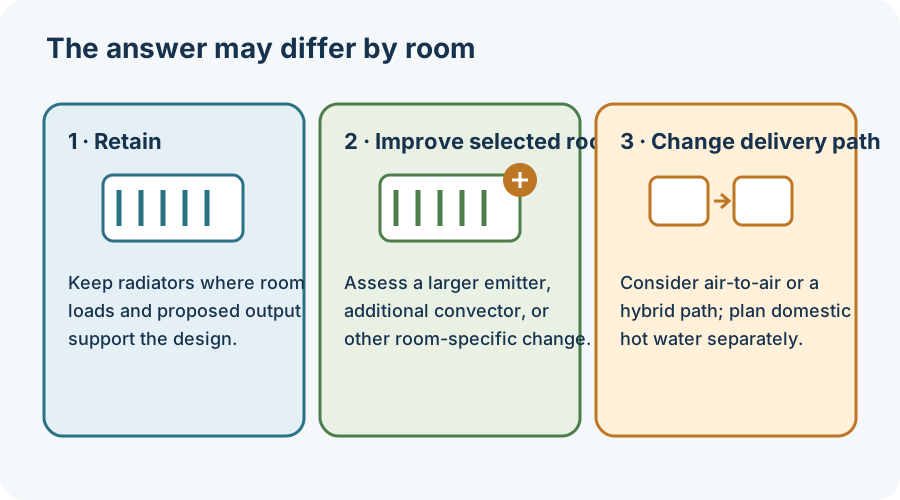
An older or larger radiator may provide enough output at the proposed conditions; another room may need a larger emitter, an added convector, or a different way of delivering heat. A peer-reviewed study of two German multifamily buildings found very different numbers of radiators would have constrained lower-temperature designs, even though the buildings had similar age and construction context. Those case results illustrate why a room-level check is useful; they are not a percentage or replacement rule for another home.
Separate the system decisions
An air-to-water heat pump can serve a hydronic circuit, but its performance depends on the emitter output, flow temperature, controls, and design. The existing radiators may be retained if a qualified calculation supports them. Where only some rooms are constrained, a designer can assess targeted emitter changes rather than treating every radiator as a failed component.
An air-to-air heat pump heats rooms through indoor air units instead of the radiator water circuit. It generally leaves domestic hot water to a separate system. A hybrid or staged path may keep another heat source, but the controls and intended coverage should be explicit. Space heating, hot-water production, and backup are related decisions, not interchangeable services.
Questions for a survey and quote
Ask for the room-by-room heat loss, each radiator’s estimated output at the proposed water temperature, and the design conditions used. Which rooms are the limiting cases? Would a larger or additional emitter address them? What controls, balancing, or pipework changes are included? If an air-to-air or hybrid path is proposed, which rooms and hot-water uses remain outside the heat pump? Request the assumptions and excluded work in writing.
Do not rely on a generic flow-temperature threshold, the old boiler’s setting, or a rule that every radiator must be replaced. If the home has a steam system, treat it as a separate retrofit assessment; the guidance in this article does not establish a residential steam conversion design. For a related UK property example, see the Victorian-terrace fit guide. Final emitter, plumbing, electrical, and safety decisions belong with qualified local professionals.
Sources and further reading
- Heating and Cooling with a Heat Pump (primary source)
- MIS 3005 Issue 3.1a — Heat Pump Systems (primary source)
- Air-to-Air Heat Pumps (authoritative-secondary source)
- Performance of air and ground source heat pumps retrofitted to radiator heating systems and measures to reduce space heating temperatures in existing buildings (primary source)
- Decarbonizing Building Thermal Systems: A How-to Guide for Heat Pump Systems and Beyond (primary source)