 HeatPumpPath
Heat Pump for a 1950s House in Minnesota
Use a mid-century Minnesota home’s condition, heat distribution and local winter design data to prepare for a heat-pump assessment. The decade alone cannot establish capacity, comfort or backup needs.
In this guideJump to a section
A 1950s house in Minnesota can be a candidate for a heat pump, but its age and the state name do not tell you how much heat the rooms need or which system can deliver it. The useful starting point is the actual building: its insulation and air leakage, the condition of its ducts or other heat delivery, local winter design weather, and whether the project will replace the furnace or add to it.
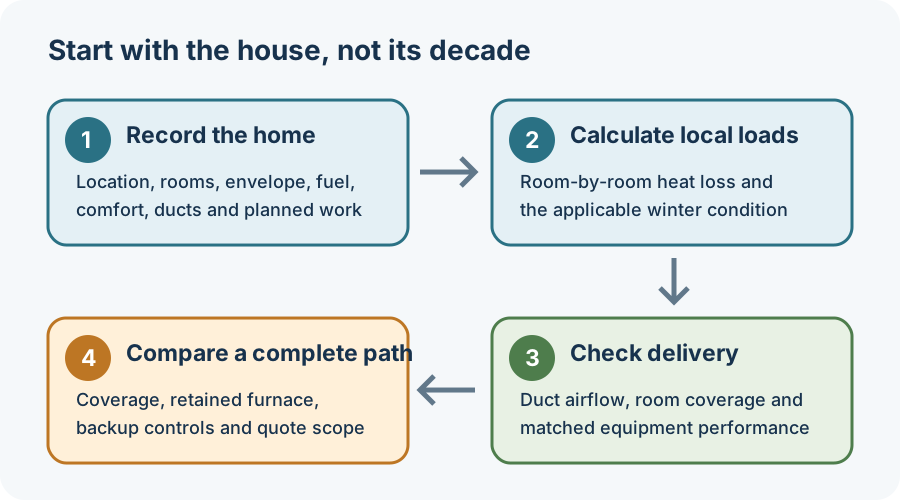
Gather the facts that change the answer
Write down the town or ZIP code, floor area, number of floors, additions, and any major changes to the home. Note where rooms feel cold, how the current furnace and central air conditioner are arranged, and which rooms are served by ducts. If you have recent fuel and electricity bills, keep them as a record of past use; they are not a substitute for a room-by-room heat-loss calculation.
For the building envelope, collect what you know about attic and wall insulation, windows, basement or crawlspace, drafts, and air sealing. Do not open walls or disturb older materials to find out. A qualified energy or HVAC professional can identify what needs inspection and whether measurements such as an air-leakage or duct test would improve the design. Tell the assessor about planned insulation or air-sealing work so the equipment is evaluated for the home it is intended to serve.
Use local winter data, not a label
Minnesota weather varies by location. A 30-year climate normal, a record low, and the outdoor design condition used for a heating calculation answer different questions. Ask the designer to name the applicable local design condition and explain which source or standard they used. The selected heat pump’s capacity and efficiency should then be checked at the conditions that matter for that home, not inferred from a broad “cold-climate” label or one headline rating.
ENERGY STAR notes that a suitable central air-source heat pump can connect to existing forced-air ducts, while ductless systems are an option where ducts are absent or a particular area needs separate treatment. Existing ducts still need an assessment: leakage, airflow, room balance, and compatibility with the proposed equipment can change what is feasible. A larger system is not automatically a better solution if the load or distribution has not been established.
Compare the project paths
The quote should say what the system is expected to heat and how it will interact with the equipment already in the house. Common paths include replacing the furnace with a heat pump, keeping the furnace as a second heat source, or adding a heat pump to cover selected rooms or an addition. Minnesota’s homeowner guide describes ducted and ductless configurations and recommends checking model performance at several outdoor temperatures; it also notes that some locations may need a secondary source on the coldest days. Neither statement determines the answer for an individual home.
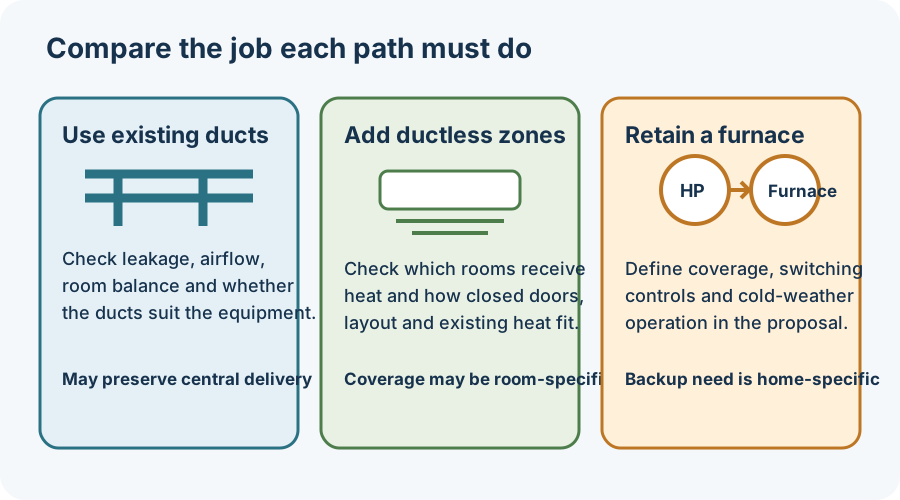
For each proposal, ask which rooms are included, what the load calculation says, what capacity the matched equipment provides at the local design condition, and when any backup source is expected to operate. If ducts are reused, ask whether their airflow and condition meet the design. If a dual-fuel arrangement is proposed, ask how its controls switch between heat sources and how that choice affects comfort and operating costs. Compare the same assumptions across bids.
A practical next step
Prepare the home details, comfort concerns, and energy-use records before a site visit. Ask for a written room-by-room load result, the local design-weather input, the equipment’s extended performance data, and a description of the rooms and distribution the proposal covers. A contractor should explain any envelope or duct work that affects the calculation and identify the backup plan rather than promise that a particular home will need none.
This guide does not choose equipment, calculate your home’s capacity, confirm a current Minnesota rebate, or forecast a bill. For radiator-based homes, see how an older house with radiators can be assessed. Confirm local program rules, permits, and product availability when you request a quote.
Sources and further reading
- Air-Source Heat Pumps (primary source)
- Home Heating — Home Energy Guide (primary source)
- HVAC — Cold Climate Heat Pump Sizing (primary source)