 HeatPumpPath
Heat-Pump Electrical Supply and Panel Planning
Prepare for a qualified electrical review by separating the heat-pump circuit, panel capacity, household loads, and utility-service questions.
In this guideJump to a section
A heat-pump proposal should say what electrical review is needed, but a homeowner should not have to calculate service capacity from a panel label. The equipment circuit, the panel’s condition and available breaker positions, the home’s overall electrical demand, and the utility connection are related questions with different answers. A licensed electrician can assess them using the selected equipment data and the requirements that apply locally.
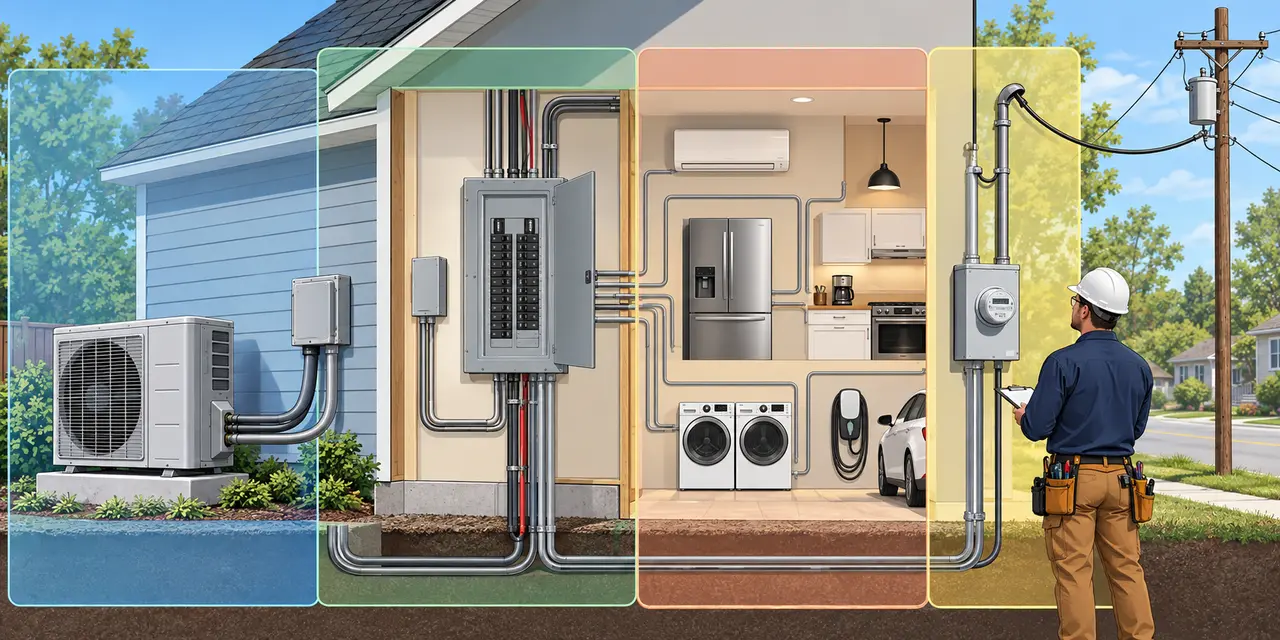
Four questions, not one panel number
Equipment circuit: The heat pump has electrical requirements for its model and configuration. The installer should supply the correct nameplate and installation information so the electrician can identify the circuit and disconnecting arrangements required by the applicable rules.
Panel condition and space: A panel may have an available breaker position but still need a capacity assessment. Conversely, lack of a spare space does not by itself prove that a service upgrade is the only solution. Condition, configuration and permitted options require a qualified review.
Calculated demand: The home’s existing and planned loads matter together. Include cooking, water heating, clothes drying, EV charging, solar or storage equipment, and electric resistance or supplementary heat where applicable. A load-management product may be considered in some designs, but it must be compatible with the equipment and accepted under local requirements.
Utility service: The electrical service, meter and utility-side connection can create a separate question from the panel inside the home. The electrician or installer can identify whether the utility needs to be involved. Terminology and rules differ among the United States, Canada and the United Kingdom, so examples from one country should not be used as universal thresholds elsewhere.
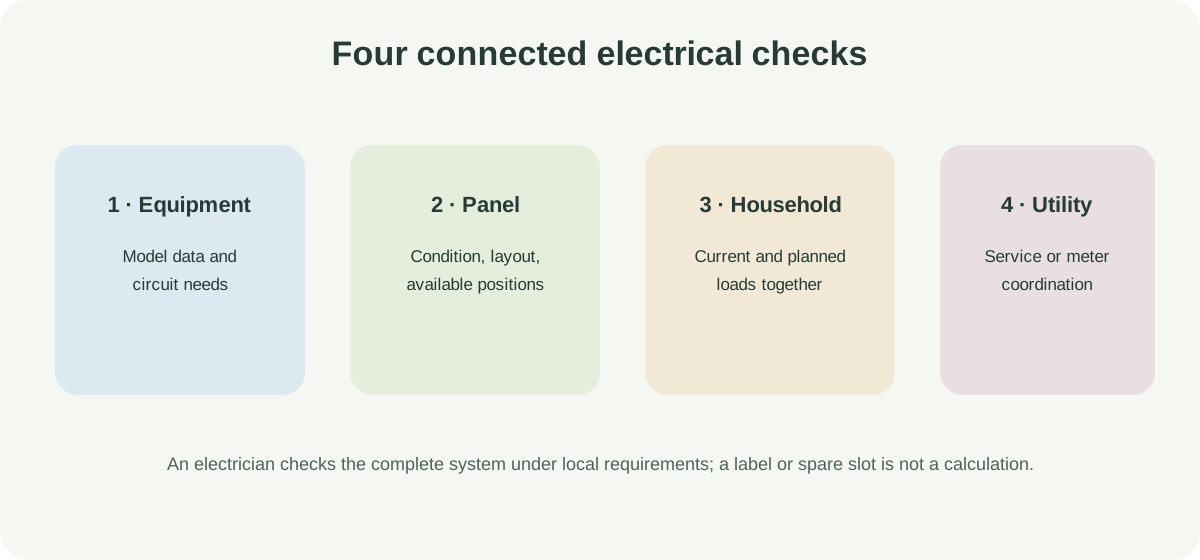
Prepare information, not a calculation
Gather photos of the closed panel exterior and labels if safe and permitted, plus available service documents, recent electrical work records and a list of current and planned large loads. Do not remove the panel cover or touch wiring. Note future projects as well as immediate equipment: adding a heat-pump water heater or EV later can change the planning conversation even if it is not part of this installation.
If the home has existing central air conditioning, electric heating or a heat-pump water heater, tell the installer and electrician what will stay, what will be removed and what may operate at the same time. Supplementary resistance heat is also a design input. Its role depends on climate, equipment capacity, controls and the system plan; it should not be treated as an assumed electrical load or omitted without checking the proposal.
What a useful electrical handoff includes
Ask the heat-pump installer to provide model-specific electrical data and identify any expected supplementary heat. Ask the electrician to explain the assessment basis, whether circuit work is needed, whether panel or service changes are proposed, and whether the utility must be contacted. If alternatives such as staged operation or load management are offered, request an explanation of how the arrangement operates and which professional is responsible for verifying it.
Do not accept a conclusion based only on the main breaker rating or an empty slot. ENERGY STAR’s U.S. electric-ready guidance uses panel size and available breaker spaces as screening information but directs homeowners to discuss capacity and planned appliances with an electrician. That U.S. guidance is useful for preparing questions, not a code calculation for every home.
Before approving electrical scope
- Are the circuit requirements tied to the exact selected heat-pump equipment?
- Which existing and planned appliances were included in the demand assessment?
- Is the panel assessment separate from the service and utility review?
- Are panel, circuit, meter or service changes included in the written scope?
- If load management is proposed, who verifies equipment, utility and local-rule compatibility?
- What electrical work requires permits, inspection or utility coordination in this location?
Electrical installation and service work should be performed by qualified people under local requirements. For the broader household-load sequence, see whole-home electrification planning and heat-pump water-heater planning.
Sources and further reading
- Make Your Home Electric Ready (primary source)
- Find a Heat Pump Installer (primary source)
- Heating and cooling with a heat pump (primary source)