 HeatPumpPath
Heat Pumps in Minnesota: Climate, Design Weather, and Rules
Use local Minnesota weather, home details, utility territory, and current program checks to prepare a heat-pump design conversation.
In this guideJump to a section
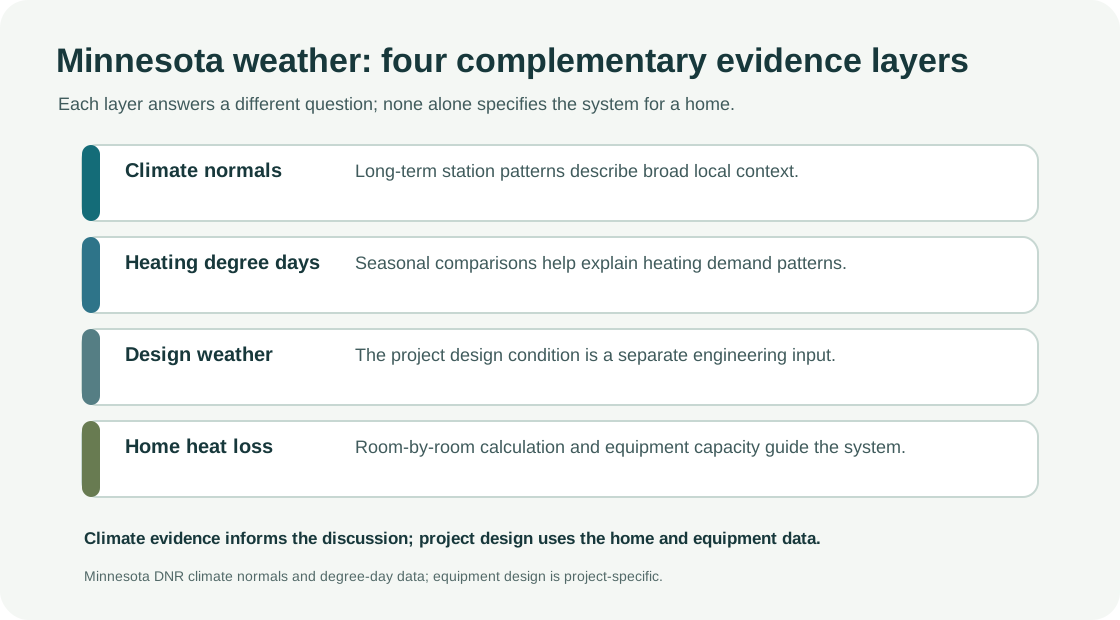
A Minnesota heat-pump decision starts with the home’s location and heat loss, not a statewide temperature or a rebate headline. Climate data help describe the conditions a system may face. A qualified designer still needs the building’s rooms, insulation, air leakage, windows, ducts or radiators, and local design weather to select equipment and backup.
Match the weather record to the address
A climate normal is a long-term average, not the temperature used to size one home. The Minnesota Department of Natural Resources lists 1991–2020 normals for Minneapolis–St. Paul using observations from the Twin Cities International Airport. That station is useful for the metro area, but it does not stand in for every Minnesota town, elevation, or exposure. Use the nearest representative station and record its name and data period.
The DNR degree-day tool can compare heating demand across dates and observing stations. Its default explanation uses a 65°F base; another base may suit a different analysis. Degree days summarize accumulated seasonal conditions. They do not calculate the heat escaping from a particular house or identify the coldest condition a heating system must meet. Keep normals, degree days, design temperatures, recorded extremes, and today’s forecast as separate kinds of information.
Ask for the design behind the equipment choice
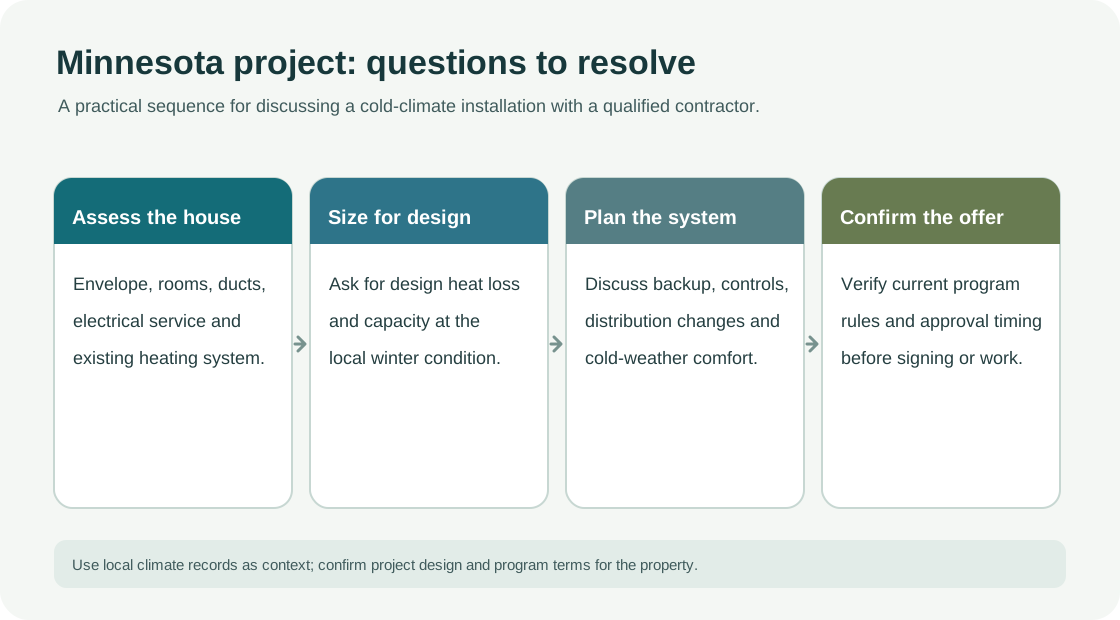
Ask the installer for the home’s room-by-room or whole-building heat-loss calculation, the outdoor design condition used, and the heat pump’s capacity at that condition. A model’s mild-weather rating does not show how much heat it can deliver in a prolonged cold spell. The proposal should explain the expected role of electric resistance or another backup source, the controls that switch between sources, and the assumptions behind any balance-point estimate.
For an older home, ask how planned air sealing or insulation changes the load, whether existing ducts can move the required air, and whether radiators or baseboards can heat rooms at the proposed water temperature. Check electrical service and panel capacity separately. Do not use a generic square-foot rule to choose capacity.
Check placement, permits, and local offers
Snowfall, drifting, roof runoff, service access, sound, and the path for defrost water affect outdoor-unit placement. Ask the designer to show the clearances and drainage plan for the actual site. Confirm local permit and electrical requirements with the authority having jurisdiction; a statewide climate page cannot approve construction at an address.
Program terms are separate from system design. Minnesota Commerce’s page, checked 29 October 2026, says the state residential heat-pump rebate had not launched as of its 12 October update, DOE approval was pending, and no launch date was estimated. Treat the page’s proposed eligibility and rebate ceiling as planned terms, not money currently available. Utility offers have their own service-area and equipment rules. The Xcel Energy Minnesota guide covers one dated utility schedule; another utility’s terms may differ.
Questions to take to a site visit
Bring your address, current fuel and bills, heating equipment, distribution type, recent insulation work, panel information, and any plans for other major electric loads. Ask which weather station and design condition the proposal uses, how capacity changes at low temperature, when backup operates, and which permits and utility approvals must precede work. Request current program terms in writing before counting an incentive toward project cost.
Sources checked 29 October 2026: Minnesota DNR climate normals, Minnesota DNR degree-day tool, and Minnesota Commerce heat-pump rebate page.
Sources and further reading
- Minneapolis/St. Paul Climate Data (primary source)
- Minnesota Residential Heat Pump Rebate Program (primary source)