 HeatPumpPath
Heat Pump Planning and Permits in Wales
Check Wales's 2026 domestic permitted-development conditions and keep planning, building regulations, and environmental permissions separate.
In this guideJump to a section
In Wales, planning permission, building regulations, and environmental permits are separate questions. Domestic heat pumps may have permitted-development rights, but only when the relevant conditions are met. A statement that a system is “permitted development” does not confirm that a particular listed home, conservation area, location, or installation complies.
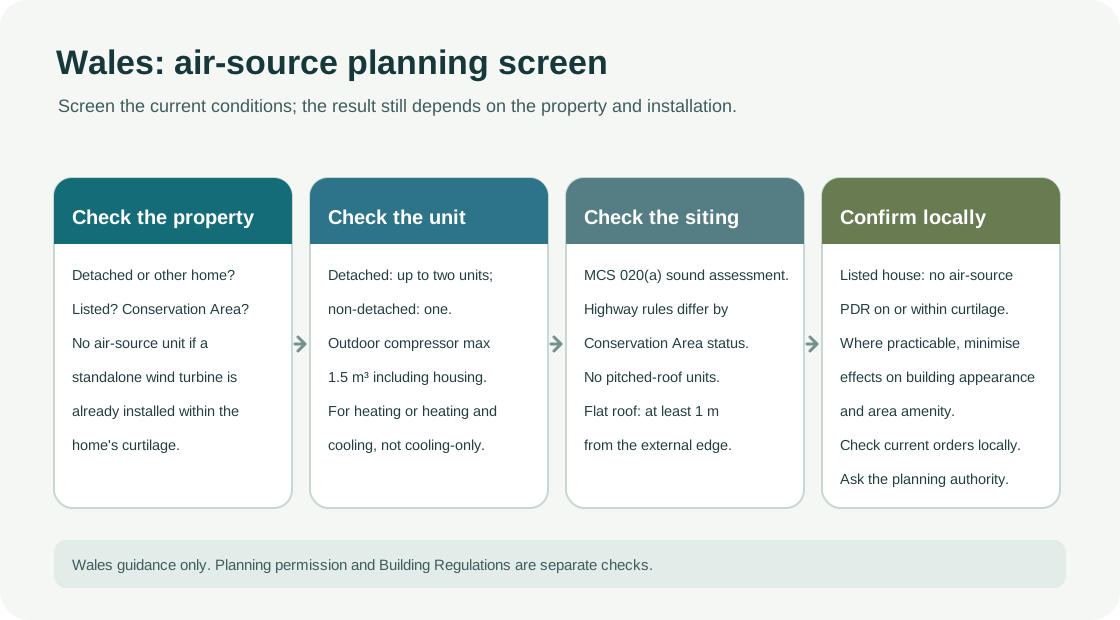
Check air-source planning conditions
Welsh Government guidance says air-source permitted-development rights were updated on 1 June 2026. Its current list includes an MCS 020(a) sound assessment, up to two units at a detached home or one at a non-detached home, and a maximum outdoor-compressor volume of 1.5 cubic metres including its housing. The guidance also says an air-source unit cannot be installed if a standalone wind turbine is already installed within the home’s curtilage—the land treated as part of the dwelling for planning. Ask the local planning authority if that boundary is unclear. Other conditions address highway siting, with different tests inside and outside a Conservation Area, listed buildings, roof type, and heating use. An air-source unit cannot be installed on a pitched roof under this route; on a flat roof it must be at least one metre from the roof’s external edge. Where practicable, the unit should minimize effects on the building’s appearance and the area’s amenity. Read the full current list; this summary is not a property decision.
If your home is listed, in a conservation area, close to a highway, or has a constrained outdoor space, ask the local planning authority before ordering equipment. Give the authority a site plan showing the proposed unit, housing, boundaries, windows, and neighbouring properties. Ask the installer to document the MCS 020(a) sound assessment and explain how the chosen location meets every applicable condition.
Keep building regulations separate
Welsh Government says air-source and ground-source installations must comply with Building Regulations. That duty remains even where planning permission is not needed under permitted-development rights. Ask who is responsible for the building-control route and whether the installer can self-certify through an applicable scheme. Do not treat a planning screen as proof that building requirements are satisfied.
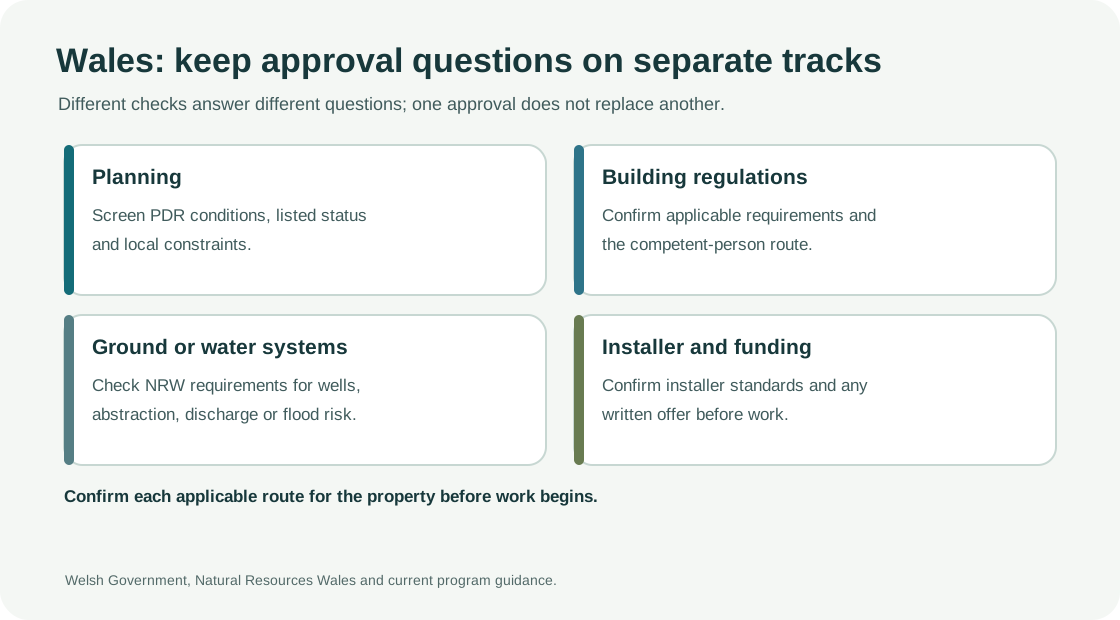
Ground- and water-source systems need another screen
Natural Resources Wales says it has no role in air-source heat-pump installation and operation. Ground- and water-source systems can raise different environmental questions, especially where water is abstracted, discharged, or a project includes work near a watercourse or flood defence. Open-loop and closed-loop designs are not interchangeable. The designer should state the water source, loop type, abstraction and discharge plan, and whether flood-risk work is involved before seeking the relevant NRW advice.
Check the current NRW route and the local authority’s requirements for the actual design. A permit exemption, where one might apply, depends on its listed conditions. No article or web page can determine the result for a specific property without the project details.
Sources checked 29 October 2026: Welsh Government domestic heat-pump planning guidance and building-regulations guidance. Natural Resources Wales permit guidance was accessed on 16 September 2026; confirm its current requirements before work.
Sources and further reading
- Planning permission: domestic heat pumps (primary source)
- Building regulations: heat pumps (primary source)
- Permits and licences needed for a heat pump (primary source)